{"title":"Comparative analysis of arch vessel revascularization techniques in proximal arch thoracic endovascular aortic repair","authors":"Hassan Chamseddine MD , Mouhammad Halabi MD , Alexander Shepard MD , Timothy Nypaver MD , Mitchell Weaver MD , Andi Peshkepija MD , Yasaman Kavousi MD , Kevin Onofrey MD , Kyle Miletic MD , Loay Kabbani MD","doi":"10.1016/j.jvs.2025.03.203","DOIUrl":null,"url":null,"abstract":"<div><h3>Objective</h3><div>Endovascular stent grafting extending into the ascending aorta (zone 0) is increasingly used in the treatment of aortic arch disease. This study aims to evaluate the risk of stroke in patients undergoing zone 0 arch thoracic endovascular aortic repair (TEVAR) based on the technique used for head vessel revascularization.</div></div><div><h3>Methods</h3><div>Patients undergoing zone 0 arch TEVAR covering all the aortic arch vessels were identified in the Vascular Quality Initiative between 2014 and 2023. Patients treated for aortic rupture or trauma were excluded. Head vessel revascularization techniques were classified into three groups: open revascularization (OR), endovascular revascularization (ER), and hybrid revascularization (HR). Multivariate logistic regression analysis was used to evaluate the association of head vessel revascularization technique with the primary outcomes of perioperative mortality and stroke.</div></div><div><h3>Results</h3><div>A total of 409 patients underwent zone 0 arch TEVAR covering all the aortic arch vessels, of which 50% (207/409) underwent OR, 20% (80/409) underwent ER, and 30% (122/409) underwent HR of the head vessels. The in-hospital mortality and stroke rates were 9% and 12%, respectively. Survival at 30 days, 1 year, and 2 years were 88%, 79%, and 74%, respectively. Patients undergoing ER of the head vessels had significantly higher stroke compared with those undergoing OR and HR (OR 11%, ER 21%, HR 8%; <em>P</em> = .02). ER was associated with a two-fold higher risk of perioperative stroke compared with OR (odds ratio, 2.16; 95% confidence interval, 1.08-4.30; <em>P</em> = .03), whereas no difference in perioperative stroke was observed between OR and HR (<em>P</em> = .40). Although OR and HR of the head vessels had a significantly lower rate of perioperative stroke compared with ER in 2017-2020 (OR 10% vs ER 30% vs HR 10%, <em>P</em> = .02), this difference diminished over time with no significant difference observed in the most recent interval (2021-2023) studied (OR 9% vs ER 12% vs HR 8%; <em>P</em> = .76). Trends revealed an increase in the use of HR (from 4% in 2014 to 57% in 2023) alongside a significant decrease in ER (from 39% in 2020 to 14% in 2023).</div></div><div><h3>Conclusions</h3><div>Stroke remains a significant concern during zone 0 arch TEVAR. Total endovascular repair of the aortic arch is associated with a greater than two-fold higher risk of stroke compared with OR and HR of the head vessels. However, advances in ER techniques and increased use of hybrid strategies highlight an ongoing evolution toward safer and less invasive approaches resulting in a decrease in perioperative stroke rates over time.</div></div>","PeriodicalId":17475,"journal":{"name":"Journal of Vascular Surgery","volume":"82 1","pages":"Pages 43-52"},"PeriodicalIF":3.6000,"publicationDate":"2025-04-01","publicationTypes":"Journal Article","fieldsOfStudy":null,"isOpenAccess":false,"openAccessPdf":"","citationCount":"0","resultStr":null,"platform":"Semanticscholar","paperid":null,"PeriodicalName":"Journal of Vascular Surgery","FirstCategoryId":"3","ListUrlMain":"https://www.sciencedirect.com/science/article/pii/S0741521425006366","RegionNum":2,"RegionCategory":"医学","ArticlePicture":[],"TitleCN":null,"AbstractTextCN":null,"PMCID":null,"EPubDate":"","PubModel":"","JCR":"Q1","JCRName":"PERIPHERAL VASCULAR DISEASE","Score":null,"Total":0}
引用次数: 0
Abstract
Objective
Endovascular stent grafting extending into the ascending aorta (zone 0) is increasingly used in the treatment of aortic arch disease. This study aims to evaluate the risk of stroke in patients undergoing zone 0 arch thoracic endovascular aortic repair (TEVAR) based on the technique used for head vessel revascularization.
Methods
Patients undergoing zone 0 arch TEVAR covering all the aortic arch vessels were identified in the Vascular Quality Initiative between 2014 and 2023. Patients treated for aortic rupture or trauma were excluded. Head vessel revascularization techniques were classified into three groups: open revascularization (OR), endovascular revascularization (ER), and hybrid revascularization (HR). Multivariate logistic regression analysis was used to evaluate the association of head vessel revascularization technique with the primary outcomes of perioperative mortality and stroke.
Results
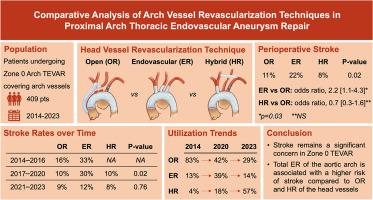
A total of 409 patients underwent zone 0 arch TEVAR covering all the aortic arch vessels, of which 50% (207/409) underwent OR, 20% (80/409) underwent ER, and 30% (122/409) underwent HR of the head vessels. The in-hospital mortality and stroke rates were 9% and 12%, respectively. Survival at 30 days, 1 year, and 2 years were 88%, 79%, and 74%, respectively. Patients undergoing ER of the head vessels had significantly higher stroke compared with those undergoing OR and HR (OR 11%, ER 21%, HR 8%; P = .02). ER was associated with a two-fold higher risk of perioperative stroke compared with OR (odds ratio, 2.16; 95% confidence interval, 1.08-4.30; P = .03), whereas no difference in perioperative stroke was observed between OR and HR (P = .40). Although OR and HR of the head vessels had a significantly lower rate of perioperative stroke compared with ER in 2017-2020 (OR 10% vs ER 30% vs HR 10%, P = .02), this difference diminished over time with no significant difference observed in the most recent interval (2021-2023) studied (OR 9% vs ER 12% vs HR 8%; P = .76). Trends revealed an increase in the use of HR (from 4% in 2014 to 57% in 2023) alongside a significant decrease in ER (from 39% in 2020 to 14% in 2023).
Conclusions
Stroke remains a significant concern during zone 0 arch TEVAR. Total endovascular repair of the aortic arch is associated with a greater than two-fold higher risk of stroke compared with OR and HR of the head vessels. However, advances in ER techniques and increased use of hybrid strategies highlight an ongoing evolution toward safer and less invasive approaches resulting in a decrease in perioperative stroke rates over time.
期刊介绍:
Journal of Vascular Surgery ® aims to be the premier international journal of medical, endovascular and surgical care of vascular diseases. It is dedicated to the science and art of vascular surgery and aims to improve the management of patients with vascular diseases by publishing relevant papers that report important medical advances, test new hypotheses, and address current controversies. To acheive this goal, the Journal will publish original clinical and laboratory studies, and reports and papers that comment on the social, economic, ethical, legal, and political factors, which relate to these aims. As the official publication of The Society for Vascular Surgery, the Journal will publish, after peer review, selected papers presented at the annual meeting of this organization and affiliated vascular societies, as well as original articles from members and non-members.



 京公网安备 11010802042870号
京ICP备2023020795号-1
京公网安备 11010802042870号
京ICP备2023020795号-1

 分享
分享
 求助内容:
求助内容: 应助结果提醒方式:
 扫码关注我们
