Jihyun Lim , Woongsik Jang , Jin Young Kim , Dong Hwan Wang
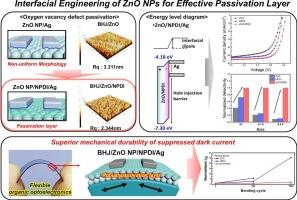
{"title":"Prolonged mechanical dynamics via imide bridged ZnO composites for fast response flexible photo-electronics","authors":"Jihyun Lim , Woongsik Jang , Jin Young Kim , Dong Hwan Wang","doi":"10.1016/j.apsusc.2025.163170","DOIUrl":null,"url":null,"abstract":"<div><div>In this study, we incorporate a promising small molecule—n-type perylene diimide derivative (NPDI)—into widely used ZnO nanoparticles (NPs) as the electron transport layer, which effectively controls interface defects and leads to significant improvements in the performance and mechanical durability of organic optoelectronic devices. Conventional ZnO NP systems suffer from defects caused by oxygen vacancies at the interface with the Ag electrode in a single-layer configuration, which hinder charge transport and mechanical stress resistance. When the ZnO/NPDI bilayer is introduced, the defects in ZnO are smoothed and bonded, forming a durable passivation layer that inhibits charge recombination and enhances the mechanical properties of flexible devices. Moreover, the ZnO/NPDI bilayer forms an ohmic contact with the Ag electrode while simultaneously enhancing the hole injection barrier, facilitating smooth charge transport and effective dark current suppression. Accordingly, ZnO/NPDI-based flexible organic devices exhibit reduced internal resistance and enhanced stability under bending stresses due to successful interface optimization.</div></div>","PeriodicalId":247,"journal":{"name":"Applied Surface Science","volume":"700 ","pages":"Article 163170"},"PeriodicalIF":6.9000,"publicationDate":"2025-04-05","publicationTypes":"Journal Article","fieldsOfStudy":null,"isOpenAccess":false,"openAccessPdf":"","citationCount":"0","resultStr":null,"platform":"Semanticscholar","paperid":null,"PeriodicalName":"Applied Surface Science","FirstCategoryId":"88","ListUrlMain":"https://www.sciencedirect.com/science/article/pii/S0169433225008840","RegionNum":2,"RegionCategory":"材料科学","ArticlePicture":[],"TitleCN":null,"AbstractTextCN":null,"PMCID":null,"EPubDate":"","PubModel":"","JCR":"Q2","JCRName":"CHEMISTRY, PHYSICAL","Score":null,"Total":0}
引用次数: 0
Abstract
In this study, we incorporate a promising small molecule—n-type perylene diimide derivative (NPDI)—into widely used ZnO nanoparticles (NPs) as the electron transport layer, which effectively controls interface defects and leads to significant improvements in the performance and mechanical durability of organic optoelectronic devices. Conventional ZnO NP systems suffer from defects caused by oxygen vacancies at the interface with the Ag electrode in a single-layer configuration, which hinder charge transport and mechanical stress resistance. When the ZnO/NPDI bilayer is introduced, the defects in ZnO are smoothed and bonded, forming a durable passivation layer that inhibits charge recombination and enhances the mechanical properties of flexible devices. Moreover, the ZnO/NPDI bilayer forms an ohmic contact with the Ag electrode while simultaneously enhancing the hole injection barrier, facilitating smooth charge transport and effective dark current suppression. Accordingly, ZnO/NPDI-based flexible organic devices exhibit reduced internal resistance and enhanced stability under bending stresses due to successful interface optimization.
期刊介绍:
Applied Surface Science covers topics contributing to a better understanding of surfaces, interfaces, nanostructures and their applications. The journal is concerned with scientific research on the atomic and molecular level of material properties determined with specific surface analytical techniques and/or computational methods, as well as the processing of such structures.




 京公网安备 11010802042870号
京ICP备2023020795号-1
京公网安备 11010802042870号
京ICP备2023020795号-1

 分享
分享
 求助内容:
求助内容: 应助结果提醒方式:
 扫码关注我们
