Wentong Zhang, Hengyi Cheng, Tao Zhang, Dan Yu, Wei Wang
{"title":"Upgrading of cotton fabrics by ionic liquid dissolving joint with wet spinning for stretchable and weavable fiber-based strain sensors","authors":"Wentong Zhang, Hengyi Cheng, Tao Zhang, Dan Yu, Wei Wang","doi":"10.1016/j.polymer.2025.128344","DOIUrl":null,"url":null,"abstract":"<div><div>With the advent of an aging society, researchers are highly interested in the development of wearable strain sensors because of its promising futures in motion detection, artificial intelligence, and healthcare. Nevertheless, its practical uses are still severely limited by its unpleasant design, low sensitivity, and poor wear comfort. In this paper, we propose to use green solvent of ionic liquid to dissolve and reuse cellulose from cotton fabrics, and by the above method cellulose/ionic liquid solution (CILS) is successfully prepared, followed with the addition of thermoplastic urethane (TPU) to improve mechanical properties and carbon nanotubes (CNTs) to provide conductivity through wet spinning technology. The fiber-based strain sensor (ILCCD-4) prepared by the wet spinning has high sensitivity (487), large tensile properties (385 %), low detection limit (2 %), excellent durability (3200 tensile cycles), and fast response time (200 ms). Based on these excellent sensing properties, the strain sensor can detect motion signals from various parts of the human body. The results show that the fiber-based strain sensor has excellent sensitivity, and sensing performance, proving it can be used for smart textiles, wearable strain sensors, and flexible strain sensors.</div></div>","PeriodicalId":405,"journal":{"name":"Polymer","volume":"327 ","pages":"Article 128344"},"PeriodicalIF":4.5000,"publicationDate":"2025-05-16","publicationTypes":"Journal Article","fieldsOfStudy":null,"isOpenAccess":false,"openAccessPdf":"","citationCount":"0","resultStr":null,"platform":"Semanticscholar","paperid":null,"PeriodicalName":"Polymer","FirstCategoryId":"92","ListUrlMain":"https://www.sciencedirect.com/science/article/pii/S0032386125003301","RegionNum":2,"RegionCategory":"化学","ArticlePicture":[],"TitleCN":null,"AbstractTextCN":null,"PMCID":null,"EPubDate":"2025/4/5 0:00:00","PubModel":"Epub","JCR":"Q2","JCRName":"POLYMER SCIENCE","Score":null,"Total":0}
引用次数: 0
Abstract
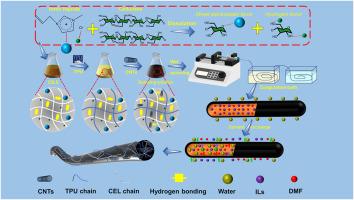
With the advent of an aging society, researchers are highly interested in the development of wearable strain sensors because of its promising futures in motion detection, artificial intelligence, and healthcare. Nevertheless, its practical uses are still severely limited by its unpleasant design, low sensitivity, and poor wear comfort. In this paper, we propose to use green solvent of ionic liquid to dissolve and reuse cellulose from cotton fabrics, and by the above method cellulose/ionic liquid solution (CILS) is successfully prepared, followed with the addition of thermoplastic urethane (TPU) to improve mechanical properties and carbon nanotubes (CNTs) to provide conductivity through wet spinning technology. The fiber-based strain sensor (ILCCD-4) prepared by the wet spinning has high sensitivity (487), large tensile properties (385 %), low detection limit (2 %), excellent durability (3200 tensile cycles), and fast response time (200 ms). Based on these excellent sensing properties, the strain sensor can detect motion signals from various parts of the human body. The results show that the fiber-based strain sensor has excellent sensitivity, and sensing performance, proving it can be used for smart textiles, wearable strain sensors, and flexible strain sensors.
期刊介绍:
Polymer is an interdisciplinary journal dedicated to publishing innovative and significant advances in Polymer Physics, Chemistry and Technology. We welcome submissions on polymer hybrids, nanocomposites, characterisation and self-assembly. Polymer also publishes work on the technological application of polymers in energy and optoelectronics.
The main scope is covered but not limited to the following core areas:
Polymer Materials
Nanocomposites and hybrid nanomaterials
Polymer blends, films, fibres, networks and porous materials
Physical Characterization
Characterisation, modelling and simulation* of molecular and materials properties in bulk, solution, and thin films
Polymer Engineering
Advanced multiscale processing methods
Polymer Synthesis, Modification and Self-assembly
Including designer polymer architectures, mechanisms and kinetics, and supramolecular polymerization
Technological Applications
Polymers for energy generation and storage
Polymer membranes for separation technology
Polymers for opto- and microelectronics.




 京公网安备 11010802042870号
京ICP备2023020795号-1
京公网安备 11010802042870号
京ICP备2023020795号-1

 分享
分享
 求助内容:
求助内容: 应助结果提醒方式:
 扫码关注我们
