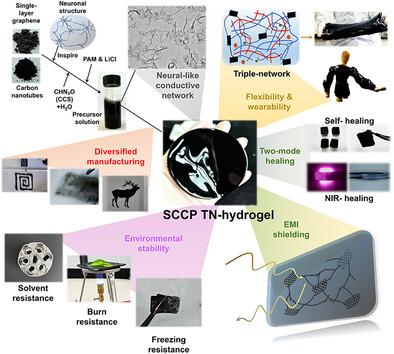
{"title":"SGs-CNTs/PAM/CCS Triple Network Hydrogel: Neural Architecture Inspired for Broadband EMI Shielding and Environmental Resilience","authors":"Jingzong He, Zhengkun Ma, Shilin Liu, Yonggen Lu, Qilin Wu","doi":"10.1002/adfm.202507404","DOIUrl":null,"url":null,"abstract":"<p>Improving traditional multi-network hydrogels by introducing a low-density rigid filler network to optimize a single ionic conductivity and overcome the limited electromagnetic properties to produce electromagnetic interference (EMI) shielding hydrogels is a pioneering challenge. Drawing inspiration from the neural network, this research introduces a novel triple-network (TN) hydrogel. The single-layer graphenes (SGs) and carbon nanotubes (CNTs) mimic the conductive channels similar to neurons and axons/dendrites, respectively, and assist the dispersion-lap-fixation process of the filler by carboxymethyl chitosan (CCS) and polyacrylamide (PAM). This collaborative assembly of SGs-CNTs, coupled with the presence of water molecules, imparts SGs-CNTs/CCS/PAM (SCCP) hydrogel with exceptional EMI shielding effectiveness (SE) across the 8.2–26.5 GHz range (X, Ku, and K bands), reaching SE of 42.31, 50.20, and 60.78 dB, respectively. Moreover, the photothermal properties of SGs-CNTs enable CCS/PAM to heal sections efficiently and recover electromagnetic properties when exposed to near-infrared (NIR) light. SCCP also boasts a significant depression of the freezing point to −43 °C, achieved through the hydration of LiCl. Boasting diversified manufacturing, self-healing properties, and exceptional environmental durability, SCCP stands out as an ideal candidate for EMI shielding and shows excellent potential for multifunctional applications in flexible electronics.</p>","PeriodicalId":112,"journal":{"name":"Advanced Functional Materials","volume":"35 37","pages":""},"PeriodicalIF":19.0000,"publicationDate":"2025-04-05","publicationTypes":"Journal Article","fieldsOfStudy":null,"isOpenAccess":false,"openAccessPdf":"","citationCount":"0","resultStr":null,"platform":"Semanticscholar","paperid":null,"PeriodicalName":"Advanced Functional Materials","FirstCategoryId":"88","ListUrlMain":"https://advanced.onlinelibrary.wiley.com/doi/10.1002/adfm.202507404","RegionNum":1,"RegionCategory":"材料科学","ArticlePicture":[],"TitleCN":null,"AbstractTextCN":null,"PMCID":null,"EPubDate":"","PubModel":"","JCR":"Q1","JCRName":"CHEMISTRY, MULTIDISCIPLINARY","Score":null,"Total":0}
引用次数: 0
Abstract
Improving traditional multi-network hydrogels by introducing a low-density rigid filler network to optimize a single ionic conductivity and overcome the limited electromagnetic properties to produce electromagnetic interference (EMI) shielding hydrogels is a pioneering challenge. Drawing inspiration from the neural network, this research introduces a novel triple-network (TN) hydrogel. The single-layer graphenes (SGs) and carbon nanotubes (CNTs) mimic the conductive channels similar to neurons and axons/dendrites, respectively, and assist the dispersion-lap-fixation process of the filler by carboxymethyl chitosan (CCS) and polyacrylamide (PAM). This collaborative assembly of SGs-CNTs, coupled with the presence of water molecules, imparts SGs-CNTs/CCS/PAM (SCCP) hydrogel with exceptional EMI shielding effectiveness (SE) across the 8.2–26.5 GHz range (X, Ku, and K bands), reaching SE of 42.31, 50.20, and 60.78 dB, respectively. Moreover, the photothermal properties of SGs-CNTs enable CCS/PAM to heal sections efficiently and recover electromagnetic properties when exposed to near-infrared (NIR) light. SCCP also boasts a significant depression of the freezing point to −43 °C, achieved through the hydration of LiCl. Boasting diversified manufacturing, self-healing properties, and exceptional environmental durability, SCCP stands out as an ideal candidate for EMI shielding and shows excellent potential for multifunctional applications in flexible electronics.
期刊介绍:
Firmly established as a top-tier materials science journal, Advanced Functional Materials reports breakthrough research in all aspects of materials science, including nanotechnology, chemistry, physics, and biology every week.
Advanced Functional Materials is known for its rapid and fair peer review, quality content, and high impact, making it the first choice of the international materials science community.






 京公网安备 11010802042870号
京ICP备2023020795号-1
京公网安备 11010802042870号
京ICP备2023020795号-1

 分享
分享
 求助内容:
求助内容: 应助结果提醒方式:
 扫码关注我们
