Interpretable Multiscale Convolutional Neural Network for Classification and Feature Visualization of Weak Raman Spectra of Biomolecules at Cell Membranes
{"title":"Interpretable Multiscale Convolutional Neural Network for Classification and Feature Visualization of Weak Raman Spectra of Biomolecules at Cell Membranes","authors":"Che-Lun Chin, Chia-En Chang, Ling Chao","doi":"10.1021/acssensors.4c03260","DOIUrl":null,"url":null,"abstract":"Raman spectroscopy in biological applications faces challenges due to complex spectra, characterized by peaks of varying widths and significant biological background noise. Convolutional neural networks (CNNs) are widely used for spectrum classification due to their ability to capture local peak features. In this study, we introduce a multiscale CNN designed to detect weak biomolecule signals and differentiate spectra with features that cannot be statistically distinguished. The approach is further enhanced by a new visualization technique tailored for multiscale spectral analysis, providing clear insights into classification results. Using the classification of cholera toxin B subunit (CTB)-treated versus untreated cell membrane samples, whose spectra cannot be statistically differentiated, the optimized multiscale CNN achieved superior performance compared to traditional machine learning methods and existing multiscale CNNs, with accuracy (99.22%), sensitivity (99.27%), specificity (99.16%), and precision (99.20%). Our new visualization method, based on gradients of activation maps with respect to class scores, generates saliency scores that capture sample variations, with decision-making relying on consistently identified peak features. By visualizing the effects of different kernel sizes, Grad-AM highlights features at varying scales, aligning closely with spectral features and enhancing CNN interpretability in complex biomolecular analysis. These advancements demonstrate the potential of our method to improve spectral analysis and reveal previously hidden peaks in complex biological environments.","PeriodicalId":24,"journal":{"name":"ACS Sensors","volume":"6 1","pages":""},"PeriodicalIF":9.1000,"publicationDate":"2025-04-04","publicationTypes":"Journal Article","fieldsOfStudy":null,"isOpenAccess":false,"openAccessPdf":"","citationCount":"0","resultStr":null,"platform":"Semanticscholar","paperid":null,"PeriodicalName":"ACS Sensors","FirstCategoryId":"92","ListUrlMain":"https://doi.org/10.1021/acssensors.4c03260","RegionNum":1,"RegionCategory":"化学","ArticlePicture":[],"TitleCN":null,"AbstractTextCN":null,"PMCID":null,"EPubDate":"","PubModel":"","JCR":"Q1","JCRName":"CHEMISTRY, ANALYTICAL","Score":null,"Total":0}
引用次数: 0
Abstract
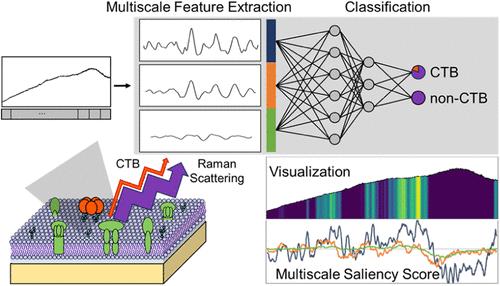
Raman spectroscopy in biological applications faces challenges due to complex spectra, characterized by peaks of varying widths and significant biological background noise. Convolutional neural networks (CNNs) are widely used for spectrum classification due to their ability to capture local peak features. In this study, we introduce a multiscale CNN designed to detect weak biomolecule signals and differentiate spectra with features that cannot be statistically distinguished. The approach is further enhanced by a new visualization technique tailored for multiscale spectral analysis, providing clear insights into classification results. Using the classification of cholera toxin B subunit (CTB)-treated versus untreated cell membrane samples, whose spectra cannot be statistically differentiated, the optimized multiscale CNN achieved superior performance compared to traditional machine learning methods and existing multiscale CNNs, with accuracy (99.22%), sensitivity (99.27%), specificity (99.16%), and precision (99.20%). Our new visualization method, based on gradients of activation maps with respect to class scores, generates saliency scores that capture sample variations, with decision-making relying on consistently identified peak features. By visualizing the effects of different kernel sizes, Grad-AM highlights features at varying scales, aligning closely with spectral features and enhancing CNN interpretability in complex biomolecular analysis. These advancements demonstrate the potential of our method to improve spectral analysis and reveal previously hidden peaks in complex biological environments.
期刊介绍:
ACS Sensors is a peer-reviewed research journal that focuses on the dissemination of new and original knowledge in the field of sensor science, particularly those that selectively sense chemical or biological species or processes. The journal covers a broad range of topics, including but not limited to biosensors, chemical sensors, gas sensors, intracellular sensors, single molecule sensors, cell chips, and microfluidic devices. It aims to publish articles that address conceptual advances in sensing technology applicable to various types of analytes or application papers that report on the use of existing sensing concepts in new ways or for new analytes.



 京公网安备 11010802042870号
京ICP备2023020795号-1
京公网安备 11010802042870号
京ICP备2023020795号-1

 分享
分享
 求助内容:
求助内容: 应助结果提醒方式:
 扫码关注我们
