Da Jun Wu , Li Ya Liang , Yichen Shi , Ya Ting Gao , Shuai Chang , Jian Lv , Ruo Can Qian , Da Wei Li , Bin Bin Chen
{"title":"A water-stable phosphorescent probe for doxorubicin detection by phosphorescence resonance energy transfer","authors":"Da Jun Wu , Li Ya Liang , Yichen Shi , Ya Ting Gao , Shuai Chang , Jian Lv , Ruo Can Qian , Da Wei Li , Bin Bin Chen","doi":"10.1016/j.snb.2025.137739","DOIUrl":null,"url":null,"abstract":"<div><div>Phosphorescent sensing probes have attracted considerable attention due to their ability to eliminate autofluorescence interference in biological samples. However, constructing water-stable phosphorescent materials remains a significant challenge because of water-quenched phosphorescence (phos.) property. Herein, a facile one-step thermal polymerization is proposed to synthesize aluminium/4-chlorobenzoicacid phosphorescent materials (Al/PCBA-PMs). The obtained Al/PCBA-PMs have two phos. emissions at 438 nm and 515 nm, respectively, with a lifetime of 83.67 ms. Importantly, the Al/PCBA-PMs show good water-stable phosphorescent property, and the introduction of water can cause a change in phosphorescent color of Al/PCBA-PMs from blue to green, but which has only a small impact on phosphorescent intensity and lifetime. Furthermore, a system of phos. resonance energy transfer (PhRET) can be constructed where Al/PCBA-PMs act as phosphorescent donors and doxorubicin (DOX) serves as fluorescent acceptors. This PhRET system has a high efficiency of 44.25 %, which can achieve the direct and precise determination of DOX in biological samples with strong autofluorescence, with a linear range of 0 −100 μM. This work proposes a powerful strategy for constructing water-stable phosphorescent probes and develops a new type of PhRET system to achieve precise phosphorescent detection in biological samples.</div></div>","PeriodicalId":425,"journal":{"name":"Sensors and Actuators B: Chemical","volume":"437 ","pages":"Article 137739"},"PeriodicalIF":3.7000,"publicationDate":"2025-08-15","publicationTypes":"Journal Article","fieldsOfStudy":null,"isOpenAccess":false,"openAccessPdf":"","citationCount":"0","resultStr":null,"platform":"Semanticscholar","paperid":null,"PeriodicalName":"Sensors and Actuators B: Chemical","FirstCategoryId":"92","ListUrlMain":"https://www.sciencedirect.com/science/article/pii/S0925400525005143","RegionNum":1,"RegionCategory":"化学","ArticlePicture":[],"TitleCN":null,"AbstractTextCN":null,"PMCID":null,"EPubDate":"2025/4/4 0:00:00","PubModel":"Epub","JCR":"Q1","JCRName":"CHEMISTRY, ANALYTICAL","Score":null,"Total":0}
引用次数: 0
Abstract
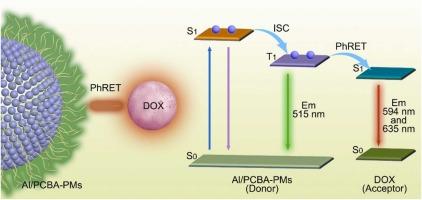
Phosphorescent sensing probes have attracted considerable attention due to their ability to eliminate autofluorescence interference in biological samples. However, constructing water-stable phosphorescent materials remains a significant challenge because of water-quenched phosphorescence (phos.) property. Herein, a facile one-step thermal polymerization is proposed to synthesize aluminium/4-chlorobenzoicacid phosphorescent materials (Al/PCBA-PMs). The obtained Al/PCBA-PMs have two phos. emissions at 438 nm and 515 nm, respectively, with a lifetime of 83.67 ms. Importantly, the Al/PCBA-PMs show good water-stable phosphorescent property, and the introduction of water can cause a change in phosphorescent color of Al/PCBA-PMs from blue to green, but which has only a small impact on phosphorescent intensity and lifetime. Furthermore, a system of phos. resonance energy transfer (PhRET) can be constructed where Al/PCBA-PMs act as phosphorescent donors and doxorubicin (DOX) serves as fluorescent acceptors. This PhRET system has a high efficiency of 44.25 %, which can achieve the direct and precise determination of DOX in biological samples with strong autofluorescence, with a linear range of 0 −100 μM. This work proposes a powerful strategy for constructing water-stable phosphorescent probes and develops a new type of PhRET system to achieve precise phosphorescent detection in biological samples.
期刊介绍:
Sensors & Actuators, B: Chemical is an international journal focused on the research and development of chemical transducers. It covers chemical sensors and biosensors, chemical actuators, and analytical microsystems. The journal is interdisciplinary, aiming to publish original works showcasing substantial advancements beyond the current state of the art in these fields, with practical applicability to solving meaningful analytical problems. Review articles are accepted by invitation from an Editor of the journal.



 京公网安备 11010802042870号
京ICP备2023020795号-1
京公网安备 11010802042870号
京ICP备2023020795号-1

 分享
分享
 求助内容:
求助内容: 应助结果提醒方式:
 扫码关注我们
