Eleni Lamprou , Athanasios Kokkinis , Panagiota M. Kalligosfyri , Panagiotis N. Koustoumpardis , Despina P. Kalogianni
{"title":"Harnessing machine vision and image processing in multicolor lateral flow assays for cutting-edge liquid biopsy applications","authors":"Eleni Lamprou , Athanasios Kokkinis , Panagiota M. Kalligosfyri , Panagiotis N. Koustoumpardis , Despina P. Kalogianni","doi":"10.1016/j.snb.2025.137729","DOIUrl":null,"url":null,"abstract":"<div><div>Lateral flow assays (LFAs) are important diagnostic tools with numerous applications in various scientific fields, including diagnostics, medicine, analytical chemistry, biochemistry, environmental and food science. Artificial Intelligence (AI) and Image Processing tools are the state-of-the-art technology in analytical tools, especially in Point-of-Care (POC) devices that improve the detection efficiency without the need for highly qualified personnel. In this context, we have developed novel multicolor LFAs exploiting machine vision and image analysis tools for the automated \"reading\" of the visual result of LFAs using beads of different colors as reporters to distinguish between multiple targets. The system consists of a multicolor test integrated with a mobile/smartphone and a web application for the automatic interpretation of the results. The use of multicolor beads, relating each color to a specific target, enhanced image analysis-based discrimination of the tests between different targets. The developed diagnostic tool has been applied to cutting-edge liquid biopsy applications which include the detection of three different microRNA molecules spiked in urine samples. The developed integrated system has been successfully applied to a series of real samples, advancing the field of LFAs diagnostics. The system showed 99.3 % accuracy, 99.1 % sensitivity and 100 % specificity.</div></div>","PeriodicalId":425,"journal":{"name":"Sensors and Actuators B: Chemical","volume":"437 ","pages":"Article 137729"},"PeriodicalIF":3.7000,"publicationDate":"2025-08-15","publicationTypes":"Journal Article","fieldsOfStudy":null,"isOpenAccess":false,"openAccessPdf":"","citationCount":"0","resultStr":null,"platform":"Semanticscholar","paperid":null,"PeriodicalName":"Sensors and Actuators B: Chemical","FirstCategoryId":"92","ListUrlMain":"https://www.sciencedirect.com/science/article/pii/S0925400525005040","RegionNum":1,"RegionCategory":"化学","ArticlePicture":[],"TitleCN":null,"AbstractTextCN":null,"PMCID":null,"EPubDate":"2025/4/4 0:00:00","PubModel":"Epub","JCR":"Q1","JCRName":"CHEMISTRY, ANALYTICAL","Score":null,"Total":0}
引用次数: 0
Abstract
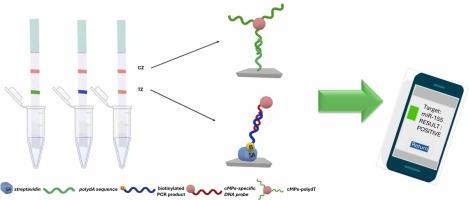
Lateral flow assays (LFAs) are important diagnostic tools with numerous applications in various scientific fields, including diagnostics, medicine, analytical chemistry, biochemistry, environmental and food science. Artificial Intelligence (AI) and Image Processing tools are the state-of-the-art technology in analytical tools, especially in Point-of-Care (POC) devices that improve the detection efficiency without the need for highly qualified personnel. In this context, we have developed novel multicolor LFAs exploiting machine vision and image analysis tools for the automated "reading" of the visual result of LFAs using beads of different colors as reporters to distinguish between multiple targets. The system consists of a multicolor test integrated with a mobile/smartphone and a web application for the automatic interpretation of the results. The use of multicolor beads, relating each color to a specific target, enhanced image analysis-based discrimination of the tests between different targets. The developed diagnostic tool has been applied to cutting-edge liquid biopsy applications which include the detection of three different microRNA molecules spiked in urine samples. The developed integrated system has been successfully applied to a series of real samples, advancing the field of LFAs diagnostics. The system showed 99.3 % accuracy, 99.1 % sensitivity and 100 % specificity.
期刊介绍:
Sensors & Actuators, B: Chemical is an international journal focused on the research and development of chemical transducers. It covers chemical sensors and biosensors, chemical actuators, and analytical microsystems. The journal is interdisciplinary, aiming to publish original works showcasing substantial advancements beyond the current state of the art in these fields, with practical applicability to solving meaningful analytical problems. Review articles are accepted by invitation from an Editor of the journal.



 京公网安备 11010802042870号
京ICP备2023020795号-1
京公网安备 11010802042870号
京ICP备2023020795号-1

 分享
分享
 求助内容:
求助内容: 应助结果提醒方式:
 扫码关注我们
