Luca Consentino , Miriam González-Castaño , Nuría Garcia-Moncada , Luis F. Bobadilla , Michelangelo Gruttadauria , Leonarda Francesca Liotta , José Antonio Odriozola
{"title":"Insights into the reactivity of Ni-La catalysts for CO2 methanation","authors":"Luca Consentino , Miriam González-Castaño , Nuría Garcia-Moncada , Luis F. Bobadilla , Michelangelo Gruttadauria , Leonarda Francesca Liotta , José Antonio Odriozola","doi":"10.1016/j.jcou.2025.103076","DOIUrl":null,"url":null,"abstract":"<div><div>Efficient catalysts are essential for CO<sub>2</sub> methanation reaction, a key process for sustainable energy applications. This study investigates the structural and chemical properties of Ni-La perovskite-based catalysts synthesized <em>via</em> one-pot and impregnation methods by microwave-assisted synthesis to improve Ni dispersion and phase homogeneity. Reduction temperature emerges as a key factor influencing catalyst structure and performance. Catalysts reduced at lower temperatures retain perovskite structures, leading to enhanced metal-support interactions, which are crucial for CO₂ activation and methane production. In contrast, higher reduction temperatures decompose the perovskite phase into metallic Ni and La₂O₃, which alters the catalytic behavior. The impregnation method enhances Ni dispersion, leading to higher metallic Ni availability and superior catalytic performance. Oxygen vacancies and carbonate species formed on the catalyst surface are identified as central to the reaction mechanism, facilitating CO₂ adsorption and conversion. This research underscores the importance of structure-to-function relationships, focusing on how synthesis methods and reduction conditions shape surface species generation and CO<sub>2</sub> methanation rates. These insights advance the design of highly efficient catalysts for CO<sub>2</sub> conversion, addressing environmental challenges and fostering sustainable energy solutions.</div></div>","PeriodicalId":350,"journal":{"name":"Journal of CO2 Utilization","volume":"95 ","pages":"Article 103076"},"PeriodicalIF":8.4000,"publicationDate":"2025-04-05","publicationTypes":"Journal Article","fieldsOfStudy":null,"isOpenAccess":false,"openAccessPdf":"","citationCount":"0","resultStr":null,"platform":"Semanticscholar","paperid":null,"PeriodicalName":"Journal of CO2 Utilization","FirstCategoryId":"5","ListUrlMain":"https://www.sciencedirect.com/science/article/pii/S2212982025000605","RegionNum":2,"RegionCategory":"工程技术","ArticlePicture":[],"TitleCN":null,"AbstractTextCN":null,"PMCID":null,"EPubDate":"","PubModel":"","JCR":"Q1","JCRName":"CHEMISTRY, MULTIDISCIPLINARY","Score":null,"Total":0}
引用次数: 0
Abstract
Efficient catalysts are essential for CO2 methanation reaction, a key process for sustainable energy applications. This study investigates the structural and chemical properties of Ni-La perovskite-based catalysts synthesized via one-pot and impregnation methods by microwave-assisted synthesis to improve Ni dispersion and phase homogeneity. Reduction temperature emerges as a key factor influencing catalyst structure and performance. Catalysts reduced at lower temperatures retain perovskite structures, leading to enhanced metal-support interactions, which are crucial for CO₂ activation and methane production. In contrast, higher reduction temperatures decompose the perovskite phase into metallic Ni and La₂O₃, which alters the catalytic behavior. The impregnation method enhances Ni dispersion, leading to higher metallic Ni availability and superior catalytic performance. Oxygen vacancies and carbonate species formed on the catalyst surface are identified as central to the reaction mechanism, facilitating CO₂ adsorption and conversion. This research underscores the importance of structure-to-function relationships, focusing on how synthesis methods and reduction conditions shape surface species generation and CO2 methanation rates. These insights advance the design of highly efficient catalysts for CO2 conversion, addressing environmental challenges and fostering sustainable energy solutions.
期刊介绍:
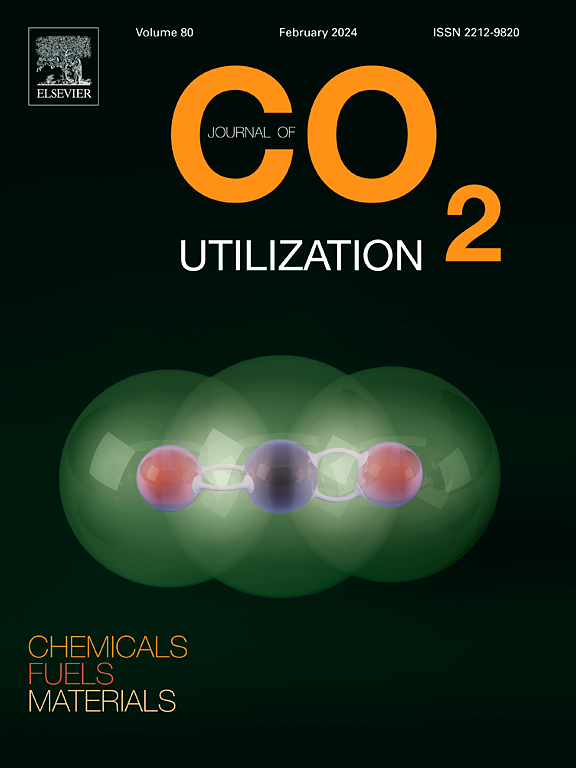
The Journal of CO2 Utilization offers a single, multi-disciplinary, scholarly platform for the exchange of novel research in the field of CO2 re-use for scientists and engineers in chemicals, fuels and materials.
The emphasis is on the dissemination of leading-edge research from basic science to the development of new processes, technologies and applications.
The Journal of CO2 Utilization publishes original peer-reviewed research papers, reviews, and short communications, including experimental and theoretical work, and analytical models and simulations.



 京公网安备 11010802042870号
京ICP备2023020795号-1
京公网安备 11010802042870号
京ICP备2023020795号-1

 分享
分享
 求助内容:
求助内容: 应助结果提醒方式:
 扫码关注我们
