Yurong Yin , Can Li , Daniel Yee Fan Ng , Rong Wang
{"title":"Quaternary ammonium-regulated fabrication of hollow fiber nanofiltration membrane for enhanced Mg2+/Li+ separation","authors":"Yurong Yin , Can Li , Daniel Yee Fan Ng , Rong Wang","doi":"10.1016/j.memsci.2025.124064","DOIUrl":null,"url":null,"abstract":"<div><div>Efficient Mg<sup>2+</sup>/Li<sup>+</sup> separation is vital for lithium recovery from salt-lake, necessitating the advancement of nanofiltration membrane technologies. Current nanofiltration membranes have been enhanced through advanced materials and surface modification to enhance the targeted separation of Mg<sup>2+</sup> and Li<sup>+</sup>. However, significant challenges still exist, including maintaining an optimal balance between high selectivity and permeability and ensuring cost-effectiveness for large-scale industrial adoption. Herein, we developed a novel nanofiltration membrane by integrating 3-bromopropyl trimethylammonium bromide (BPTAB) into the aqueous phase as an additive during interfacial polymerization. The modified membrane’s physicochemical properties and performances were evaluated against a control membrane prepared using tris(2-aminoethyl)amine and trimesoyl chloride on a polyethersulfone substrate. With BPTAB added, the positive charge densities on both top and bottom surfaces of the membrane selective layer were enhanced. Besides, the introduction of the BPTAB led to a reduced membrane pore size and a more uniform pore size distribution. Both the increased positive charge density and refined pore structure collectively contributed to the improved MgCl<sub>2</sub> rejection and enhanced Mg<sup>2+</sup>/Li<sup>+</sup> separation. The BPTAB-modified membrane exhibited a high pure water permeability of 23.5 L m<sup>−2</sup> h<sup>−1</sup> bar<sup>−1</sup> and achieved a Mg<sup>2+</sup>/Li<sup>+</sup> selectivity (S<sub>Li/Mg</sub>) of 24.8 in a 2000 ppm mixed solution with a Mg<sup>2+</sup>/Li<sup>+</sup> ratio of 20, significantly surpassing the control membrane (S<sub>Li/Mg</sub> = 5.2). The results emphasize the considerable ability of BPTAB-modified membrane for efficient Mg<sup>2+</sup>/Li<sup>+</sup> separation in lithium extraction applications.</div></div>","PeriodicalId":368,"journal":{"name":"Journal of Membrane Science","volume":"726 ","pages":"Article 124064"},"PeriodicalIF":9.0000,"publicationDate":"2025-04-02","publicationTypes":"Journal Article","fieldsOfStudy":null,"isOpenAccess":false,"openAccessPdf":"","citationCount":"0","resultStr":null,"platform":"Semanticscholar","paperid":null,"PeriodicalName":"Journal of Membrane Science","FirstCategoryId":"5","ListUrlMain":"https://www.sciencedirect.com/science/article/pii/S0376738825003771","RegionNum":1,"RegionCategory":"工程技术","ArticlePicture":[],"TitleCN":null,"AbstractTextCN":null,"PMCID":null,"EPubDate":"","PubModel":"","JCR":"Q1","JCRName":"ENGINEERING, CHEMICAL","Score":null,"Total":0}
引用次数: 0
Abstract
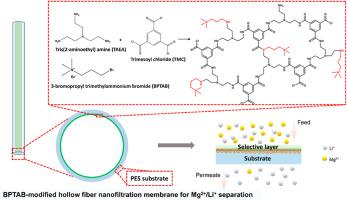
Efficient Mg2+/Li+ separation is vital for lithium recovery from salt-lake, necessitating the advancement of nanofiltration membrane technologies. Current nanofiltration membranes have been enhanced through advanced materials and surface modification to enhance the targeted separation of Mg2+ and Li+. However, significant challenges still exist, including maintaining an optimal balance between high selectivity and permeability and ensuring cost-effectiveness for large-scale industrial adoption. Herein, we developed a novel nanofiltration membrane by integrating 3-bromopropyl trimethylammonium bromide (BPTAB) into the aqueous phase as an additive during interfacial polymerization. The modified membrane’s physicochemical properties and performances were evaluated against a control membrane prepared using tris(2-aminoethyl)amine and trimesoyl chloride on a polyethersulfone substrate. With BPTAB added, the positive charge densities on both top and bottom surfaces of the membrane selective layer were enhanced. Besides, the introduction of the BPTAB led to a reduced membrane pore size and a more uniform pore size distribution. Both the increased positive charge density and refined pore structure collectively contributed to the improved MgCl2 rejection and enhanced Mg2+/Li+ separation. The BPTAB-modified membrane exhibited a high pure water permeability of 23.5 L m−2 h−1 bar−1 and achieved a Mg2+/Li+ selectivity (SLi/Mg) of 24.8 in a 2000 ppm mixed solution with a Mg2+/Li+ ratio of 20, significantly surpassing the control membrane (SLi/Mg = 5.2). The results emphasize the considerable ability of BPTAB-modified membrane for efficient Mg2+/Li+ separation in lithium extraction applications.
期刊介绍:
The Journal of Membrane Science is a publication that focuses on membrane systems and is aimed at academic and industrial chemists, chemical engineers, materials scientists, and membranologists. It publishes original research and reviews on various aspects of membrane transport, membrane formation/structure, fouling, module/process design, and processes/applications. The journal primarily focuses on the structure, function, and performance of non-biological membranes but also includes papers that relate to biological membranes. The Journal of Membrane Science publishes Full Text Papers, State-of-the-Art Reviews, Letters to the Editor, and Perspectives.



 京公网安备 11010802042870号
京ICP备2023020795号-1
京公网安备 11010802042870号
京ICP备2023020795号-1

 分享
分享
 求助内容:
求助内容: 应助结果提醒方式:
 扫码关注我们
