Andrew Patt, Iris Pang, Fred Lee, Chiraag Gohel, Eoin Fahy, Vicki Stevens, David Ruggieri, Steven C Moore, Ewy A Mathé
{"title":"metLinkR: Facilitating Metaanalysis of Human Metabolomics Data through Automated Linking of Metabolite Identifiers.","authors":"Andrew Patt, Iris Pang, Fred Lee, Chiraag Gohel, Eoin Fahy, Vicki Stevens, David Ruggieri, Steven C Moore, Ewy A Mathé","doi":"10.1021/acs.jproteome.4c01051","DOIUrl":null,"url":null,"abstract":"<p><p>Metabolites are referenced in spectral, structural and pathway databases with a diverse array of schemas, including various internal database identifiers and large tables of common name synonyms. Cross-linking metabolite identifiers is a required step for meta-analysis of metabolomic results across studies but made difficult due to the lack of a consensus identifier system. We have implemented metLinkR, an R package that leverages RefMet and RaMP-DB to automate and simplify cross-linking metabolite identifiers across studies and generating common names. MetLinkR accepts as input metabolite common names and identifiers from five different databases (HMDB, KEGG, ChEBI, LIPIDMAPS and PubChem) to exhaustively search for possible overlap in supplied metabolites from input data sets. In an example of 13 metabolomic data sets totaling 10,400 metabolites, metLinkR identified and provided common names for 1377 metabolites in common between at least 2 data sets in less than 18 min and produced standardized names for 74.4% of the input metabolites. In another example comprising five data sets with 3512 metabolites, metLinkR identified 715 metabolites in common between at least two data sets in under 12 min and produced standardized names for 82.3% of the input metabolites. Outputs of MetLInR include output tables and metrics allowing users to readily double check the mappings and to get an overview of chemical classes represented. Overall, MetLinkR provides a streamlined solution for a common task in metabolomic epidemiology and other fields that meta-analyze metabolomic data. The R package, vignette and source code are freely downloadable at https://github.com/ncats/metLinkR.</p>","PeriodicalId":48,"journal":{"name":"Journal of Proteome Research","volume":" ","pages":"2403-2407"},"PeriodicalIF":3.8000,"publicationDate":"2025-05-02","publicationTypes":"Journal Article","fieldsOfStudy":null,"isOpenAccess":false,"openAccessPdf":"https://www.ncbi.nlm.nih.gov/pmc/articles/PMC12053952/pdf/","citationCount":"0","resultStr":null,"platform":"Semanticscholar","paperid":null,"PeriodicalName":"Journal of Proteome Research","FirstCategoryId":"99","ListUrlMain":"https://doi.org/10.1021/acs.jproteome.4c01051","RegionNum":2,"RegionCategory":"生物学","ArticlePicture":[],"TitleCN":null,"AbstractTextCN":null,"PMCID":null,"EPubDate":"2025/4/4 0:00:00","PubModel":"Epub","JCR":"Q1","JCRName":"BIOCHEMICAL RESEARCH METHODS","Score":null,"Total":0}
引用次数: 0
Abstract
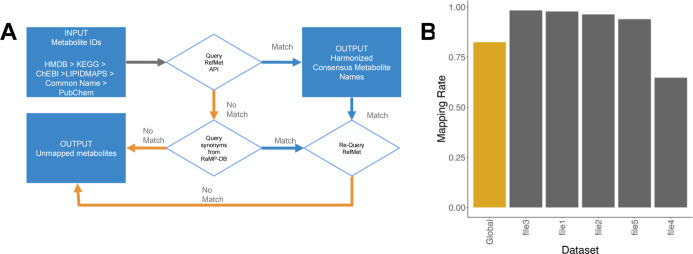
Metabolites are referenced in spectral, structural and pathway databases with a diverse array of schemas, including various internal database identifiers and large tables of common name synonyms. Cross-linking metabolite identifiers is a required step for meta-analysis of metabolomic results across studies but made difficult due to the lack of a consensus identifier system. We have implemented metLinkR, an R package that leverages RefMet and RaMP-DB to automate and simplify cross-linking metabolite identifiers across studies and generating common names. MetLinkR accepts as input metabolite common names and identifiers from five different databases (HMDB, KEGG, ChEBI, LIPIDMAPS and PubChem) to exhaustively search for possible overlap in supplied metabolites from input data sets. In an example of 13 metabolomic data sets totaling 10,400 metabolites, metLinkR identified and provided common names for 1377 metabolites in common between at least 2 data sets in less than 18 min and produced standardized names for 74.4% of the input metabolites. In another example comprising five data sets with 3512 metabolites, metLinkR identified 715 metabolites in common between at least two data sets in under 12 min and produced standardized names for 82.3% of the input metabolites. Outputs of MetLInR include output tables and metrics allowing users to readily double check the mappings and to get an overview of chemical classes represented. Overall, MetLinkR provides a streamlined solution for a common task in metabolomic epidemiology and other fields that meta-analyze metabolomic data. The R package, vignette and source code are freely downloadable at https://github.com/ncats/metLinkR.
期刊介绍:
Journal of Proteome Research publishes content encompassing all aspects of global protein analysis and function, including the dynamic aspects of genomics, spatio-temporal proteomics, metabonomics and metabolomics, clinical and agricultural proteomics, as well as advances in methodology including bioinformatics. The theme and emphasis is on a multidisciplinary approach to the life sciences through the synergy between the different types of "omics".





 京公网安备 11010802042870号
京ICP备2023020795号-1
京公网安备 11010802042870号
京ICP备2023020795号-1

 分享
分享
 求助内容:
求助内容: 应助结果提醒方式:
 扫码关注我们
