Xiangrong Yang, Yaya Chen, Tianwu Zhang, Panhong Zhang, Zengpeng Guo, Li Huang, Guorui Hu, Hui Zhang, Miaojun Ma
{"title":"Plant phenology response to nitrogen addition decreases community biomass stability in an alpine meadow","authors":"Xiangrong Yang, Yaya Chen, Tianwu Zhang, Panhong Zhang, Zengpeng Guo, Li Huang, Guorui Hu, Hui Zhang, Miaojun Ma","doi":"10.1111/nph.70132","DOIUrl":null,"url":null,"abstract":"<div>\n \n <p>\n </p><ul>\n \n <li>Phenology is a sensitive indicator of plant responses to environmental changes, and its shifts could impact community structure and function. However, the effects of phenological shifts on community stability are poorly understood.</li>\n \n <li>We conducted a 4-yr N enrichment and precipitation change experiment to assess their effects on community stability through phenological responses. To do so, we measured phenological duration and overlap (based on leaf-out and flowering phenology of 55 species) in an alpine meadow on the Tibetan Plateau.</li>\n \n <li>N enrichment extended the vegetative stage of grasses, sedges, and community by 4.62, 4.72, and 11.74 d, respectively, but shortened that of forbs by 6.14 d and increased the overlap of flowering among individuals within the community. Meanwhile, N enrichment decreased species richness, asynchrony, and stability of sedges. Furthermore, N enrichment decreased community stability by decreasing asynchrony but was not associated with richness. Interestingly, N enrichment also decreased sedges stability by extending their vegetative stage and increasing the overlap of flowering, consequently reducing community stability.</li>\n \n <li>Our findings imply that N enrichment reduces phenological compensation and thus threatens grassland stability, which highlights the importance of phenological niches in understanding the maintenance of grassland stability under ongoing climate change.</li>\n </ul>\n </div>","PeriodicalId":214,"journal":{"name":"New Phytologist","volume":"247 3","pages":"1145-1155"},"PeriodicalIF":8.1000,"publicationDate":"2025-04-05","publicationTypes":"Journal Article","fieldsOfStudy":null,"isOpenAccess":false,"openAccessPdf":"","citationCount":"0","resultStr":null,"platform":"Semanticscholar","paperid":null,"PeriodicalName":"New Phytologist","FirstCategoryId":"99","ListUrlMain":"https://nph.onlinelibrary.wiley.com/doi/10.1111/nph.70132","RegionNum":1,"RegionCategory":"生物学","ArticlePicture":[],"TitleCN":null,"AbstractTextCN":null,"PMCID":null,"EPubDate":"","PubModel":"","JCR":"Q1","JCRName":"PLANT SCIENCES","Score":null,"Total":0}
引用次数: 0
Abstract
Phenology is a sensitive indicator of plant responses to environmental changes, and its shifts could impact community structure and function. However, the effects of phenological shifts on community stability are poorly understood.
We conducted a 4-yr N enrichment and precipitation change experiment to assess their effects on community stability through phenological responses. To do so, we measured phenological duration and overlap (based on leaf-out and flowering phenology of 55 species) in an alpine meadow on the Tibetan Plateau.
N enrichment extended the vegetative stage of grasses, sedges, and community by 4.62, 4.72, and 11.74 d, respectively, but shortened that of forbs by 6.14 d and increased the overlap of flowering among individuals within the community. Meanwhile, N enrichment decreased species richness, asynchrony, and stability of sedges. Furthermore, N enrichment decreased community stability by decreasing asynchrony but was not associated with richness. Interestingly, N enrichment also decreased sedges stability by extending their vegetative stage and increasing the overlap of flowering, consequently reducing community stability.
Our findings imply that N enrichment reduces phenological compensation and thus threatens grassland stability, which highlights the importance of phenological niches in understanding the maintenance of grassland stability under ongoing climate change.
期刊介绍:
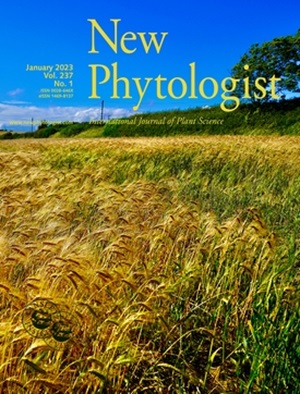
New Phytologist is an international electronic journal published 24 times a year. It is owned by the New Phytologist Foundation, a non-profit-making charitable organization dedicated to promoting plant science. The journal publishes excellent, novel, rigorous, and timely research and scholarship in plant science and its applications. The articles cover topics in five sections: Physiology & Development, Environment, Interaction, Evolution, and Transformative Plant Biotechnology. These sections encompass intracellular processes, global environmental change, and encourage cross-disciplinary approaches. The journal recognizes the use of techniques from molecular and cell biology, functional genomics, modeling, and system-based approaches in plant science. Abstracting and Indexing Information for New Phytologist includes Academic Search, AgBiotech News & Information, Agroforestry Abstracts, Biochemistry & Biophysics Citation Index, Botanical Pesticides, CAB Abstracts®, Environment Index, Global Health, and Plant Breeding Abstracts, and others.



 京公网安备 11010802042870号
京ICP备2023020795号-1
京公网安备 11010802042870号
京ICP备2023020795号-1

 分享
分享
 求助内容:
求助内容: 应助结果提醒方式:
 扫码关注我们
