Tyler A. Malkoske , Pierre R. Bérubé , Robert C. Andrews
{"title":"Hydraulic and chemical cleaning efficiency for the release of microplastics retained during coagulation/flocculation-ultrafiltration","authors":"Tyler A. Malkoske , Pierre R. Bérubé , Robert C. Andrews","doi":"10.1016/j.watres.2025.123601","DOIUrl":null,"url":null,"abstract":"<div><div>Microplastics (MPs) are ubiquitous in global drinking water sources (lakes, rivers), with reported concentrations ranging from 0.5 to >7,500 particles/L. Ultrafiltration (UF), widely applied in drinking water treatment, is anticipated to represent an effective barrier to MPs due to its pore size (0.01-0.1 µm), which can retain MPs of potential health concern. To-date limited studies have reported that MPs may contribute to UF fouling, albeit when considering concentrations up to 10 orders of magnitude higher than those typically observed in source waters. The present study evaluated the retention of MPs by UF membranes when incorporating coagulation/flocculation pre-treatment, as well as their release during hydraulic and chemical cleaning. Polyethylene (PE) fragments, representing a range of environmentally relevant sizes (1-50 µm) and concentrations (907 ± 293 particles/L), were spiked into untreated lake waters prior to coagulation/flocculation-UF. Results suggest that in the absence of coagulant (alum) addition, only 50% of MPs retained during UF permeation were subsequently released during hydraulic cleaning. The release of MPs during hydraulic cleaning decreased (<20%) at medium and high (8 mg/L, 15 mg/L) alum dosages when compared to the absence of coagulant addition. Chemical cleaning with sodium hypochlorite (500 mg/L) was only capable of releasing 20% to 60% of retained MPs. Both hydraulic and chemical cleaning were less effective for the release of MPs when compared to reversible fouling resistance, organic matter, and aluminum. As such, future research is required to determine if the accumulation of MPs leads to increased UF fouling over extended operating periods, in addition cleaning practices which specifically target MPs should be further examined. Low and medium alum dosages (2 mg/L, 8 mg/L) were observed to increase the release of retained MPs during chemical cleaning, suggesting that incorporation of coagulation pre-treatment is useful to increase the release of MPs and minimize potential long-term accumulation on membranes.</div></div>","PeriodicalId":443,"journal":{"name":"Water Research","volume":"282 ","pages":"Article 123601"},"PeriodicalIF":12.4000,"publicationDate":"2025-08-15","publicationTypes":"Journal Article","fieldsOfStudy":null,"isOpenAccess":false,"openAccessPdf":"","citationCount":"0","resultStr":null,"platform":"Semanticscholar","paperid":null,"PeriodicalName":"Water Research","FirstCategoryId":"93","ListUrlMain":"https://www.sciencedirect.com/science/article/pii/S0043135425005135","RegionNum":1,"RegionCategory":"环境科学与生态学","ArticlePicture":[],"TitleCN":null,"AbstractTextCN":null,"PMCID":null,"EPubDate":"2025/4/5 0:00:00","PubModel":"Epub","JCR":"Q1","JCRName":"ENGINEERING, ENVIRONMENTAL","Score":null,"Total":0}
引用次数: 0
Abstract
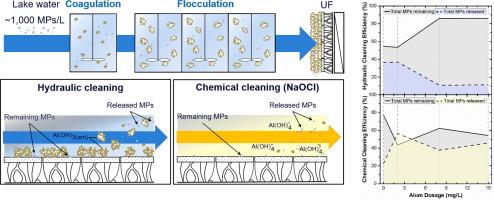
Microplastics (MPs) are ubiquitous in global drinking water sources (lakes, rivers), with reported concentrations ranging from 0.5 to >7,500 particles/L. Ultrafiltration (UF), widely applied in drinking water treatment, is anticipated to represent an effective barrier to MPs due to its pore size (0.01-0.1 µm), which can retain MPs of potential health concern. To-date limited studies have reported that MPs may contribute to UF fouling, albeit when considering concentrations up to 10 orders of magnitude higher than those typically observed in source waters. The present study evaluated the retention of MPs by UF membranes when incorporating coagulation/flocculation pre-treatment, as well as their release during hydraulic and chemical cleaning. Polyethylene (PE) fragments, representing a range of environmentally relevant sizes (1-50 µm) and concentrations (907 ± 293 particles/L), were spiked into untreated lake waters prior to coagulation/flocculation-UF. Results suggest that in the absence of coagulant (alum) addition, only 50% of MPs retained during UF permeation were subsequently released during hydraulic cleaning. The release of MPs during hydraulic cleaning decreased (<20%) at medium and high (8 mg/L, 15 mg/L) alum dosages when compared to the absence of coagulant addition. Chemical cleaning with sodium hypochlorite (500 mg/L) was only capable of releasing 20% to 60% of retained MPs. Both hydraulic and chemical cleaning were less effective for the release of MPs when compared to reversible fouling resistance, organic matter, and aluminum. As such, future research is required to determine if the accumulation of MPs leads to increased UF fouling over extended operating periods, in addition cleaning practices which specifically target MPs should be further examined. Low and medium alum dosages (2 mg/L, 8 mg/L) were observed to increase the release of retained MPs during chemical cleaning, suggesting that incorporation of coagulation pre-treatment is useful to increase the release of MPs and minimize potential long-term accumulation on membranes.
期刊介绍:
Water Research, along with its open access companion journal Water Research X, serves as a platform for publishing original research papers covering various aspects of the science and technology related to the anthropogenic water cycle, water quality, and its management worldwide. The audience targeted by the journal comprises biologists, chemical engineers, chemists, civil engineers, environmental engineers, limnologists, and microbiologists. The scope of the journal include:
•Treatment processes for water and wastewaters (municipal, agricultural, industrial, and on-site treatment), including resource recovery and residuals management;
•Urban hydrology including sewer systems, stormwater management, and green infrastructure;
•Drinking water treatment and distribution;
•Potable and non-potable water reuse;
•Sanitation, public health, and risk assessment;
•Anaerobic digestion, solid and hazardous waste management, including source characterization and the effects and control of leachates and gaseous emissions;
•Contaminants (chemical, microbial, anthropogenic particles such as nanoparticles or microplastics) and related water quality sensing, monitoring, fate, and assessment;
•Anthropogenic impacts on inland, tidal, coastal and urban waters, focusing on surface and ground waters, and point and non-point sources of pollution;
•Environmental restoration, linked to surface water, groundwater and groundwater remediation;
•Analysis of the interfaces between sediments and water, and between water and atmosphere, focusing specifically on anthropogenic impacts;
•Mathematical modelling, systems analysis, machine learning, and beneficial use of big data related to the anthropogenic water cycle;
•Socio-economic, policy, and regulations studies.




 京公网安备 11010802042870号
京ICP备2023020795号-1
京公网安备 11010802042870号
京ICP备2023020795号-1

 分享
分享
 求助内容:
求助内容: 应助结果提醒方式:
 扫码关注我们
