Zixiang Chen, Kaifeng Niu, Mengge Li, Yuchun Deng, Ji Zhang, Di Wei, Jiaqi Wang, Yongliang Zhao
{"title":"GCLC desuccinylation regulated by oxidative stress protects human cancer cells from ferroptosis","authors":"Zixiang Chen, Kaifeng Niu, Mengge Li, Yuchun Deng, Ji Zhang, Di Wei, Jiaqi Wang, Yongliang Zhao","doi":"10.1038/s41418-025-01505-8","DOIUrl":null,"url":null,"abstract":"Tumor cells evolve strong antioxidant capacities to counteract the abnormal high level of reactive oxygen species (ROS) in the tumor microenvironment. Glutamate-cysteine ligase catalyzing subunit (GCLC) for synthesis of antioxidant glutathione (GSH) represents the key enzyme to maintain redox homeostasis of tumor cells, however, whether its activity is regulated by posttranslational modifications, such as succinylation, remains to be clarified. Here, we demonstrate the existence of succinylation modification on GCLC by in vitro and in vivo assays. NAD-dependent deacetylase Sirtuin-2 (SIRT2) serves as the desuccinylase and catalyzes GCLC desuccinylation at sites of K38, K126, and K326. Specifically, GCLC directly interacts with SIRT2, which can be substantially enhanced upon ROS treatment. This strengthened association results in GCLC desuccinylation and activation, consequently promoting GSH synthesis and rendering cancer cells resistant to ferroptosis induction. Depletion of SIRT2 decreases total GSH level and meanwhile increases the cellular susceptibility to ferroptosis, which can mostly be rescued by introducing wild-type GCLC, but not its 3K-E mutant. We further demonstrated that histone acetyltransferase P300 serves as the succinyltransferase of GCLC, and their association is remarkably decreased after ROS treatment. Thus, SIRT2-regulated GCLC succinylation represents an essential signaling axis for cancer cells to maintain their redox balance in coping with oxidative stress-induced ferroptosis.","PeriodicalId":9731,"journal":{"name":"Cell Death and Differentiation","volume":"32 9","pages":"1679-1690"},"PeriodicalIF":15.4000,"publicationDate":"2025-04-05","publicationTypes":"Journal Article","fieldsOfStudy":null,"isOpenAccess":false,"openAccessPdf":"https://www.nature.comhttps://www.nature.com/articles/s41418-025-01505-8.pdf","citationCount":"0","resultStr":null,"platform":"Semanticscholar","paperid":null,"PeriodicalName":"Cell Death and Differentiation","FirstCategoryId":"99","ListUrlMain":"https://www.nature.com/articles/s41418-025-01505-8","RegionNum":1,"RegionCategory":"生物学","ArticlePicture":[],"TitleCN":null,"AbstractTextCN":null,"PMCID":null,"EPubDate":"","PubModel":"","JCR":"Q1","JCRName":"BIOCHEMISTRY & MOLECULAR BIOLOGY","Score":null,"Total":0}
引用次数: 0
Abstract
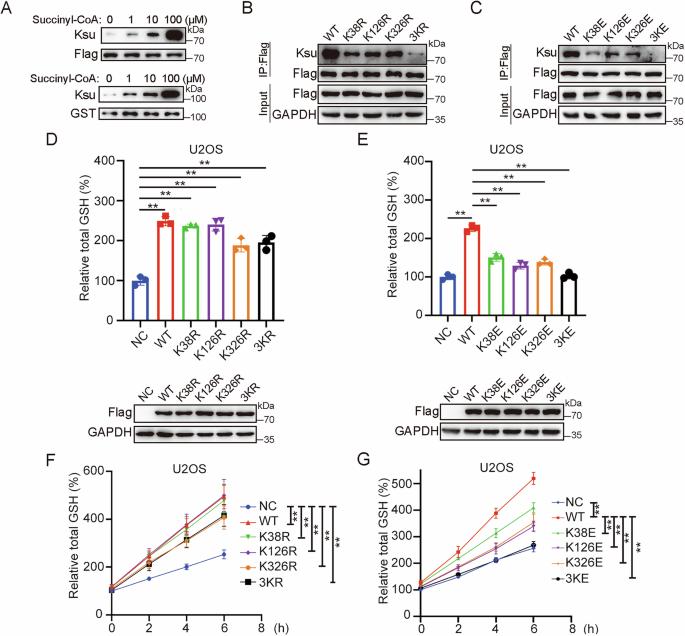
Tumor cells evolve strong antioxidant capacities to counteract the abnormal high level of reactive oxygen species (ROS) in the tumor microenvironment. Glutamate-cysteine ligase catalyzing subunit (GCLC) for synthesis of antioxidant glutathione (GSH) represents the key enzyme to maintain redox homeostasis of tumor cells, however, whether its activity is regulated by posttranslational modifications, such as succinylation, remains to be clarified. Here, we demonstrate the existence of succinylation modification on GCLC by in vitro and in vivo assays. NAD-dependent deacetylase Sirtuin-2 (SIRT2) serves as the desuccinylase and catalyzes GCLC desuccinylation at sites of K38, K126, and K326. Specifically, GCLC directly interacts with SIRT2, which can be substantially enhanced upon ROS treatment. This strengthened association results in GCLC desuccinylation and activation, consequently promoting GSH synthesis and rendering cancer cells resistant to ferroptosis induction. Depletion of SIRT2 decreases total GSH level and meanwhile increases the cellular susceptibility to ferroptosis, which can mostly be rescued by introducing wild-type GCLC, but not its 3K-E mutant. We further demonstrated that histone acetyltransferase P300 serves as the succinyltransferase of GCLC, and their association is remarkably decreased after ROS treatment. Thus, SIRT2-regulated GCLC succinylation represents an essential signaling axis for cancer cells to maintain their redox balance in coping with oxidative stress-induced ferroptosis.
期刊介绍:
Mission, vision and values of Cell Death & Differentiation:
To devote itself to scientific excellence in the field of cell biology, molecular biology, and biochemistry of cell death and disease.
To provide a unified forum for scientists and clinical researchers
It is committed to the rapid publication of high quality original papers relating to these subjects, together with topical, usually solicited, reviews, meeting reports, editorial correspondence and occasional commentaries on controversial and scientifically informative issues.




 京公网安备 11010802042870号
京ICP备2023020795号-1
京公网安备 11010802042870号
京ICP备2023020795号-1

 分享
分享
 求助内容:
求助内容: 应助结果提醒方式:
 扫码关注我们
