Revealing the film-forming property and microstructure evolution of polylactide during simultaneous biaxial stretching: Toward high-performance sustainable film
{"title":"Revealing the film-forming property and microstructure evolution of polylactide during simultaneous biaxial stretching: Toward high-performance sustainable film","authors":"Bingbing Zeng, Jinxiang Ai, Mingxin Xia, Yucen Pang, Jiabin Shen, Yu Zheng, Shaoyun Guo","doi":"10.1016/j.polymer.2025.128360","DOIUrl":null,"url":null,"abstract":"<div><div>The film-forming property of PLA during simultaneous biaxial stretching was investigated by the visualized contour graphic method. Meanwhile, the multiscale microstructure evolution in both amorphous and crystalline domains was studied in detail. It is revealed that the film thickness uniformity is governed by the microstructure evolution and related to the engineering stress-strain behavior. At the low stretching ratio, the excellent chain mobility and fast chain relaxation enabled by thermal activation and formation of gauche-gauche (gg) conformers make PLA show a linear elastic tensile behavior thus a good thickness uniformity. As the film subjected to yielding, the enhanced chain orientation promotes crystallization, inducing the conformational transition and the slowing down of chain relaxation. However, the localized disentanglement and disorientation of chains during yielding lead to the asynchronous structure evolution from the central to edge areas, bringing about the deterioration of film-forming property. At the high stretching ratio where PLA exhibits strain hardening, the oriented and crystalline structures of the whole film become homogeneous again, which optimizes the film thickness uniformity. Moreover, the isotropically oriented structure with tiny crystals imparts superior strength-toughness balance, good gas barrier property, and excellent optical transparency to the highly stretched PLA films. This work provides significant guidance for developing high-quality PLA films, and can also conduct significance in production of other biaxially oriented polymer films.</div></div>","PeriodicalId":405,"journal":{"name":"Polymer","volume":"326 ","pages":"Article 128360"},"PeriodicalIF":4.5000,"publicationDate":"2025-05-09","publicationTypes":"Journal Article","fieldsOfStudy":null,"isOpenAccess":false,"openAccessPdf":"","citationCount":"0","resultStr":null,"platform":"Semanticscholar","paperid":null,"PeriodicalName":"Polymer","FirstCategoryId":"92","ListUrlMain":"https://www.sciencedirect.com/science/article/pii/S0032386125003465","RegionNum":2,"RegionCategory":"化学","ArticlePicture":[],"TitleCN":null,"AbstractTextCN":null,"PMCID":null,"EPubDate":"2025/4/5 0:00:00","PubModel":"Epub","JCR":"Q2","JCRName":"POLYMER SCIENCE","Score":null,"Total":0}
引用次数: 0
Abstract
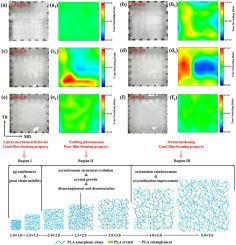
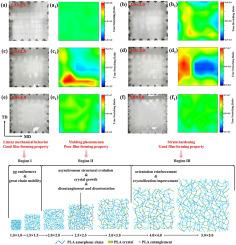
The film-forming property of PLA during simultaneous biaxial stretching was investigated by the visualized contour graphic method. Meanwhile, the multiscale microstructure evolution in both amorphous and crystalline domains was studied in detail. It is revealed that the film thickness uniformity is governed by the microstructure evolution and related to the engineering stress-strain behavior. At the low stretching ratio, the excellent chain mobility and fast chain relaxation enabled by thermal activation and formation of gauche-gauche (gg) conformers make PLA show a linear elastic tensile behavior thus a good thickness uniformity. As the film subjected to yielding, the enhanced chain orientation promotes crystallization, inducing the conformational transition and the slowing down of chain relaxation. However, the localized disentanglement and disorientation of chains during yielding lead to the asynchronous structure evolution from the central to edge areas, bringing about the deterioration of film-forming property. At the high stretching ratio where PLA exhibits strain hardening, the oriented and crystalline structures of the whole film become homogeneous again, which optimizes the film thickness uniformity. Moreover, the isotropically oriented structure with tiny crystals imparts superior strength-toughness balance, good gas barrier property, and excellent optical transparency to the highly stretched PLA films. This work provides significant guidance for developing high-quality PLA films, and can also conduct significance in production of other biaxially oriented polymer films.
期刊介绍:
Polymer is an interdisciplinary journal dedicated to publishing innovative and significant advances in Polymer Physics, Chemistry and Technology. We welcome submissions on polymer hybrids, nanocomposites, characterisation and self-assembly. Polymer also publishes work on the technological application of polymers in energy and optoelectronics.
The main scope is covered but not limited to the following core areas:
Polymer Materials
Nanocomposites and hybrid nanomaterials
Polymer blends, films, fibres, networks and porous materials
Physical Characterization
Characterisation, modelling and simulation* of molecular and materials properties in bulk, solution, and thin films
Polymer Engineering
Advanced multiscale processing methods
Polymer Synthesis, Modification and Self-assembly
Including designer polymer architectures, mechanisms and kinetics, and supramolecular polymerization
Technological Applications
Polymers for energy generation and storage
Polymer membranes for separation technology
Polymers for opto- and microelectronics.



 京公网安备 11010802042870号
京ICP备2023020795号-1
京公网安备 11010802042870号
京ICP备2023020795号-1

 分享
分享
 求助内容:
求助内容: 应助结果提醒方式:
 扫码关注我们
