Xiaoting Sun, Wanting Rong, Lanfang Wang, Jiangnan Lv, Ruixia Yang, Tingting Liang, Qianwen Yang, Xiaohong Xu, Yang Liu
{"title":"Enhanced nitrate-to-ammonia electroreduction on manganese-doped ceria with oxygen vacancies","authors":"Xiaoting Sun, Wanting Rong, Lanfang Wang, Jiangnan Lv, Ruixia Yang, Tingting Liang, Qianwen Yang, Xiaohong Xu, Yang Liu","doi":"10.1016/j.cej.2025.162323","DOIUrl":null,"url":null,"abstract":"Electrochemical NO<sub>3</sub><sup>–</sup> reduction reaction (NO<sub>3</sub><sup>−</sup>RR) represents a promising avenue for efficient and sustainable synthesis of ammonia (NH<sub>3</sub>), with active hydrogen playing a pivotal role in multiple hydrogenation steps. Manganese (Mn)-based electrocatalysts have demonstrated potential in modulating active hydrogen, however, achieving atomically dispersed Mn active sites poses a fundamental challenge. To address the issue, we synthesize Mn-doped ceria with oxygen vacancies (Mn-CeO<sub>2−</sub><em><sub>x</sub></em>) nanoparticles, where Mn<sup>2+</sup> is stabilized within the CeO<sub>2−</sub><em><sub>x</sub></em> host lattice, to facilitate efficient NO<sub>3</sub><sup>−</sup> reduction to NH<sub>3</sub>. The highest NH<sub>3</sub> FE of 91.8 % is observed over Mn-CeO<sub>2−</sub><em><sub>x</sub></em> catalyst at −0.60 V<sub>RHE</sub> and the maximum NH<sub>3</sub> yield rate reaches 1.01 mmol h<sup>−1</sup> cm<sup>−2</sup>, outperforming other metal (M = Fe, Co, Ni, and Cu) doped and undoped CeO<sub>2−</sub><em><sub>x</sub></em> nanoparticles. Experimental analysis and density functional theory (DFT) calculations cooperatively elucidate that the Mn doping optimizes the electronic structure of CeO<sub>2−</sub><em><sub>x</sub></em> catalysts, leading to the generation of ample active hydrogen, improve the reaction kinetics and promote the *NH<sub>2</sub>O → *NH<sub>2</sub>OH step in NO<sub>3</sub><sup>−</sup>RR. Our study introduces a rare-earth metal oxide platform for dispersing transition metal active sites, enabling the regulation of active hydrogen and the enhancement of electrocatalytic performance in NO<sub>3</sub><sup>−</sup>RR.","PeriodicalId":270,"journal":{"name":"Chemical Engineering Journal","volume":"59 1","pages":""},"PeriodicalIF":13.2000,"publicationDate":"2025-04-06","publicationTypes":"Journal Article","fieldsOfStudy":null,"isOpenAccess":false,"openAccessPdf":"","citationCount":"0","resultStr":null,"platform":"Semanticscholar","paperid":null,"PeriodicalName":"Chemical Engineering Journal","FirstCategoryId":"5","ListUrlMain":"https://doi.org/10.1016/j.cej.2025.162323","RegionNum":1,"RegionCategory":"工程技术","ArticlePicture":[],"TitleCN":null,"AbstractTextCN":null,"PMCID":null,"EPubDate":"","PubModel":"","JCR":"Q1","JCRName":"ENGINEERING, CHEMICAL","Score":null,"Total":0}
引用次数: 0
Abstract
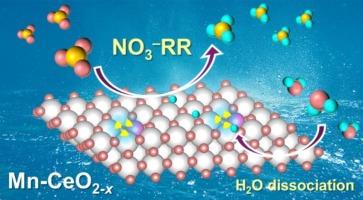
Electrochemical NO3– reduction reaction (NO3−RR) represents a promising avenue for efficient and sustainable synthesis of ammonia (NH3), with active hydrogen playing a pivotal role in multiple hydrogenation steps. Manganese (Mn)-based electrocatalysts have demonstrated potential in modulating active hydrogen, however, achieving atomically dispersed Mn active sites poses a fundamental challenge. To address the issue, we synthesize Mn-doped ceria with oxygen vacancies (Mn-CeO2−x) nanoparticles, where Mn2+ is stabilized within the CeO2−x host lattice, to facilitate efficient NO3− reduction to NH3. The highest NH3 FE of 91.8 % is observed over Mn-CeO2−x catalyst at −0.60 VRHE and the maximum NH3 yield rate reaches 1.01 mmol h−1 cm−2, outperforming other metal (M = Fe, Co, Ni, and Cu) doped and undoped CeO2−x nanoparticles. Experimental analysis and density functional theory (DFT) calculations cooperatively elucidate that the Mn doping optimizes the electronic structure of CeO2−x catalysts, leading to the generation of ample active hydrogen, improve the reaction kinetics and promote the *NH2O → *NH2OH step in NO3−RR. Our study introduces a rare-earth metal oxide platform for dispersing transition metal active sites, enabling the regulation of active hydrogen and the enhancement of electrocatalytic performance in NO3−RR.
期刊介绍:
The Chemical Engineering Journal is an international research journal that invites contributions of original and novel fundamental research. It aims to provide an international platform for presenting original fundamental research, interpretative reviews, and discussions on new developments in chemical engineering. The journal welcomes papers that describe novel theory and its practical application, as well as those that demonstrate the transfer of techniques from other disciplines. It also welcomes reports on carefully conducted experimental work that is soundly interpreted. The main focus of the journal is on original and rigorous research results that have broad significance. The Catalysis section within the Chemical Engineering Journal focuses specifically on Experimental and Theoretical studies in the fields of heterogeneous catalysis, molecular catalysis, and biocatalysis. These studies have industrial impact on various sectors such as chemicals, energy, materials, foods, healthcare, and environmental protection.



 京公网安备 11010802042870号
京ICP备2023020795号-1
京公网安备 11010802042870号
京ICP备2023020795号-1

 分享
分享
 求助内容:
求助内容: 应助结果提醒方式:
 扫码关注我们
