Defect passivation and crystallization management enabled by thulium dopant as B-site cation for highly stable and efficiency fully inorganic perovskite solar cells with over 17% efficiency
Ebubekir Camizci, Ibrahimhan Dilci, Zhengguo Xiao, Savas Sonmezoglu
{"title":"Defect passivation and crystallization management enabled by thulium dopant as B-site cation for highly stable and efficiency fully inorganic perovskite solar cells with over 17% efficiency","authors":"Ebubekir Camizci, Ibrahimhan Dilci, Zhengguo Xiao, Savas Sonmezoglu","doi":"10.1016/j.cej.2025.162314","DOIUrl":null,"url":null,"abstract":"Despite their outstanding thermal stability and optimal band gap for tandem devices, the development of high-performance CsPbI<sub>2</sub>Br-based inorganic perovskite solar cells is considerably hampered by defect-induced nonradiative recombination and halide ion migration. Herein, we have developed a series of CsPbI<sub>2</sub>Br inorganic perovskite materials modified by incorporation of thulium (Tm<sup>3+</sup>) ions as B-site heterovalent dopants and explored their favourable impacts on the photovoltaic and stability performance of fully inorganic perovskite solar cells (FTO/SnO<sub>2</sub>/CsPb<sub>1-x</sub>Tm<sub>x</sub>I<sub>2</sub>Br/CuSCN/r-GO/Au) for the first time. The champion solar cells achieve an impressive efficiency of over 17 %, with less degradations (<5%) after 400 h of operational stability and ∼30 % after 320 h of shelf stability owing to suppression of nonradiative recombination of carriers and inhibition of halide ion migration by controlling crystallization and phase stabilization. Overall, it was revealed that the Tm<sup>3+</sup> ions do not play a role only elimination of ion migration and defects in perovskite film but also protects perovskite layer from moisture and continuous light illumination in fully inorganic perovskite solar cells","PeriodicalId":270,"journal":{"name":"Chemical Engineering Journal","volume":"35 1","pages":""},"PeriodicalIF":13.2000,"publicationDate":"2025-04-06","publicationTypes":"Journal Article","fieldsOfStudy":null,"isOpenAccess":false,"openAccessPdf":"","citationCount":"0","resultStr":null,"platform":"Semanticscholar","paperid":null,"PeriodicalName":"Chemical Engineering Journal","FirstCategoryId":"5","ListUrlMain":"https://doi.org/10.1016/j.cej.2025.162314","RegionNum":1,"RegionCategory":"工程技术","ArticlePicture":[],"TitleCN":null,"AbstractTextCN":null,"PMCID":null,"EPubDate":"","PubModel":"","JCR":"Q1","JCRName":"ENGINEERING, CHEMICAL","Score":null,"Total":0}
引用次数: 0
Abstract
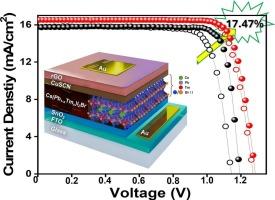
Despite their outstanding thermal stability and optimal band gap for tandem devices, the development of high-performance CsPbI2Br-based inorganic perovskite solar cells is considerably hampered by defect-induced nonradiative recombination and halide ion migration. Herein, we have developed a series of CsPbI2Br inorganic perovskite materials modified by incorporation of thulium (Tm3+) ions as B-site heterovalent dopants and explored their favourable impacts on the photovoltaic and stability performance of fully inorganic perovskite solar cells (FTO/SnO2/CsPb1-xTmxI2Br/CuSCN/r-GO/Au) for the first time. The champion solar cells achieve an impressive efficiency of over 17 %, with less degradations (<5%) after 400 h of operational stability and ∼30 % after 320 h of shelf stability owing to suppression of nonradiative recombination of carriers and inhibition of halide ion migration by controlling crystallization and phase stabilization. Overall, it was revealed that the Tm3+ ions do not play a role only elimination of ion migration and defects in perovskite film but also protects perovskite layer from moisture and continuous light illumination in fully inorganic perovskite solar cells
期刊介绍:
The Chemical Engineering Journal is an international research journal that invites contributions of original and novel fundamental research. It aims to provide an international platform for presenting original fundamental research, interpretative reviews, and discussions on new developments in chemical engineering. The journal welcomes papers that describe novel theory and its practical application, as well as those that demonstrate the transfer of techniques from other disciplines. It also welcomes reports on carefully conducted experimental work that is soundly interpreted. The main focus of the journal is on original and rigorous research results that have broad significance. The Catalysis section within the Chemical Engineering Journal focuses specifically on Experimental and Theoretical studies in the fields of heterogeneous catalysis, molecular catalysis, and biocatalysis. These studies have industrial impact on various sectors such as chemicals, energy, materials, foods, healthcare, and environmental protection.



 京公网安备 11010802042870号
京ICP备2023020795号-1
京公网安备 11010802042870号
京ICP备2023020795号-1

 分享
分享
 求助内容:
求助内容: 应助结果提醒方式:
 扫码关注我们
