{"title":"Sandwich-structured HDPE-based medium-temperature phase change composites with MXene interlayers for photo-thermal-electrical applications","authors":"Bin Ai, Zhigang Liu, Xinpeng Hu, Bingqing Quan, Miao Sui, Chuanbiao Zhu, Yang Xiao, Minjiang Zhang, Lewen Liu, Xiangyu Yan, Xiang Lu, Jinping Qu","doi":"10.1016/j.cej.2025.162367","DOIUrl":null,"url":null,"abstract":"As global resource depletion intensifies, solar energy has gained widespread attention due to its vast potential. However, the inherent variability and intermittency of solar radiation emphasizes the need for energy storage. Against this backdrop, the thermoelectric devices based on phase change material (PCM) have attracted numerous attention. Currently, traditional PCMs suffer from low phase change temperatures, resulting in insufficient temperature differences for thermoelectric devices. In this work, high-density polyethylene (HDPE) is used as a medium-temperature (125-135°C) PCM, in which the polyamide 6 (PA6) particles are dispersed to prepare shape-stable phase change material (SSPCM) through tensile flow field. The HDPE/PA6 blends is combined with a MXene@PTA to produce a sandwich-structured SSPCM. The sandwich-structured SSPCM has a latent heat of more than 165 J/g with the phase change temperature of 130 °C. In the photo-thermal-electrical experiment, the SSPCM could reaches 145.4 °C, which benefits the photo-thermal-electric conversion. Notably, the sample’s power generation time under no-light conditions is extended by 16.4 % and the power generation capacity is increased by 47.6 %. Moreover, the samples maintain excellent thermal performance even after 200 thermal cycles. This work provides a promising strategy for the development of multifunctional materials capable of efficient solar energy harvesting and upgrading photo-thermal-electrical conversion, demonstrating great potential for applications in energy storage and conversion technologies.","PeriodicalId":270,"journal":{"name":"Chemical Engineering Journal","volume":"183 1","pages":""},"PeriodicalIF":13.2000,"publicationDate":"2025-04-06","publicationTypes":"Journal Article","fieldsOfStudy":null,"isOpenAccess":false,"openAccessPdf":"","citationCount":"0","resultStr":null,"platform":"Semanticscholar","paperid":null,"PeriodicalName":"Chemical Engineering Journal","FirstCategoryId":"5","ListUrlMain":"https://doi.org/10.1016/j.cej.2025.162367","RegionNum":1,"RegionCategory":"工程技术","ArticlePicture":[],"TitleCN":null,"AbstractTextCN":null,"PMCID":null,"EPubDate":"","PubModel":"","JCR":"Q1","JCRName":"ENGINEERING, CHEMICAL","Score":null,"Total":0}
引用次数: 0
Abstract
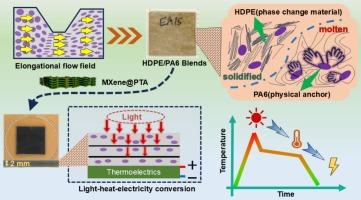
As global resource depletion intensifies, solar energy has gained widespread attention due to its vast potential. However, the inherent variability and intermittency of solar radiation emphasizes the need for energy storage. Against this backdrop, the thermoelectric devices based on phase change material (PCM) have attracted numerous attention. Currently, traditional PCMs suffer from low phase change temperatures, resulting in insufficient temperature differences for thermoelectric devices. In this work, high-density polyethylene (HDPE) is used as a medium-temperature (125-135°C) PCM, in which the polyamide 6 (PA6) particles are dispersed to prepare shape-stable phase change material (SSPCM) through tensile flow field. The HDPE/PA6 blends is combined with a MXene@PTA to produce a sandwich-structured SSPCM. The sandwich-structured SSPCM has a latent heat of more than 165 J/g with the phase change temperature of 130 °C. In the photo-thermal-electrical experiment, the SSPCM could reaches 145.4 °C, which benefits the photo-thermal-electric conversion. Notably, the sample’s power generation time under no-light conditions is extended by 16.4 % and the power generation capacity is increased by 47.6 %. Moreover, the samples maintain excellent thermal performance even after 200 thermal cycles. This work provides a promising strategy for the development of multifunctional materials capable of efficient solar energy harvesting and upgrading photo-thermal-electrical conversion, demonstrating great potential for applications in energy storage and conversion technologies.
期刊介绍:
The Chemical Engineering Journal is an international research journal that invites contributions of original and novel fundamental research. It aims to provide an international platform for presenting original fundamental research, interpretative reviews, and discussions on new developments in chemical engineering. The journal welcomes papers that describe novel theory and its practical application, as well as those that demonstrate the transfer of techniques from other disciplines. It also welcomes reports on carefully conducted experimental work that is soundly interpreted. The main focus of the journal is on original and rigorous research results that have broad significance. The Catalysis section within the Chemical Engineering Journal focuses specifically on Experimental and Theoretical studies in the fields of heterogeneous catalysis, molecular catalysis, and biocatalysis. These studies have industrial impact on various sectors such as chemicals, energy, materials, foods, healthcare, and environmental protection.



 京公网安备 11010802042870号
京ICP备2023020795号-1
京公网安备 11010802042870号
京ICP备2023020795号-1

 分享
分享
 求助内容:
求助内容: 应助结果提醒方式:
 扫码关注我们
