{"title":"Toluene-induced framework expansion in carbazole-based porous organic polymers anchored with Cu-ZnIn2S4 for ultrafast azeotropic wastewater recovery","authors":"Yingxue Zhang, Xunxun Li, Wanjun Xu, Yuxin Cheng, Shihong Dong, Najun Li, Qingfeng Xu, Hua Li, Dongyun Chen, Jianmei Lu","doi":"10.1016/j.cej.2025.162369","DOIUrl":null,"url":null,"abstract":"Toluene, n-propanol, and water are frequently encountered in petrochemical production processes and have a tendency to form azeotropes, thereby complicating their separation. Consequently, achieving efficient separation of these components is essential for both environmental protection and resource conservation. In this study, a composite material comprising a carbazole-based flexible porous organic polymer (POP) and Cu-ZnIn<sub>2</sub>S<sub>4</sub> was constructed. The prepared composite achieved 100 % selective separation of toluene from the ternary azeotrope of n-propanol/toluene/water due to π–π conjugation and weak hydrogen bonding interactions between the POP and toluene molecules. Furthermore, the adsorption capacity of the POP/Cu-ZnIn<sub>2</sub>S<sub>4</sub> composite for toluene reached an unprecedented 3184 mg/g, surpassing the highest reported capacity to date. Additionally, the selective adsorption of toluene by the POP was coupled with in situ photocatalytic degradation of toluene by Cu-ZnIn<sub>2</sub>S<sub>4</sub>. During the photocatalytic process, photogenerated charge carriers were effectively separated and transferred via the S-scheme charge transfer pathway, leading to complete degradation of toluene within 3 min. Finally, cycling experiments demonstrated that the POP could be continuously recycled without significant loss of performance.","PeriodicalId":270,"journal":{"name":"Chemical Engineering Journal","volume":"21 1","pages":""},"PeriodicalIF":13.2000,"publicationDate":"2025-04-06","publicationTypes":"Journal Article","fieldsOfStudy":null,"isOpenAccess":false,"openAccessPdf":"","citationCount":"0","resultStr":null,"platform":"Semanticscholar","paperid":null,"PeriodicalName":"Chemical Engineering Journal","FirstCategoryId":"5","ListUrlMain":"https://doi.org/10.1016/j.cej.2025.162369","RegionNum":1,"RegionCategory":"工程技术","ArticlePicture":[],"TitleCN":null,"AbstractTextCN":null,"PMCID":null,"EPubDate":"","PubModel":"","JCR":"Q1","JCRName":"ENGINEERING, CHEMICAL","Score":null,"Total":0}
引用次数: 0
Abstract
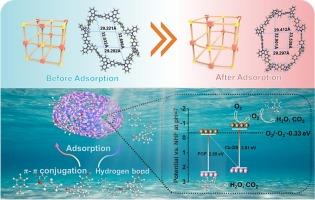
Toluene, n-propanol, and water are frequently encountered in petrochemical production processes and have a tendency to form azeotropes, thereby complicating their separation. Consequently, achieving efficient separation of these components is essential for both environmental protection and resource conservation. In this study, a composite material comprising a carbazole-based flexible porous organic polymer (POP) and Cu-ZnIn2S4 was constructed. The prepared composite achieved 100 % selective separation of toluene from the ternary azeotrope of n-propanol/toluene/water due to π–π conjugation and weak hydrogen bonding interactions between the POP and toluene molecules. Furthermore, the adsorption capacity of the POP/Cu-ZnIn2S4 composite for toluene reached an unprecedented 3184 mg/g, surpassing the highest reported capacity to date. Additionally, the selective adsorption of toluene by the POP was coupled with in situ photocatalytic degradation of toluene by Cu-ZnIn2S4. During the photocatalytic process, photogenerated charge carriers were effectively separated and transferred via the S-scheme charge transfer pathway, leading to complete degradation of toluene within 3 min. Finally, cycling experiments demonstrated that the POP could be continuously recycled without significant loss of performance.
期刊介绍:
The Chemical Engineering Journal is an international research journal that invites contributions of original and novel fundamental research. It aims to provide an international platform for presenting original fundamental research, interpretative reviews, and discussions on new developments in chemical engineering. The journal welcomes papers that describe novel theory and its practical application, as well as those that demonstrate the transfer of techniques from other disciplines. It also welcomes reports on carefully conducted experimental work that is soundly interpreted. The main focus of the journal is on original and rigorous research results that have broad significance. The Catalysis section within the Chemical Engineering Journal focuses specifically on Experimental and Theoretical studies in the fields of heterogeneous catalysis, molecular catalysis, and biocatalysis. These studies have industrial impact on various sectors such as chemicals, energy, materials, foods, healthcare, and environmental protection.



 京公网安备 11010802042870号
京ICP备2023020795号-1
京公网安备 11010802042870号
京ICP备2023020795号-1

 分享
分享
 求助内容:
求助内容: 应助结果提醒方式:
 扫码关注我们
