Xiaoxi Guo , Zhuoyan Liu , Jiajia Lan , Hongyang Wu , Yi-Fan Han
{"title":"Co-Cu-Al-Ox for chloramphenicol degradation: Modification of CoOx coordination and electronic environment by Cu incorporation","authors":"Xiaoxi Guo , Zhuoyan Liu , Jiajia Lan , Hongyang Wu , Yi-Fan Han","doi":"10.1016/j.apsusc.2025.163130","DOIUrl":null,"url":null,"abstract":"<div><div>In heterogeneous Fenton catalysis, the modification of electronic structures at active sites is crucial for enhancing degradation efficiency. This strategy enhances the activation of H<sub>2</sub>O<sub>2</sub> and the subsequent generation of hydroxyl radicals (·OH). However, the effectiveness of these processes is often limited by suboptimal coordination environments at the active sites. In this study, we synthesized a series of MAl<sub>2</sub>O<sub>4</sub> (M=Co and/or Cu) catalysts with spinel structures, specifically tailored for the efficient degradation of chloramphenicol (CAP). We modulated the electronic structure at the active sites by strategically incorporating Cu atoms, controlling the doping concentration to boost the surface enrichment of Cu-embedded CoO<sub>6</sub> on CoAl<sub>2</sub>O<sub>4</sub>, thus optimizing catalyst performance. This alteration promotes Cu–O-Co interactions within the MO<sub>6</sub> environment, enhancing the reducibility of Cu atoms and boosting electron donation and transfer during reactions. This improvement leads to more effective adsorption of H<sub>2</sub>O<sub>2</sub> and enhanced desorption of hydroxyl radicals, coupled with improved regeneration of active sites. The optimized Co<sub>7.5</sub>Cu<sub>2.5</sub>/Al<sub>2</sub>O<sub>3</sub> catalyst achieved a remarkable 95.5 % conversion rate of chloramphenicol, demonstrating its potential as an effective solution for treating persistent organic pollutants.</div></div>","PeriodicalId":247,"journal":{"name":"Applied Surface Science","volume":"699 ","pages":"Article 163130"},"PeriodicalIF":6.9000,"publicationDate":"2025-04-06","publicationTypes":"Journal Article","fieldsOfStudy":null,"isOpenAccess":false,"openAccessPdf":"","citationCount":"0","resultStr":null,"platform":"Semanticscholar","paperid":null,"PeriodicalName":"Applied Surface Science","FirstCategoryId":"88","ListUrlMain":"https://www.sciencedirect.com/science/article/pii/S016943322500844X","RegionNum":2,"RegionCategory":"材料科学","ArticlePicture":[],"TitleCN":null,"AbstractTextCN":null,"PMCID":null,"EPubDate":"","PubModel":"","JCR":"Q2","JCRName":"CHEMISTRY, PHYSICAL","Score":null,"Total":0}
引用次数: 0
Abstract
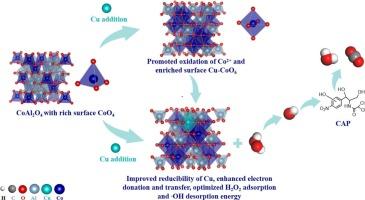
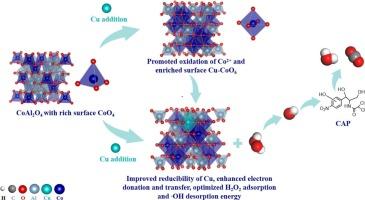
In heterogeneous Fenton catalysis, the modification of electronic structures at active sites is crucial for enhancing degradation efficiency. This strategy enhances the activation of H2O2 and the subsequent generation of hydroxyl radicals (·OH). However, the effectiveness of these processes is often limited by suboptimal coordination environments at the active sites. In this study, we synthesized a series of MAl2O4 (M=Co and/or Cu) catalysts with spinel structures, specifically tailored for the efficient degradation of chloramphenicol (CAP). We modulated the electronic structure at the active sites by strategically incorporating Cu atoms, controlling the doping concentration to boost the surface enrichment of Cu-embedded CoO6 on CoAl2O4, thus optimizing catalyst performance. This alteration promotes Cu–O-Co interactions within the MO6 environment, enhancing the reducibility of Cu atoms and boosting electron donation and transfer during reactions. This improvement leads to more effective adsorption of H2O2 and enhanced desorption of hydroxyl radicals, coupled with improved regeneration of active sites. The optimized Co7.5Cu2.5/Al2O3 catalyst achieved a remarkable 95.5 % conversion rate of chloramphenicol, demonstrating its potential as an effective solution for treating persistent organic pollutants.
期刊介绍:
Applied Surface Science covers topics contributing to a better understanding of surfaces, interfaces, nanostructures and their applications. The journal is concerned with scientific research on the atomic and molecular level of material properties determined with specific surface analytical techniques and/or computational methods, as well as the processing of such structures.




 京公网安备 11010802042870号
京ICP备2023020795号-1
京公网安备 11010802042870号
京ICP备2023020795号-1

 分享
分享
 求助内容:
求助内容: 应助结果提醒方式:
 扫码关注我们
