Qiushi Cheng , Jiayu Chen , Chenzheng Yue , Kai Yu , Guang Yang , Huiying Mu , Wei Su , Yingjuan Hao , Ning Lin , Fatang Li
{"title":"Dislocation-engineered MoNb12-xVxO33 for ultra-fast and stable lithium storage at low temperature","authors":"Qiushi Cheng , Jiayu Chen , Chenzheng Yue , Kai Yu , Guang Yang , Huiying Mu , Wei Su , Yingjuan Hao , Ning Lin , Fatang Li","doi":"10.1016/j.apsusc.2025.163184","DOIUrl":null,"url":null,"abstract":"<div><div>The advancement of lithium-ion batteries with high power density at low temperature is limited by sluggish Li<sup>+</sup> diffusion kinetics and exacerbated polarization effects. Herein, MoNb<sub>12-x</sub>V<sub>x</sub>O<sub>33</sub> with abundant dislocations is constructed by a hetero-atom doping strategy, demonstrating enhanced fast rechargeability and low-temperature kinetics. The presence of dislocations in MoNb<sub>12-x</sub>V<sub>x</sub>O<sub>33</sub> lattice has been confirmed using transmission electron microscope, inverse fast Fourier transform and geometrical phase analysis. The dislocation-rich structure enables a reduction in Li<sup>+</sup> desolvation barrier, lowers Li<sup>+</sup> site energy and enhances Li<sup>+</sup> diffusion capability, particularly at low temperature. The boosted ion diffusion and electronic transport have been established through multiple kinetic analyses and theoretical calculations. Furthermore, the introduced dislocations facilitate stress relief<!--> <!-->and maintain structural stability during rapid (de)lithiation procedures. Consequently, MoNb<sub>12-x</sub>V<sub>x</sub>O<sub>33</sub> displays a high reversible capacity of 116.8 mAh g<sup>−1</sup> at 100C. Particularly at −20 °C, MoNb<sub>12-x</sub>V<sub>x</sub>O<sub>33</sub> demonstrates exceptional long-term cycling stability exceeding 7000 cycles at 5C with 98.9 % capacity retention.</div></div>","PeriodicalId":247,"journal":{"name":"Applied Surface Science","volume":"699 ","pages":"Article 163184"},"PeriodicalIF":6.9000,"publicationDate":"2025-04-06","publicationTypes":"Journal Article","fieldsOfStudy":null,"isOpenAccess":false,"openAccessPdf":"","citationCount":"0","resultStr":null,"platform":"Semanticscholar","paperid":null,"PeriodicalName":"Applied Surface Science","FirstCategoryId":"88","ListUrlMain":"https://www.sciencedirect.com/science/article/pii/S0169433225008980","RegionNum":2,"RegionCategory":"材料科学","ArticlePicture":[],"TitleCN":null,"AbstractTextCN":null,"PMCID":null,"EPubDate":"","PubModel":"","JCR":"Q2","JCRName":"CHEMISTRY, PHYSICAL","Score":null,"Total":0}
引用次数: 0
Abstract
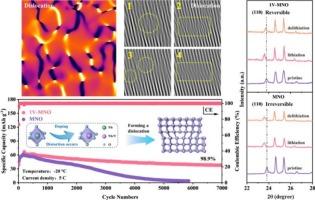
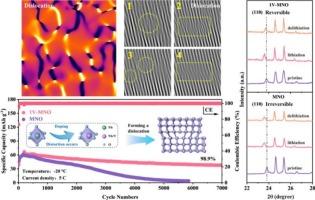
The advancement of lithium-ion batteries with high power density at low temperature is limited by sluggish Li+ diffusion kinetics and exacerbated polarization effects. Herein, MoNb12-xVxO33 with abundant dislocations is constructed by a hetero-atom doping strategy, demonstrating enhanced fast rechargeability and low-temperature kinetics. The presence of dislocations in MoNb12-xVxO33 lattice has been confirmed using transmission electron microscope, inverse fast Fourier transform and geometrical phase analysis. The dislocation-rich structure enables a reduction in Li+ desolvation barrier, lowers Li+ site energy and enhances Li+ diffusion capability, particularly at low temperature. The boosted ion diffusion and electronic transport have been established through multiple kinetic analyses and theoretical calculations. Furthermore, the introduced dislocations facilitate stress relief and maintain structural stability during rapid (de)lithiation procedures. Consequently, MoNb12-xVxO33 displays a high reversible capacity of 116.8 mAh g−1 at 100C. Particularly at −20 °C, MoNb12-xVxO33 demonstrates exceptional long-term cycling stability exceeding 7000 cycles at 5C with 98.9 % capacity retention.
期刊介绍:
Applied Surface Science covers topics contributing to a better understanding of surfaces, interfaces, nanostructures and their applications. The journal is concerned with scientific research on the atomic and molecular level of material properties determined with specific surface analytical techniques and/or computational methods, as well as the processing of such structures.



 京公网安备 11010802042870号
京ICP备2023020795号-1
京公网安备 11010802042870号
京ICP备2023020795号-1

 分享
分享
 求助内容:
求助内容: 应助结果提醒方式:
 扫码关注我们
