Optimized repeated impregnation-drying co-precipitation method for roll-to-roll industrial production: A case study on FeCo(OOH)x catalysts for the oxygen evolution reaction
Duo Xu , Chenchangxiang Wang , Xiaochen Hu , Qiming Sun , Weigao Zhong , Qiangli lv , Haoran Guo , Hua Wang , Zhouhang Li , Kongzhai Li , Zhishan Li
{"title":"Optimized repeated impregnation-drying co-precipitation method for roll-to-roll industrial production: A case study on FeCo(OOH)x catalysts for the oxygen evolution reaction","authors":"Duo Xu , Chenchangxiang Wang , Xiaochen Hu , Qiming Sun , Weigao Zhong , Qiangli lv , Haoran Guo , Hua Wang , Zhouhang Li , Kongzhai Li , Zhishan Li","doi":"10.1016/j.apsusc.2025.163180","DOIUrl":null,"url":null,"abstract":"<div><div>The oxygen evolution reaction (OER) plays a crucial role in hydrogen production, but its potential is limited by the lack of scalable and stable electrocatalysts for industrial applications. In this study, we developed a repeated impregnation-drying co-precipitation (RIP) method to prepare CoFe-based OER electrocatalysts. We found that the optimized FeCo(OOH)<sub>x</sub>-5/NF catalyst achieves an overpotential of 340 mV at 500 mA cm<sup>−2</sup>, significantly outperforming catalysts prepared via hydrothermal or chemical bath deposition methods. The RIP method accelerates the co-precipitation rate of metal ions and helps repair defects between the catalytic layer and the nickel foam substrate, promoting the three-dimensional growth of the catalyst layer. Notably, the entire reaction occurs in air, and the solution can be reused, ensuring the optimal utilization of all ions. Additionally, the FeCo(OOH)<sub>x</sub>-5/NF catalyst was scaled up to 6000 cm<sup>2</sup> to assess the feasibility of roll-to-roll industrial production. In practical alkaline water electrolysis, electrolyzers equipped with FeCo(OOH)<sub>x</sub>-5&RANEY Nickel catalysts demonstrated excellent performance, achieving 500 mA cm<sup>−2</sup> at 1.75 V in 6.0 M KOH. This work provides valuable insights into the design of efficient alkaline OER electrocatalysts, such as FeCo(OOH)<sub>x</sub>/NF, for promising industrial applications.</div></div>","PeriodicalId":247,"journal":{"name":"Applied Surface Science","volume":"699 ","pages":"Article 163180"},"PeriodicalIF":6.9000,"publicationDate":"2025-08-01","publicationTypes":"Journal Article","fieldsOfStudy":null,"isOpenAccess":false,"openAccessPdf":"","citationCount":"0","resultStr":null,"platform":"Semanticscholar","paperid":null,"PeriodicalName":"Applied Surface Science","FirstCategoryId":"88","ListUrlMain":"https://www.sciencedirect.com/science/article/pii/S0169433225008943","RegionNum":2,"RegionCategory":"材料科学","ArticlePicture":[],"TitleCN":null,"AbstractTextCN":null,"PMCID":null,"EPubDate":"2025/4/5 0:00:00","PubModel":"Epub","JCR":"Q2","JCRName":"CHEMISTRY, PHYSICAL","Score":null,"Total":0}
引用次数: 0
Abstract
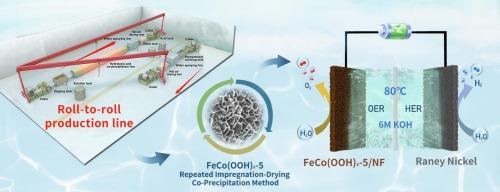
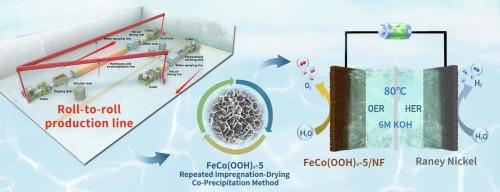
The oxygen evolution reaction (OER) plays a crucial role in hydrogen production, but its potential is limited by the lack of scalable and stable electrocatalysts for industrial applications. In this study, we developed a repeated impregnation-drying co-precipitation (RIP) method to prepare CoFe-based OER electrocatalysts. We found that the optimized FeCo(OOH)x-5/NF catalyst achieves an overpotential of 340 mV at 500 mA cm−2, significantly outperforming catalysts prepared via hydrothermal or chemical bath deposition methods. The RIP method accelerates the co-precipitation rate of metal ions and helps repair defects between the catalytic layer and the nickel foam substrate, promoting the three-dimensional growth of the catalyst layer. Notably, the entire reaction occurs in air, and the solution can be reused, ensuring the optimal utilization of all ions. Additionally, the FeCo(OOH)x-5/NF catalyst was scaled up to 6000 cm2 to assess the feasibility of roll-to-roll industrial production. In practical alkaline water electrolysis, electrolyzers equipped with FeCo(OOH)x-5&RANEY Nickel catalysts demonstrated excellent performance, achieving 500 mA cm−2 at 1.75 V in 6.0 M KOH. This work provides valuable insights into the design of efficient alkaline OER electrocatalysts, such as FeCo(OOH)x/NF, for promising industrial applications.
析氧反应(OER)在制氢中起着至关重要的作用,但由于缺乏可扩展和稳定的工业应用电催化剂,其潜力受到限制。在这项研究中,我们开发了一种重复浸渍-干燥共沉淀法(RIP)来制备cofe基OER电催化剂。我们发现,优化后的FeCo(OOH)x-5/NF催化剂在500 mA cm−2下的过电位为340 mV,明显优于水热或化学浴沉积方法制备的催化剂。RIP方法加速了金属离子的共沉淀速率,有助于修复催化层与泡沫镍衬底之间的缺陷,促进了催化剂层的三维生长。值得注意的是,整个反应发生在空气中,溶液可以重复使用,确保了所有离子的最佳利用。此外,FeCo(OOH)x-5/NF催化剂被放大到6000 cm2,以评估卷对卷工业生产的可行性。在实际的碱性电解中,配备FeCo(OOH)x-5&;RANEY镍催化剂的电解槽表现出优异的性能,在1.75 V和6.0 M KOH下达到500 mA cm−2。这项工作为高效碱性OER电催化剂的设计提供了有价值的见解,例如FeCo(OOH)x/NF,用于有前途的工业应用。
期刊介绍:
Applied Surface Science covers topics contributing to a better understanding of surfaces, interfaces, nanostructures and their applications. The journal is concerned with scientific research on the atomic and molecular level of material properties determined with specific surface analytical techniques and/or computational methods, as well as the processing of such structures.



 京公网安备 11010802042870号
京ICP备2023020795号-1
京公网安备 11010802042870号
京ICP备2023020795号-1

 分享
分享
 求助内容:
求助内容: 应助结果提醒方式:
 扫码关注我们
