Xuhai Pan , Qingwan Xie , Dali Wu , Chenggong Zhang , Xiaowei Zang , Min Hua , Juncheng Jiang
{"title":"Fast response and high contrast of monoclinic MoO3-based hydrogen gasochromic sensor","authors":"Xuhai Pan , Qingwan Xie , Dali Wu , Chenggong Zhang , Xiaowei Zang , Min Hua , Juncheng Jiang","doi":"10.1016/j.apsusc.2025.163182","DOIUrl":null,"url":null,"abstract":"<div><div>In this paper, monoclinic phase MoO<sub>3</sub>(β-MoO<sub>3</sub>) was successfully prepared by a low-cost, additive-free one-step hydrothermal synthesis method and evaluated for the first time for its performance in hydrogen gasochromic. The research results show that, under room temperature conditions, the monoclinal MoO<sub>3</sub>(β-MoO<sub>3</sub>) doped with the precious metal Pd exhibits a faster response time and higher contrast in a hydrogen gas environment., with a color change visible to the naked eye occurring in 10 s at 1 % H<sub>2</sub> concentration, from white to blue-black. Compared to Pd/α-MoO<sub>3</sub> it shows superior gas sensing performance. Through the analysis of the relationship between the material’s structure and performance, the higher density of Lewis acid sites (Mo<sup>6+</sup>) on the surface of β-MoO<sub>3</sub>, its lower bandgap energy, and the synergistic effect of its own structure result in a higher content of Mo<sup>5+</sup> formed during the color change process. Therefore, the reaction rate of β-MoO<sub>3</sub>-based materials is faster, and the color contrast after coloring is more pronounced. These findings provide an important experimental basis for applying monoclinic MoO<sub>3</sub> as a hydrogen sensing material, demonstrating its potential for future environmental monitoring and safety detection. A new perspective on the field of MoO<sub>3</sub>-based high-performance hydrogen gasochromic sensors.</div></div>","PeriodicalId":247,"journal":{"name":"Applied Surface Science","volume":"700 ","pages":"Article 163182"},"PeriodicalIF":6.9000,"publicationDate":"2025-04-05","publicationTypes":"Journal Article","fieldsOfStudy":null,"isOpenAccess":false,"openAccessPdf":"","citationCount":"0","resultStr":null,"platform":"Semanticscholar","paperid":null,"PeriodicalName":"Applied Surface Science","FirstCategoryId":"88","ListUrlMain":"https://www.sciencedirect.com/science/article/pii/S0169433225008967","RegionNum":2,"RegionCategory":"材料科学","ArticlePicture":[],"TitleCN":null,"AbstractTextCN":null,"PMCID":null,"EPubDate":"","PubModel":"","JCR":"Q2","JCRName":"CHEMISTRY, PHYSICAL","Score":null,"Total":0}
引用次数: 0
Abstract
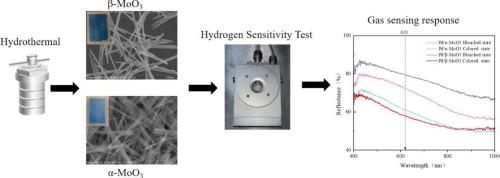
In this paper, monoclinic phase MoO3(β-MoO3) was successfully prepared by a low-cost, additive-free one-step hydrothermal synthesis method and evaluated for the first time for its performance in hydrogen gasochromic. The research results show that, under room temperature conditions, the monoclinal MoO3(β-MoO3) doped with the precious metal Pd exhibits a faster response time and higher contrast in a hydrogen gas environment., with a color change visible to the naked eye occurring in 10 s at 1 % H2 concentration, from white to blue-black. Compared to Pd/α-MoO3 it shows superior gas sensing performance. Through the analysis of the relationship between the material’s structure and performance, the higher density of Lewis acid sites (Mo6+) on the surface of β-MoO3, its lower bandgap energy, and the synergistic effect of its own structure result in a higher content of Mo5+ formed during the color change process. Therefore, the reaction rate of β-MoO3-based materials is faster, and the color contrast after coloring is more pronounced. These findings provide an important experimental basis for applying monoclinic MoO3 as a hydrogen sensing material, demonstrating its potential for future environmental monitoring and safety detection. A new perspective on the field of MoO3-based high-performance hydrogen gasochromic sensors.
期刊介绍:
Applied Surface Science covers topics contributing to a better understanding of surfaces, interfaces, nanostructures and their applications. The journal is concerned with scientific research on the atomic and molecular level of material properties determined with specific surface analytical techniques and/or computational methods, as well as the processing of such structures.




 京公网安备 11010802042870号
京ICP备2023020795号-1
京公网安备 11010802042870号
京ICP备2023020795号-1

 分享
分享
 求助内容:
求助内容: 应助结果提醒方式:
 扫码关注我们
