Yuhan Zhou, Min Zhao, Ke Bai, Xiaomin Xu, Haifeng Wang, Yong Chen, Jing Zeng, Hui Tong, Hanbing He
{"title":"Research on the construction of high-stability O3-type sodium-ion battery cathode materials via B-Co doping based on solid solutions","authors":"Yuhan Zhou, Min Zhao, Ke Bai, Xiaomin Xu, Haifeng Wang, Yong Chen, Jing Zeng, Hui Tong, Hanbing He","doi":"10.1016/j.cej.2025.161943","DOIUrl":null,"url":null,"abstract":"The O3-type Na[Ni<sub>1/3</sub>Fe<sub>1/3</sub>Mn<sub>1/3</sub>]O<sub>2</sub> cathode material for sodium-ion batteries is restricted by problems such as poor performance and low capacity retention rate during high-rate charge and discharge, making it difficult to be applied on a large scale. In this study, a B-Co co-doping strategy based on solid solution was adopted to address the issues of low capacity retention rate and slow ion diffusion rate caused by the complex phase transition of the Na[Ni<sub>1/3</sub>Fe<sub>1/3</sub>Mn<sub>1/3</sub>]O<sub>2</sub> cathode material. B-Co co-doped Na[Ni<sub>1/3</sub>Fe<sub>1/3</sub>Mn<sub>1/3</sub>]O<sub>2</sub> samples were prepared by solid-phase sintering method and investigated. The B-Co co-doped sample exhibits an initial discharge specific capacity of 105.4 mAh·g<sup>−1</sup> at a 1C rate, with a capacity retention rate as high as 92.79 % after 100 cycles. The experimental results demonstrate that the B-Co co-doping strategy based on solid solution can effectively mitigate phase transition, increase the interlayer spacing, and significantly enhance the structural stability, endowing the cathode material with high electrical conductivity, high structural stability, and high specific capacity retention rate. This research provides solid theoretical support and important references for the development of high-performance sodium-ion battery cathode materials.","PeriodicalId":270,"journal":{"name":"Chemical Engineering Journal","volume":"56 1","pages":""},"PeriodicalIF":13.2000,"publicationDate":"2025-04-06","publicationTypes":"Journal Article","fieldsOfStudy":null,"isOpenAccess":false,"openAccessPdf":"","citationCount":"0","resultStr":null,"platform":"Semanticscholar","paperid":null,"PeriodicalName":"Chemical Engineering Journal","FirstCategoryId":"5","ListUrlMain":"https://doi.org/10.1016/j.cej.2025.161943","RegionNum":1,"RegionCategory":"工程技术","ArticlePicture":[],"TitleCN":null,"AbstractTextCN":null,"PMCID":null,"EPubDate":"","PubModel":"","JCR":"Q1","JCRName":"ENGINEERING, CHEMICAL","Score":null,"Total":0}
引用次数: 0
Abstract
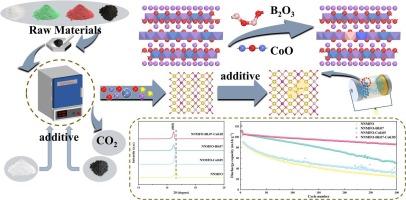
The O3-type Na[Ni1/3Fe1/3Mn1/3]O2 cathode material for sodium-ion batteries is restricted by problems such as poor performance and low capacity retention rate during high-rate charge and discharge, making it difficult to be applied on a large scale. In this study, a B-Co co-doping strategy based on solid solution was adopted to address the issues of low capacity retention rate and slow ion diffusion rate caused by the complex phase transition of the Na[Ni1/3Fe1/3Mn1/3]O2 cathode material. B-Co co-doped Na[Ni1/3Fe1/3Mn1/3]O2 samples were prepared by solid-phase sintering method and investigated. The B-Co co-doped sample exhibits an initial discharge specific capacity of 105.4 mAh·g−1 at a 1C rate, with a capacity retention rate as high as 92.79 % after 100 cycles. The experimental results demonstrate that the B-Co co-doping strategy based on solid solution can effectively mitigate phase transition, increase the interlayer spacing, and significantly enhance the structural stability, endowing the cathode material with high electrical conductivity, high structural stability, and high specific capacity retention rate. This research provides solid theoretical support and important references for the development of high-performance sodium-ion battery cathode materials.
期刊介绍:
The Chemical Engineering Journal is an international research journal that invites contributions of original and novel fundamental research. It aims to provide an international platform for presenting original fundamental research, interpretative reviews, and discussions on new developments in chemical engineering. The journal welcomes papers that describe novel theory and its practical application, as well as those that demonstrate the transfer of techniques from other disciplines. It also welcomes reports on carefully conducted experimental work that is soundly interpreted. The main focus of the journal is on original and rigorous research results that have broad significance. The Catalysis section within the Chemical Engineering Journal focuses specifically on Experimental and Theoretical studies in the fields of heterogeneous catalysis, molecular catalysis, and biocatalysis. These studies have industrial impact on various sectors such as chemicals, energy, materials, foods, healthcare, and environmental protection.



 京公网安备 11010802042870号
京ICP备2023020795号-1
京公网安备 11010802042870号
京ICP备2023020795号-1

 分享
分享
 求助内容:
求助内容: 应助结果提醒方式:
 扫码关注我们
