Muqaddas M. Mujawar , Vinod V. Patil , Vijay S. Kumbhar , Umakant M. Patil , Nilesh R. Chodankar , Amal Al Ghaferi , Masaharu Nakayama , Jae-Jin Shim
{"title":"Tailored Co3O4/MnO2 heterostructure via sequential ionic layering for high performance supercapacitor applications","authors":"Muqaddas M. Mujawar , Vinod V. Patil , Vijay S. Kumbhar , Umakant M. Patil , Nilesh R. Chodankar , Amal Al Ghaferi , Masaharu Nakayama , Jae-Jin Shim","doi":"10.1016/j.jpowsour.2025.236980","DOIUrl":null,"url":null,"abstract":"<div><div>Energy storage technology is facing the challenge of fabrication of low-cost supercapacitors with high specific energy without compromising its specific power and stability. The present work deals with the cost-effective and simple strategy towards the formation of Co<sub>3</sub>O<sub>4</sub>/MnO<sub>2</sub> core/shell electrodes to get rid of the aforementioned challenges. Herein, an easiest successive ionic layer adsorption and reaction (SILAR) method is employed to obtain hexagonal Co<sub>3</sub>O<sub>4</sub> nanoplates which then coated with the state of art MnO<sub>2</sub> nanosheets forming highly porous core/shell electrode. Due to synergistic effect between Co<sub>3</sub>O<sub>4</sub> and MnO<sub>2</sub>, the Co<sub>3</sub>O<sub>4</sub>/MnO<sub>2</sub> core/shell electrode showed an improved specific capacitance of 744 F g<sup>−1</sup> and rate capability of 45 % for 5-fold increase in the current density. Moreover, it exhibited a capacitive retention of 85.3 % after 10,000 charge-discharge cycles at 10 A g<sup>−1</sup> which can be attributed to the vertically aligned Co<sub>3</sub>O<sub>4</sub> nanoplates as backbone to the MnO<sub>2</sub> shell material. Furthermore, all-solid-state supercapacitor is fabricated between Co<sub>3</sub>O<sub>4</sub>/MnO<sub>2</sub>//reduced graphene oxide using KOH-polyvinyl alcohol polymer based gel electrolyte. It delivered a maximum specific energy and specific power of 46.57 Wh kg<sup>−1</sup> and 2794 kW kg<sup>−1</sup>, respectively. Finally, as-fabricated device performance is demonstrated through the discharge of 50 light emitting diodes (LEDs).</div></div>","PeriodicalId":377,"journal":{"name":"Journal of Power Sources","volume":"642 ","pages":"Article 236980"},"PeriodicalIF":7.9000,"publicationDate":"2025-06-30","publicationTypes":"Journal Article","fieldsOfStudy":null,"isOpenAccess":false,"openAccessPdf":"","citationCount":"0","resultStr":null,"platform":"Semanticscholar","paperid":null,"PeriodicalName":"Journal of Power Sources","FirstCategoryId":"5","ListUrlMain":"https://www.sciencedirect.com/science/article/pii/S037877532500816X","RegionNum":2,"RegionCategory":"工程技术","ArticlePicture":[],"TitleCN":null,"AbstractTextCN":null,"PMCID":null,"EPubDate":"2025/4/7 0:00:00","PubModel":"Epub","JCR":"Q1","JCRName":"CHEMISTRY, PHYSICAL","Score":null,"Total":0}
引用次数: 0
Abstract
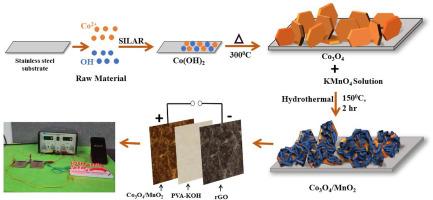
Energy storage technology is facing the challenge of fabrication of low-cost supercapacitors with high specific energy without compromising its specific power and stability. The present work deals with the cost-effective and simple strategy towards the formation of Co3O4/MnO2 core/shell electrodes to get rid of the aforementioned challenges. Herein, an easiest successive ionic layer adsorption and reaction (SILAR) method is employed to obtain hexagonal Co3O4 nanoplates which then coated with the state of art MnO2 nanosheets forming highly porous core/shell electrode. Due to synergistic effect between Co3O4 and MnO2, the Co3O4/MnO2 core/shell electrode showed an improved specific capacitance of 744 F g−1 and rate capability of 45 % for 5-fold increase in the current density. Moreover, it exhibited a capacitive retention of 85.3 % after 10,000 charge-discharge cycles at 10 A g−1 which can be attributed to the vertically aligned Co3O4 nanoplates as backbone to the MnO2 shell material. Furthermore, all-solid-state supercapacitor is fabricated between Co3O4/MnO2//reduced graphene oxide using KOH-polyvinyl alcohol polymer based gel electrolyte. It delivered a maximum specific energy and specific power of 46.57 Wh kg−1 and 2794 kW kg−1, respectively. Finally, as-fabricated device performance is demonstrated through the discharge of 50 light emitting diodes (LEDs).
如何在不影响比功率和稳定性的前提下,制造低成本、高比能量的超级电容器,是储能技术面临的挑战。目前的工作涉及成本效益和简单的策略,以形成Co3O4/MnO2芯/壳电极,以摆脱上述挑战。本文采用最简单的连续离子层吸附和反应(SILAR)方法获得六方Co3O4纳米板,然后在其表面涂覆二氧化锰纳米片,形成高多孔的核/壳电极。由于Co3O4和MnO2之间的协同作用,Co3O4/MnO2芯壳电极的比电容提高了744 F g−1,电流密度提高了5倍,倍率容量提高了45%。此外,在10 a g−1的条件下,经过10,000次充放电循环后,它的电容保留率为85.3%,这可以归因于垂直排列的Co3O4纳米板作为MnO2壳材料的骨架。在此基础上,利用koh -聚乙烯醇聚合物凝胶电解质制备了Co3O4/MnO2/还原氧化石墨烯之间的全固态超级电容器。最大比能量和比功率分别为46.57 Wh kg−1和2794 kW kg−1。最后,通过50个发光二极管(led)的放电验证了器件的性能。
期刊介绍:
The Journal of Power Sources is a publication catering to researchers and technologists interested in various aspects of the science, technology, and applications of electrochemical power sources. It covers original research and reviews on primary and secondary batteries, fuel cells, supercapacitors, and photo-electrochemical cells.
Topics considered include the research, development and applications of nanomaterials and novel componentry for these devices. Examples of applications of these electrochemical power sources include:
• Portable electronics
• Electric and Hybrid Electric Vehicles
• Uninterruptible Power Supply (UPS) systems
• Storage of renewable energy
• Satellites and deep space probes
• Boats and ships, drones and aircrafts
• Wearable energy storage systems




 京公网安备 11010802042870号
京ICP备2023020795号-1
京公网安备 11010802042870号
京ICP备2023020795号-1

 分享
分享
 求助内容:
求助内容: 应助结果提醒方式:
 扫码关注我们
