C.O.W. Trost , S. Žák , S. Schaffer , L. Walch , J. Zitz , T. Klünsner , H. Leitner , L. Exl , M.J. Cordill
{"title":"Explainable machine learning and feature engineering applied to nanoindentation data","authors":"C.O.W. Trost , S. Žák , S. Schaffer , L. Walch , J. Zitz , T. Klünsner , H. Leitner , L. Exl , M.J. Cordill","doi":"10.1016/j.matdes.2025.113897","DOIUrl":null,"url":null,"abstract":"<div><div>The work aims to challenge the hegemony in the literature of clustering nanoindentation data solely relying on elastic modulus and hardness as features, thereby discarding information provided by the full load–displacement curve. Features based on dimensional analysis initially aimed to solve the inverse nanoindentation problem were adopted to describe the load–displacement curves. More than 3000 indents in high-speed steels were labelled via imaging after indenting. The resulting dataset was used to train and benchmark supervised (classification) and unsupervised (clustering) machine learning models, showing that feature engineering was more impactful than model selection and hyperparameter tuning, increasing the prediction quality in all studied models. The best classifier’s predictions were explained via a game theory-based approach, allowing insights into the model’s decision-making process and connecting the fields of materials property clustering and materials mechanics.</div></div>","PeriodicalId":383,"journal":{"name":"Materials & Design","volume":"253 ","pages":"Article 113897"},"PeriodicalIF":7.9000,"publicationDate":"2025-05-01","publicationTypes":"Journal Article","fieldsOfStudy":null,"isOpenAccess":false,"openAccessPdf":"","citationCount":"0","resultStr":null,"platform":"Semanticscholar","paperid":null,"PeriodicalName":"Materials & Design","FirstCategoryId":"88","ListUrlMain":"https://www.sciencedirect.com/science/article/pii/S026412752500317X","RegionNum":2,"RegionCategory":"材料科学","ArticlePicture":[],"TitleCN":null,"AbstractTextCN":null,"PMCID":null,"EPubDate":"2025/3/29 0:00:00","PubModel":"Epub","JCR":"Q1","JCRName":"MATERIALS SCIENCE, MULTIDISCIPLINARY","Score":null,"Total":0}
引用次数: 0
Abstract
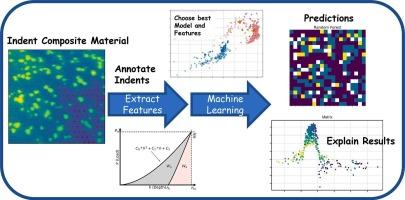
The work aims to challenge the hegemony in the literature of clustering nanoindentation data solely relying on elastic modulus and hardness as features, thereby discarding information provided by the full load–displacement curve. Features based on dimensional analysis initially aimed to solve the inverse nanoindentation problem were adopted to describe the load–displacement curves. More than 3000 indents in high-speed steels were labelled via imaging after indenting. The resulting dataset was used to train and benchmark supervised (classification) and unsupervised (clustering) machine learning models, showing that feature engineering was more impactful than model selection and hyperparameter tuning, increasing the prediction quality in all studied models. The best classifier’s predictions were explained via a game theory-based approach, allowing insights into the model’s decision-making process and connecting the fields of materials property clustering and materials mechanics.
期刊介绍:
Materials and Design is a multi-disciplinary journal that publishes original research reports, review articles, and express communications. The journal focuses on studying the structure and properties of inorganic and organic materials, advancements in synthesis, processing, characterization, and testing, the design of materials and engineering systems, and their applications in technology. It aims to bring together various aspects of materials science, engineering, physics, and chemistry.
The journal explores themes ranging from materials to design and aims to reveal the connections between natural and artificial materials, as well as experiment and modeling. Manuscripts submitted to Materials and Design should contain elements of discovery and surprise, as they often contribute new insights into the architecture and function of matter.



 京公网安备 11010802042870号
京ICP备2023020795号-1
京公网安备 11010802042870号
京ICP备2023020795号-1

 分享
分享
 求助内容:
求助内容: 应助结果提醒方式:
 扫码关注我们
