A novel architectured BiCe metal organic framework-integrated MoS2 nanosheet: An intriguing strategy for deriving synergistic effects in high-performance symmetric supercapacitors
{"title":"A novel architectured BiCe metal organic framework-integrated MoS2 nanosheet: An intriguing strategy for deriving synergistic effects in high-performance symmetric supercapacitors","authors":"Sugasri Chinnasamy, Jayachandran Madhavan, Pavithra Karthikesan, Alagiri Mani","doi":"10.1016/j.jpowsour.2025.236924","DOIUrl":null,"url":null,"abstract":"<div><div>Metal-organic framework (MOF) based supercapacitors have attracted enormous attention nowadays due to their unique physiochemical properties. In this study, we are addressing the synergistic effect of MoS<sub>2</sub> when intercalated with redox-active bimetallic MOF-2 to enhance the efficiency of the electrode material. Herein, bimetal MOF incorporating bismuth and cerium has been synthesized and MoS<sub>2</sub> is introduced to increase the electron transport potentially. All the samples underwent experimental characterization techniques to procure their crystal structure, morphology, surface area, and electrochemical properties. Electrochemical measurement demonstrates that the MOF-2@MoS<sub>2</sub> electrode presents a significant specific capacitance of 510 F g<sup>−1</sup> at a current density of 1 A g<sup>−1</sup> corresponding to a capacity of 255 C g<sup>−1</sup>, while its initial capacitance remains at over 94 % even after 4500 cycles, with outstanding cycling stability. The MOF-2 rod-like structure is uniformly distributed on the surface and within the pores of the MoS<sub>2</sub> nanosheet, maintaining structural integrity throughout repeated cycles. Subsequently, a symmetric supercapacitor has been constructed using MOF-2@MoS<sub>2</sub> electrodes which delivers an energy density of 20.12 Wh kg<sup>−1</sup> at a power density of 799.47 W kg<sup>−1</sup>, with excellent cycling stability of 92 % over 4500 cycles at 10 A g<sup>−1</sup>. These findings suggest intercalating 2D material with bimetal MOF shows great promise for further practical application.</div></div>","PeriodicalId":377,"journal":{"name":"Journal of Power Sources","volume":"642 ","pages":""},"PeriodicalIF":7.9000,"publicationDate":"2025-06-30","publicationTypes":"Journal Article","fieldsOfStudy":null,"isOpenAccess":false,"openAccessPdf":"","citationCount":"0","resultStr":null,"platform":"Semanticscholar","paperid":null,"PeriodicalName":"Journal of Power Sources","FirstCategoryId":"5","ListUrlMain":"https://www.sciencedirect.com/science/article/pii/S0378775325007608","RegionNum":2,"RegionCategory":"工程技术","ArticlePicture":[],"TitleCN":null,"AbstractTextCN":null,"PMCID":null,"EPubDate":"2025/4/7 0:00:00","PubModel":"Epub","JCR":"Q1","JCRName":"CHEMISTRY, PHYSICAL","Score":null,"Total":0}
引用次数: 0
Abstract
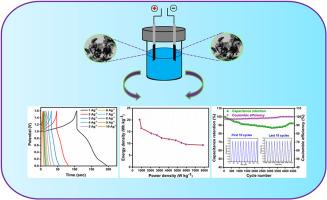
Metal-organic framework (MOF) based supercapacitors have attracted enormous attention nowadays due to their unique physiochemical properties. In this study, we are addressing the synergistic effect of MoS2 when intercalated with redox-active bimetallic MOF-2 to enhance the efficiency of the electrode material. Herein, bimetal MOF incorporating bismuth and cerium has been synthesized and MoS2 is introduced to increase the electron transport potentially. All the samples underwent experimental characterization techniques to procure their crystal structure, morphology, surface area, and electrochemical properties. Electrochemical measurement demonstrates that the MOF-2@MoS2 electrode presents a significant specific capacitance of 510 F g−1 at a current density of 1 A g−1 corresponding to a capacity of 255 C g−1, while its initial capacitance remains at over 94 % even after 4500 cycles, with outstanding cycling stability. The MOF-2 rod-like structure is uniformly distributed on the surface and within the pores of the MoS2 nanosheet, maintaining structural integrity throughout repeated cycles. Subsequently, a symmetric supercapacitor has been constructed using MOF-2@MoS2 electrodes which delivers an energy density of 20.12 Wh kg−1 at a power density of 799.47 W kg−1, with excellent cycling stability of 92 % over 4500 cycles at 10 A g−1. These findings suggest intercalating 2D material with bimetal MOF shows great promise for further practical application.
基于金属有机框架(MOF)的超级电容器以其独特的物理化学性质引起了人们的广泛关注。在这项研究中,我们正在研究在氧化还原活性双金属MOF-2中插入MoS2的协同效应,以提高电极材料的效率。本文合成了含有铋和铈的双金属MOF,并引入了MoS2来潜在地增加电子传递。所有样品都进行了实验表征技术,以获得它们的晶体结构、形貌、表面积和电化学性能。电化学测量表明,MOF-2@MoS2电极在电流密度为1 a g−1时,具有510 F g−1的显著比电容,对应于255 C g−1的容量,而在循环4500次后,其初始电容仍保持在94%以上,具有出色的循环稳定性。二硫化钼棒状结构均匀分布在二硫化钼纳米片的表面和孔隙内,在重复循环中保持结构完整性。随后,使用MOF-2@MoS2电极构建了一个对称超级电容器,其能量密度为20.12 Wh kg - 1,功率密度为799.47 W kg - 1,在10 a g - 1下循环4500次,循环稳定性为92%。这些发现表明,用双金属MOF嵌入二维材料具有进一步的实际应用前景。
期刊介绍:
The Journal of Power Sources is a publication catering to researchers and technologists interested in various aspects of the science, technology, and applications of electrochemical power sources. It covers original research and reviews on primary and secondary batteries, fuel cells, supercapacitors, and photo-electrochemical cells.
Topics considered include the research, development and applications of nanomaterials and novel componentry for these devices. Examples of applications of these electrochemical power sources include:
• Portable electronics
• Electric and Hybrid Electric Vehicles
• Uninterruptible Power Supply (UPS) systems
• Storage of renewable energy
• Satellites and deep space probes
• Boats and ships, drones and aircrafts
• Wearable energy storage systems




 京公网安备 11010802042870号
京ICP备2023020795号-1
京公网安备 11010802042870号
京ICP备2023020795号-1

 分享
分享
 求助内容:
求助内容: 应助结果提醒方式:
 扫码关注我们
