{"title":"High entropy oxides (CuCoMnMgZn)O microspheres as counter electrodes for quantum dot sensitized solar cells","authors":"Limin Zhang, Tingting Zhang, Donghui Cui, Chunxue Wang, Huiyang Yu, Fengyan Li","doi":"10.1016/j.jpowsour.2025.236946","DOIUrl":null,"url":null,"abstract":"<div><div>In quantum dot sensitized solar cells (QDSSCs), the counter electrode serves as an essential component by collecting electrons from the external circuit and catalyzing the electrolyte. In this work, four spinel-type high-entropy oxides are synthesized using a solvothermal method and are being applied with CdTe/Mn-CdS/CdSe/ZnS photoanodes for QDSSCs to explore counter electrode materials with better performance by adjusting the elements in the high-entropy oxides. The exploration reveals that the surface of (CuCoMnMgZn)O appears rough, with pores and a large specific surface area (125.61 m<sup>2</sup>/g), supplying substantial active sites to promote electron transfer and facilitate electrolyte access. The counter electrode photovoltaic conversion efficiency (PCE) of QDSSCs composed using this material is 8.33 %, which is significantly higher than that of other high entropy oxides (6.5–7.5 %). Other photovoltaic performances are demonstrated as J<sub>sc</sub> = 26.25 mA· cm<sup>−2</sup>, V<sub>oc</sub> = 0.646 V, and FF = 0.49. Electrochemical impedance spectroscopy (EIS) and continuous cyclic voltammetry curves confirm the lowest charge transfer resistance (R<sub>ct</sub> = 0.191 Ω) and good stability in the S<sup>2−</sup>/S<sub>n</sub><sup>2−</sup> reduction reaction. Both the higher catalytic activity and stability further indicate that the high-entropy oxide could be a prospective material for QDSSCs counter electrodes.</div></div>","PeriodicalId":377,"journal":{"name":"Journal of Power Sources","volume":"642 ","pages":""},"PeriodicalIF":7.9000,"publicationDate":"2025-04-07","publicationTypes":"Journal Article","fieldsOfStudy":null,"isOpenAccess":false,"openAccessPdf":"","citationCount":"0","resultStr":null,"platform":"Semanticscholar","paperid":null,"PeriodicalName":"Journal of Power Sources","FirstCategoryId":"5","ListUrlMain":"https://www.sciencedirect.com/science/article/pii/S0378775325007827","RegionNum":2,"RegionCategory":"工程技术","ArticlePicture":[],"TitleCN":null,"AbstractTextCN":null,"PMCID":null,"EPubDate":"","PubModel":"","JCR":"Q1","JCRName":"CHEMISTRY, PHYSICAL","Score":null,"Total":0}
引用次数: 0
Abstract
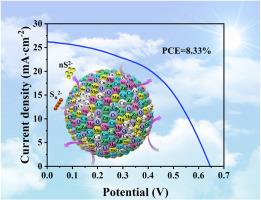
In quantum dot sensitized solar cells (QDSSCs), the counter electrode serves as an essential component by collecting electrons from the external circuit and catalyzing the electrolyte. In this work, four spinel-type high-entropy oxides are synthesized using a solvothermal method and are being applied with CdTe/Mn-CdS/CdSe/ZnS photoanodes for QDSSCs to explore counter electrode materials with better performance by adjusting the elements in the high-entropy oxides. The exploration reveals that the surface of (CuCoMnMgZn)O appears rough, with pores and a large specific surface area (125.61 m2/g), supplying substantial active sites to promote electron transfer and facilitate electrolyte access. The counter electrode photovoltaic conversion efficiency (PCE) of QDSSCs composed using this material is 8.33 %, which is significantly higher than that of other high entropy oxides (6.5–7.5 %). Other photovoltaic performances are demonstrated as Jsc = 26.25 mA· cm−2, Voc = 0.646 V, and FF = 0.49. Electrochemical impedance spectroscopy (EIS) and continuous cyclic voltammetry curves confirm the lowest charge transfer resistance (Rct = 0.191 Ω) and good stability in the S2−/Sn2− reduction reaction. Both the higher catalytic activity and stability further indicate that the high-entropy oxide could be a prospective material for QDSSCs counter electrodes.
期刊介绍:
The Journal of Power Sources is a publication catering to researchers and technologists interested in various aspects of the science, technology, and applications of electrochemical power sources. It covers original research and reviews on primary and secondary batteries, fuel cells, supercapacitors, and photo-electrochemical cells.
Topics considered include the research, development and applications of nanomaterials and novel componentry for these devices. Examples of applications of these electrochemical power sources include:
• Portable electronics
• Electric and Hybrid Electric Vehicles
• Uninterruptible Power Supply (UPS) systems
• Storage of renewable energy
• Satellites and deep space probes
• Boats and ships, drones and aircrafts
• Wearable energy storage systems




 京公网安备 11010802042870号
京ICP备2023020795号-1
京公网安备 11010802042870号
京ICP备2023020795号-1

 分享
分享
 求助内容:
求助内容: 应助结果提醒方式:
 扫码关注我们
