{"title":"Upcycling strategy of spent LiCoO2: Toward enhanced high-voltage stability based on Al doping","authors":"Hongbin Lin , Guiying Zhao , Xiumei Kang , Weijian Zhang , Yue Chen , Guigui Xu , Kehua Zhong , Jian-Min Zhang , Zhigao Huang","doi":"10.1016/j.jpowsour.2025.236950","DOIUrl":null,"url":null,"abstract":"<div><div>Direct regeneration of spent LiCoO<sub>2</sub> in recycling field is regarded as a promising strategy to reduce production costs and alleviate the burden of metal pollution. Targeting the extensively studied high-voltage LiCoO<sub>2</sub> electrode, the simultaneous achievement of restoring the spent LiCoO<sub>2</sub> and upgrading the high-voltage stability of regenerated LiCoO<sub>2</sub> poses a considerable challenge. Herein, based on a first-principles-informed thermodynamic study, a modulation strategy has been proposed by introducing Al doping during direct regeneration to enhance the high-voltage performance of regenerated LiCoO<sub>2</sub>. The calculated results reveal that, due to the sufficient Li vacancies in the spent LiCoO<sub>2</sub>, Al atoms can preferentially occupy the Li vacancies (denoted as Al<sub>V(Li)</sub>) rather than Co sites (denoted as Al<sub>Co</sub>) by synergistically regulating Co chemical potential and temperature. Inspiringly, the surface stability of regenerated LiCoO<sub>2</sub> with Al<sub>V(Li)</sub> doping is significantly enhanced at high voltages. Furthermore, although both Al<sub>V(Li)</sub> and Al<sub>Co</sub> doping improve the electronic conductivity of regenerated LiCoO<sub>2</sub>, only the Al<sub>V(Li)</sub> doping exhibits an improvement of the Li<sup>+</sup> diffusion kinetics. This innovative strategy provides a novel perspective for the efficient and high-quality recycling of the spent LiCoO<sub>2</sub> in industrial applications.</div></div>","PeriodicalId":377,"journal":{"name":"Journal of Power Sources","volume":"642 ","pages":"Article 236950"},"PeriodicalIF":7.9000,"publicationDate":"2025-06-30","publicationTypes":"Journal Article","fieldsOfStudy":null,"isOpenAccess":false,"openAccessPdf":"","citationCount":"0","resultStr":null,"platform":"Semanticscholar","paperid":null,"PeriodicalName":"Journal of Power Sources","FirstCategoryId":"5","ListUrlMain":"https://www.sciencedirect.com/science/article/pii/S0378775325007864","RegionNum":2,"RegionCategory":"工程技术","ArticlePicture":[],"TitleCN":null,"AbstractTextCN":null,"PMCID":null,"EPubDate":"2025/4/7 0:00:00","PubModel":"Epub","JCR":"Q1","JCRName":"CHEMISTRY, PHYSICAL","Score":null,"Total":0}
引用次数: 0
Abstract
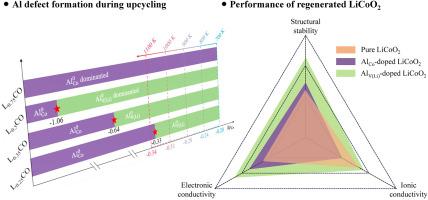
Direct regeneration of spent LiCoO2 in recycling field is regarded as a promising strategy to reduce production costs and alleviate the burden of metal pollution. Targeting the extensively studied high-voltage LiCoO2 electrode, the simultaneous achievement of restoring the spent LiCoO2 and upgrading the high-voltage stability of regenerated LiCoO2 poses a considerable challenge. Herein, based on a first-principles-informed thermodynamic study, a modulation strategy has been proposed by introducing Al doping during direct regeneration to enhance the high-voltage performance of regenerated LiCoO2. The calculated results reveal that, due to the sufficient Li vacancies in the spent LiCoO2, Al atoms can preferentially occupy the Li vacancies (denoted as AlV(Li)) rather than Co sites (denoted as AlCo) by synergistically regulating Co chemical potential and temperature. Inspiringly, the surface stability of regenerated LiCoO2 with AlV(Li) doping is significantly enhanced at high voltages. Furthermore, although both AlV(Li) and AlCo doping improve the electronic conductivity of regenerated LiCoO2, only the AlV(Li) doping exhibits an improvement of the Li+ diffusion kinetics. This innovative strategy provides a novel perspective for the efficient and high-quality recycling of the spent LiCoO2 in industrial applications.
期刊介绍:
The Journal of Power Sources is a publication catering to researchers and technologists interested in various aspects of the science, technology, and applications of electrochemical power sources. It covers original research and reviews on primary and secondary batteries, fuel cells, supercapacitors, and photo-electrochemical cells.
Topics considered include the research, development and applications of nanomaterials and novel componentry for these devices. Examples of applications of these electrochemical power sources include:
• Portable electronics
• Electric and Hybrid Electric Vehicles
• Uninterruptible Power Supply (UPS) systems
• Storage of renewable energy
• Satellites and deep space probes
• Boats and ships, drones and aircrafts
• Wearable energy storage systems



 京公网安备 11010802042870号
京ICP备2023020795号-1
京公网安备 11010802042870号
京ICP备2023020795号-1

 分享
分享
 求助内容:
求助内容: 应助结果提醒方式:
 扫码关注我们
