Kamran Tanwari , Paweł Terefenko , Xiaohao Shi , Jakub Śledziowski , Andrzej Giza
{"title":"Coastal zones vulnerability evaluation in the southern Baltic Sea: Shoreline dynamics and land use/land cover changes over five decades","authors":"Kamran Tanwari , Paweł Terefenko , Xiaohao Shi , Jakub Śledziowski , Andrzej Giza","doi":"10.1016/j.scitotenv.2025.179345","DOIUrl":null,"url":null,"abstract":"<div><div>Over the past century, coastal zones have experienced significant population growth and rapid development, often conflicting with these environments' dynamic and sensitive nature. The present study investigated five decades (1972–2023) of shoreline dynamics and land-use/land-cover (LULC) transformations along three study sectors located on a 47 km stretch of the Southern Baltic coastline. The research employed eleven multispectral Landsat MSS/TM/OLI images within a geographic information system (GIS) framework to analyze coastline variations and LULC patterns. Results showed significant accretion in Sector I (Usedom), while Sectors II and III (Wolin) experienced marked erosion. Over the entire study period, 29.59 % (3.21 km), 39.90 % (4.51 km), and 67.54 % (9.45 km) of the shorelines in Sector-I, Sector-II, and Sector-III experienced erosion. The distance correlation showed that hydrometeorological variables associated with wind-wave dynamics, exerted a stronger influence on shoreline changes. The LULC change analysis highlighted a decline in forest cover (−846.86 ha) and increased built-up areas (+1137.86) across all sectors. These results enabled the identification of four coastal vulnerability zones—one in Usedom and three in Wolin—characterized by pronounced erosion, forest degradation, and urban expansion. These findings can inform coastal management strategies by identifying high-risk zones, guiding sustainable development practices, and prioritizing areas for conservation and intervention.</div></div>","PeriodicalId":422,"journal":{"name":"Science of the Total Environment","volume":"976 ","pages":"Article 179345"},"PeriodicalIF":8.0000,"publicationDate":"2025-04-07","publicationTypes":"Journal Article","fieldsOfStudy":null,"isOpenAccess":false,"openAccessPdf":"","citationCount":"0","resultStr":null,"platform":"Semanticscholar","paperid":null,"PeriodicalName":"Science of the Total Environment","FirstCategoryId":"93","ListUrlMain":"https://www.sciencedirect.com/science/article/pii/S0048969725009817","RegionNum":1,"RegionCategory":"环境科学与生态学","ArticlePicture":[],"TitleCN":null,"AbstractTextCN":null,"PMCID":null,"EPubDate":"","PubModel":"","JCR":"Q1","JCRName":"ENVIRONMENTAL SCIENCES","Score":null,"Total":0}
引用次数: 0
Abstract
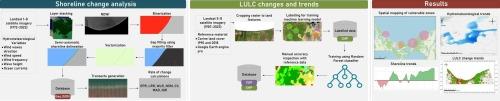
Over the past century, coastal zones have experienced significant population growth and rapid development, often conflicting with these environments' dynamic and sensitive nature. The present study investigated five decades (1972–2023) of shoreline dynamics and land-use/land-cover (LULC) transformations along three study sectors located on a 47 km stretch of the Southern Baltic coastline. The research employed eleven multispectral Landsat MSS/TM/OLI images within a geographic information system (GIS) framework to analyze coastline variations and LULC patterns. Results showed significant accretion in Sector I (Usedom), while Sectors II and III (Wolin) experienced marked erosion. Over the entire study period, 29.59 % (3.21 km), 39.90 % (4.51 km), and 67.54 % (9.45 km) of the shorelines in Sector-I, Sector-II, and Sector-III experienced erosion. The distance correlation showed that hydrometeorological variables associated with wind-wave dynamics, exerted a stronger influence on shoreline changes. The LULC change analysis highlighted a decline in forest cover (−846.86 ha) and increased built-up areas (+1137.86) across all sectors. These results enabled the identification of four coastal vulnerability zones—one in Usedom and three in Wolin—characterized by pronounced erosion, forest degradation, and urban expansion. These findings can inform coastal management strategies by identifying high-risk zones, guiding sustainable development practices, and prioritizing areas for conservation and intervention.
期刊介绍:
The Science of the Total Environment is an international journal dedicated to scientific research on the environment and its interaction with humanity. It covers a wide range of disciplines and seeks to publish innovative, hypothesis-driven, and impactful research that explores the entire environment, including the atmosphere, lithosphere, hydrosphere, biosphere, and anthroposphere.
The journal's updated Aims & Scope emphasizes the importance of interdisciplinary environmental research with broad impact. Priority is given to studies that advance fundamental understanding and explore the interconnectedness of multiple environmental spheres. Field studies are preferred, while laboratory experiments must demonstrate significant methodological advancements or mechanistic insights with direct relevance to the environment.



 京公网安备 11010802042870号
京ICP备2023020795号-1
京公网安备 11010802042870号
京ICP备2023020795号-1

 分享
分享
 求助内容:
求助内容: 应助结果提醒方式:
 扫码关注我们
