Dipti Kamath , Xingang Zhao , Kristina O. Armstrong , Paula Bran Anleu , Hongbin Sun , Rocio Uria Martinez , M. Parans Paranthaman
{"title":"Towards low-carbon low-energy concrete alternatives: Life cycle assessment of carbonated cementitious material-based precast panels","authors":"Dipti Kamath , Xingang Zhao , Kristina O. Armstrong , Paula Bran Anleu , Hongbin Sun , Rocio Uria Martinez , M. Parans Paranthaman","doi":"10.1016/j.scitotenv.2025.179279","DOIUrl":null,"url":null,"abstract":"<div><div>Cement is responsible for 22 % of all global CO<sub>2</sub> emissions from industrial processes. Technological innovation for developing and deploying of alternative materials will be required to decarbonize the cement industry. Carbonated cementitious materials (CCMs) are building materials that rely on carbon mineralization for their strength. A process-based cradle-to-gate life cycle assessment (LCA) was conducted to evaluate the global warming potential (GWP), cumulative energy demand, and water consumption of a lab-scale CCM-based precast panel compared to a conventional precast concrete panel. Since the CCM process is currently a lab-scale early-stage process, the CCM panel showed higher environmental impacts compared to the conventional panel. However, scenario analyses include mature production process scenarios. A sensitivity analysis revealed that the GWP of CCM can be lowered to below that of the conventional panel using polymers, fillers, low-carbon electricity sources, and optimized carbonation parameters.</div></div><div><h3>Extended abstract</h3><div>Concrete is the second-most consumed product by weight worldwide and a significant contributor to global CO<sub>2</sub> emissions. Cement, the critical component of concrete, is responsible for 22 % of all global CO<sub>2</sub> emissions from industrial processes. Technological innovation for developing and deploying of alternative materials will be required to decarbonize the cement industry. Carbonated cementitious materials (CCMs) are building materials that rely on carbon mineralization for their strength. As with the development of any new technology, evaluating the environmental impacts of CCM throughout its development process is imperative to identify hotspots and ensure no unintended consequences. A process-based cradle-to-gate life cycle assessment (LCA) was conducted to evaluate the global warming potential (GWP), cumulative energy demand, and water consumption of a lab-scale CCM-based precast panel compared to a conventional precast concrete panel. Since the CCM process is currently a lab-scale early-stage process, the CCM panel showed higher environmental impacts compared to the conventional panel. The CCM panel is currently produced by curing in a lab-scale carbonation chamber for weeks, which results in high electricity consumption. However, as the production process matures, changes to the LCA results will be expected and have been incorporated into this study by scenario analysis. Multiple scenarios were considered, including reduction of electricity consumption during carbonation, change in polymer type, addition of filler materials like sand, use of renewable electricity sources, and integration of lime calcination with carbon capture and reuse for carbonation. This last scenario offers promising potential to promote circular economy practices and move towards greater sustainability. A sensitivity analysis revealed that the GWP of CCM can be lowered to below that of the conventional panel using polymers, fillers, low-carbon electricity sources, and optimized carbonation parameters.</div></div>","PeriodicalId":422,"journal":{"name":"Science of the Total Environment","volume":"976 ","pages":"Article 179279"},"PeriodicalIF":8.0000,"publicationDate":"2025-04-07","publicationTypes":"Journal Article","fieldsOfStudy":null,"isOpenAccess":false,"openAccessPdf":"","citationCount":"0","resultStr":null,"platform":"Semanticscholar","paperid":null,"PeriodicalName":"Science of the Total Environment","FirstCategoryId":"93","ListUrlMain":"https://www.sciencedirect.com/science/article/pii/S0048969725009155","RegionNum":1,"RegionCategory":"环境科学与生态学","ArticlePicture":[],"TitleCN":null,"AbstractTextCN":null,"PMCID":null,"EPubDate":"","PubModel":"","JCR":"Q1","JCRName":"ENVIRONMENTAL SCIENCES","Score":null,"Total":0}
引用次数: 0
Abstract
Cement is responsible for 22 % of all global CO2 emissions from industrial processes. Technological innovation for developing and deploying of alternative materials will be required to decarbonize the cement industry. Carbonated cementitious materials (CCMs) are building materials that rely on carbon mineralization for their strength. A process-based cradle-to-gate life cycle assessment (LCA) was conducted to evaluate the global warming potential (GWP), cumulative energy demand, and water consumption of a lab-scale CCM-based precast panel compared to a conventional precast concrete panel. Since the CCM process is currently a lab-scale early-stage process, the CCM panel showed higher environmental impacts compared to the conventional panel. However, scenario analyses include mature production process scenarios. A sensitivity analysis revealed that the GWP of CCM can be lowered to below that of the conventional panel using polymers, fillers, low-carbon electricity sources, and optimized carbonation parameters.
Extended abstract
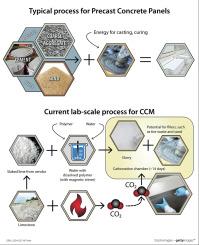
Concrete is the second-most consumed product by weight worldwide and a significant contributor to global CO2 emissions. Cement, the critical component of concrete, is responsible for 22 % of all global CO2 emissions from industrial processes. Technological innovation for developing and deploying of alternative materials will be required to decarbonize the cement industry. Carbonated cementitious materials (CCMs) are building materials that rely on carbon mineralization for their strength. As with the development of any new technology, evaluating the environmental impacts of CCM throughout its development process is imperative to identify hotspots and ensure no unintended consequences. A process-based cradle-to-gate life cycle assessment (LCA) was conducted to evaluate the global warming potential (GWP), cumulative energy demand, and water consumption of a lab-scale CCM-based precast panel compared to a conventional precast concrete panel. Since the CCM process is currently a lab-scale early-stage process, the CCM panel showed higher environmental impacts compared to the conventional panel. The CCM panel is currently produced by curing in a lab-scale carbonation chamber for weeks, which results in high electricity consumption. However, as the production process matures, changes to the LCA results will be expected and have been incorporated into this study by scenario analysis. Multiple scenarios were considered, including reduction of electricity consumption during carbonation, change in polymer type, addition of filler materials like sand, use of renewable electricity sources, and integration of lime calcination with carbon capture and reuse for carbonation. This last scenario offers promising potential to promote circular economy practices and move towards greater sustainability. A sensitivity analysis revealed that the GWP of CCM can be lowered to below that of the conventional panel using polymers, fillers, low-carbon electricity sources, and optimized carbonation parameters.
期刊介绍:
The Science of the Total Environment is an international journal dedicated to scientific research on the environment and its interaction with humanity. It covers a wide range of disciplines and seeks to publish innovative, hypothesis-driven, and impactful research that explores the entire environment, including the atmosphere, lithosphere, hydrosphere, biosphere, and anthroposphere.
The journal's updated Aims & Scope emphasizes the importance of interdisciplinary environmental research with broad impact. Priority is given to studies that advance fundamental understanding and explore the interconnectedness of multiple environmental spheres. Field studies are preferred, while laboratory experiments must demonstrate significant methodological advancements or mechanistic insights with direct relevance to the environment.



 京公网安备 11010802042870号
京ICP备2023020795号-1
京公网安备 11010802042870号
京ICP备2023020795号-1

 分享
分享
 求助内容:
求助内容: 应助结果提醒方式:
 扫码关注我们
