Spatial and seasonal variability of the contribution of sources to PM2.5, PM10 and their oxidative potential in different sites in a central Mediterranean area
Serena Potì , Eva Merico , Marianna Conte , Florin Unga , Daniela Cesari , Adelaide Dinoi , Anna Rita De Bartolomeo , Antonio Pennetta , Ermelinda Bloise , Giuseppe Deluca , Giuseppe Egidio De Benedetto , Roberto Ferrera , Enrico Bompadre , Maria Rachele Guascito , Daniele Contini
{"title":"Spatial and seasonal variability of the contribution of sources to PM2.5, PM10 and their oxidative potential in different sites in a central Mediterranean area","authors":"Serena Potì , Eva Merico , Marianna Conte , Florin Unga , Daniela Cesari , Adelaide Dinoi , Anna Rita De Bartolomeo , Antonio Pennetta , Ermelinda Bloise , Giuseppe Deluca , Giuseppe Egidio De Benedetto , Roberto Ferrera , Enrico Bompadre , Maria Rachele Guascito , Daniele Contini","doi":"10.1016/j.scitotenv.2025.179283","DOIUrl":null,"url":null,"abstract":"<div><div>Oxidative potential (OP) is a potential indicator of negative health effects of particulate matter (PM). To address mitigation strategies, there is need of understanding how natural and anthropogenic sources influence OP at different sites. This work investigates spatial and seasonal variabilities of PM<sub>2.5</sub> and PM<sub>10</sub> concentrations, composition, and oxidative potential (OP<sup>DTT</sup><sub>V</sub>, obtained with DTT assay), simultaneously at 22 sites in a central Mediterranean area in south Italy. Source apportionment using PMF5 allowed to evaluate the contributions of eight sources: traffic, biomass burning (BB), nitrate, sulphate-rich, marine, crustal, carbonates/construction, and industrial (only for PM<sub>2.5</sub>). Nitrate, traffic, and BB had larger contributions during the cold season and presented spatial variability with exclusion of nitrate. Industrial contributions did not have relevant seasonal or spatial variability. The other sources had an opposite trend with larger values during the warm season but only sulphate-rich had non-negligible spatial variability. OP<sup>DTT</sup><sub>V</sub> had relevant spatial variability only during the cold season. Four sources had statistically significant contributions to OP<sup>DTT</sup><sub>V</sub>: traffic, BB, sulphate-rich, and crustal (in descending order). The use of soluble and insoluble fractions of OC and Ca in PMF5 allowed a better separation between traffic and BB sources and allowed to determine the role of local construction works. The results may have implications in future policies for mitigation strategies of OP targeting specific sources categories.</div></div>","PeriodicalId":422,"journal":{"name":"Science of the Total Environment","volume":"976 ","pages":"Article 179283"},"PeriodicalIF":8.0000,"publicationDate":"2025-05-10","publicationTypes":"Journal Article","fieldsOfStudy":null,"isOpenAccess":false,"openAccessPdf":"","citationCount":"0","resultStr":null,"platform":"Semanticscholar","paperid":null,"PeriodicalName":"Science of the Total Environment","FirstCategoryId":"93","ListUrlMain":"https://www.sciencedirect.com/science/article/pii/S0048969725009192","RegionNum":1,"RegionCategory":"环境科学与生态学","ArticlePicture":[],"TitleCN":null,"AbstractTextCN":null,"PMCID":null,"EPubDate":"2025/4/7 0:00:00","PubModel":"Epub","JCR":"Q1","JCRName":"ENVIRONMENTAL SCIENCES","Score":null,"Total":0}
引用次数: 0
Abstract
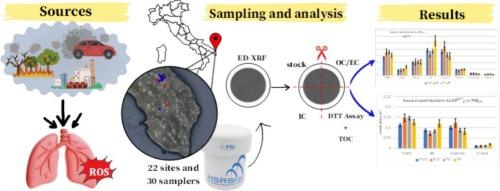
Oxidative potential (OP) is a potential indicator of negative health effects of particulate matter (PM). To address mitigation strategies, there is need of understanding how natural and anthropogenic sources influence OP at different sites. This work investigates spatial and seasonal variabilities of PM2.5 and PM10 concentrations, composition, and oxidative potential (OPDTTV, obtained with DTT assay), simultaneously at 22 sites in a central Mediterranean area in south Italy. Source apportionment using PMF5 allowed to evaluate the contributions of eight sources: traffic, biomass burning (BB), nitrate, sulphate-rich, marine, crustal, carbonates/construction, and industrial (only for PM2.5). Nitrate, traffic, and BB had larger contributions during the cold season and presented spatial variability with exclusion of nitrate. Industrial contributions did not have relevant seasonal or spatial variability. The other sources had an opposite trend with larger values during the warm season but only sulphate-rich had non-negligible spatial variability. OPDTTV had relevant spatial variability only during the cold season. Four sources had statistically significant contributions to OPDTTV: traffic, BB, sulphate-rich, and crustal (in descending order). The use of soluble and insoluble fractions of OC and Ca in PMF5 allowed a better separation between traffic and BB sources and allowed to determine the role of local construction works. The results may have implications in future policies for mitigation strategies of OP targeting specific sources categories.
期刊介绍:
The Science of the Total Environment is an international journal dedicated to scientific research on the environment and its interaction with humanity. It covers a wide range of disciplines and seeks to publish innovative, hypothesis-driven, and impactful research that explores the entire environment, including the atmosphere, lithosphere, hydrosphere, biosphere, and anthroposphere.
The journal's updated Aims & Scope emphasizes the importance of interdisciplinary environmental research with broad impact. Priority is given to studies that advance fundamental understanding and explore the interconnectedness of multiple environmental spheres. Field studies are preferred, while laboratory experiments must demonstrate significant methodological advancements or mechanistic insights with direct relevance to the environment.



 京公网安备 11010802042870号
京ICP备2023020795号-1
京公网安备 11010802042870号
京ICP备2023020795号-1

 分享
分享
 求助内容:
求助内容: 应助结果提醒方式:
 扫码关注我们
