{"title":"A critical review on the properties and applications of bulk micro and nanobubbles for the degradation of organic pollutants in wastewater treatment","authors":"Arijit Dutta Gupta , Vivek Kumar Jaiswal , Karan Chabhadiya , Ram Sharan Singh , M.K. Gupta , Harinder Singh","doi":"10.1016/j.scitotenv.2025.179310","DOIUrl":null,"url":null,"abstract":"<div><div>The presence of persistent organic pollutants in wastewater streams has presented significant challenges towards their removal. In the recent decade, bulk micro (1–100 μm) and nanobubble (50–150 nm) (MNB) technology has exhibited technological advancements via integration of MNB technology in degrading organic pollutants from wastewater streams. The present review critically analyses the physico-chemical properties such as stability, zeta potential, mass transfer rates, rising velocity and size distribution of MNBs. The paradigm shift from conventional wastewater treatment to more sustainable solution is initiated by the production of OH<sup>−</sup> ions and free radicals for the degradation of organic pollutants by the MNB technology. Applications of MNBs are also explored in various wastewater treatment processes such as floatation, membrane cleaning, adsorption, aeration, and advanced oxidation processes. Future researches highlighting the challenges in the development of efficient and robust MNB technology and its real-time applications have also been highlighted. It is anticipated that MNBs could be a sustainable and economic solution for wastewater treatment.</div></div>","PeriodicalId":422,"journal":{"name":"Science of the Total Environment","volume":"976 ","pages":"Article 179310"},"PeriodicalIF":8.0000,"publicationDate":"2025-05-10","publicationTypes":"Journal Article","fieldsOfStudy":null,"isOpenAccess":false,"openAccessPdf":"","citationCount":"0","resultStr":null,"platform":"Semanticscholar","paperid":null,"PeriodicalName":"Science of the Total Environment","FirstCategoryId":"93","ListUrlMain":"https://www.sciencedirect.com/science/article/pii/S0048969725009465","RegionNum":1,"RegionCategory":"环境科学与生态学","ArticlePicture":[],"TitleCN":null,"AbstractTextCN":null,"PMCID":null,"EPubDate":"2025/4/7 0:00:00","PubModel":"Epub","JCR":"Q1","JCRName":"ENVIRONMENTAL SCIENCES","Score":null,"Total":0}
引用次数: 0
Abstract
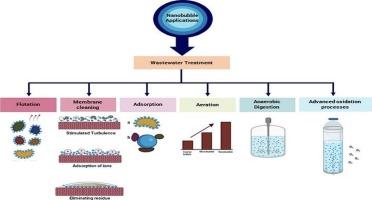
The presence of persistent organic pollutants in wastewater streams has presented significant challenges towards their removal. In the recent decade, bulk micro (1–100 μm) and nanobubble (50–150 nm) (MNB) technology has exhibited technological advancements via integration of MNB technology in degrading organic pollutants from wastewater streams. The present review critically analyses the physico-chemical properties such as stability, zeta potential, mass transfer rates, rising velocity and size distribution of MNBs. The paradigm shift from conventional wastewater treatment to more sustainable solution is initiated by the production of OH− ions and free radicals for the degradation of organic pollutants by the MNB technology. Applications of MNBs are also explored in various wastewater treatment processes such as floatation, membrane cleaning, adsorption, aeration, and advanced oxidation processes. Future researches highlighting the challenges in the development of efficient and robust MNB technology and its real-time applications have also been highlighted. It is anticipated that MNBs could be a sustainable and economic solution for wastewater treatment.
期刊介绍:
The Science of the Total Environment is an international journal dedicated to scientific research on the environment and its interaction with humanity. It covers a wide range of disciplines and seeks to publish innovative, hypothesis-driven, and impactful research that explores the entire environment, including the atmosphere, lithosphere, hydrosphere, biosphere, and anthroposphere.
The journal's updated Aims & Scope emphasizes the importance of interdisciplinary environmental research with broad impact. Priority is given to studies that advance fundamental understanding and explore the interconnectedness of multiple environmental spheres. Field studies are preferred, while laboratory experiments must demonstrate significant methodological advancements or mechanistic insights with direct relevance to the environment.



 京公网安备 11010802042870号
京ICP备2023020795号-1
京公网安备 11010802042870号
京ICP备2023020795号-1

 分享
分享
 求助内容:
求助内容: 应助结果提醒方式:
 扫码关注我们
