Asad ur Rehman Khan , Majid Niaz Akhtar , Aqsa Afzal , Sohail Ahmad , Sajawal ur Rehman Khan , Abdul Rehman , Mohamed Mohany , Salim S. Al-Rejaie , M.S. Al-Buriahi
{"title":"Enhanced multifaceted performance of Ce-ZnO nanocomposites for DB71 degradation: Gas sensing and UV photodetection","authors":"Asad ur Rehman Khan , Majid Niaz Akhtar , Aqsa Afzal , Sohail Ahmad , Sajawal ur Rehman Khan , Abdul Rehman , Mohamed Mohany , Salim S. Al-Rejaie , M.S. Al-Buriahi","doi":"10.1016/j.inoche.2025.114389","DOIUrl":null,"url":null,"abstract":"<div><div>Tunable semiconductor nanoparticles continue to be the primary inorganic catalytic materials for photochemistry. Nanostructured semiconductor materials have unveiled a novel realm of opportunities for photodetection and photocatalysis devices. Pure and rare earth Ce-doped ZnO nanoparticles were synthesized by hydrothermal method and characterized to investigate the gas sensing abilities (especially for NO<sub>2</sub>), UV sensitivity and photocatalytic investigations. The influence of Ce dopant on ZnO’s structural, morphological and optical properties was examined. 1 % Ce doped ZnO nanostructures revealed the maximum responsivity for NO<sub>2</sub> gas over CO, H<sub>2</sub>, NH<sub>3,</sub> and acetone gases at 100 ppm concentration and 250 °C optimised temperature. The effectiveness of the sensor was recorded against relative humidity, and it illustrated the attractive response time (11.8 s) and recovery time (56.3 s) in even 41 % humidity. Results revealed that the 1 % Ce doped ZnO-based gas sensor is recommended as a reliable NO<sub>2</sub> gas sensor for applications in environmental safety and monitoring. Sample with 3 % Ce doped ZnO revealed the efficient performance for UV photodetection with photo detective of 420 × 10<sup>8</sup> Jones, a rise time of 0.1 s, and a decay time of 8.7 s. 3 % Ce doped ZnO nanoparticles illustrated the maximum degradation efficiency of 98.4 % for DB71 under solar irradiation. The effect of catalyst weight and pH on the degradation efficiency was investigated. The five-cycle photostability test of selective catalyst revealed its potential for gas sensing and wastewater treatment applications.</div></div>","PeriodicalId":13609,"journal":{"name":"Inorganic Chemistry Communications","volume":"178 ","pages":"Article 114389"},"PeriodicalIF":5.4000,"publicationDate":"2025-04-01","publicationTypes":"Journal Article","fieldsOfStudy":null,"isOpenAccess":false,"openAccessPdf":"","citationCount":"0","resultStr":null,"platform":"Semanticscholar","paperid":null,"PeriodicalName":"Inorganic Chemistry Communications","FirstCategoryId":"92","ListUrlMain":"https://www.sciencedirect.com/science/article/pii/S1387700325005052","RegionNum":3,"RegionCategory":"化学","ArticlePicture":[],"TitleCN":null,"AbstractTextCN":null,"PMCID":null,"EPubDate":"","PubModel":"","JCR":"Q1","JCRName":"CHEMISTRY, INORGANIC & NUCLEAR","Score":null,"Total":0}
引用次数: 0
Abstract
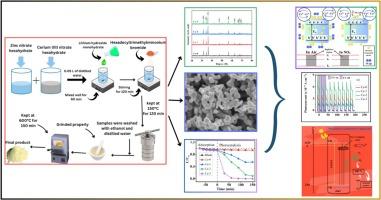
Tunable semiconductor nanoparticles continue to be the primary inorganic catalytic materials for photochemistry. Nanostructured semiconductor materials have unveiled a novel realm of opportunities for photodetection and photocatalysis devices. Pure and rare earth Ce-doped ZnO nanoparticles were synthesized by hydrothermal method and characterized to investigate the gas sensing abilities (especially for NO2), UV sensitivity and photocatalytic investigations. The influence of Ce dopant on ZnO’s structural, morphological and optical properties was examined. 1 % Ce doped ZnO nanostructures revealed the maximum responsivity for NO2 gas over CO, H2, NH3, and acetone gases at 100 ppm concentration and 250 °C optimised temperature. The effectiveness of the sensor was recorded against relative humidity, and it illustrated the attractive response time (11.8 s) and recovery time (56.3 s) in even 41 % humidity. Results revealed that the 1 % Ce doped ZnO-based gas sensor is recommended as a reliable NO2 gas sensor for applications in environmental safety and monitoring. Sample with 3 % Ce doped ZnO revealed the efficient performance for UV photodetection with photo detective of 420 × 108 Jones, a rise time of 0.1 s, and a decay time of 8.7 s. 3 % Ce doped ZnO nanoparticles illustrated the maximum degradation efficiency of 98.4 % for DB71 under solar irradiation. The effect of catalyst weight and pH on the degradation efficiency was investigated. The five-cycle photostability test of selective catalyst revealed its potential for gas sensing and wastewater treatment applications.
期刊介绍:
Launched in January 1998, Inorganic Chemistry Communications is an international journal dedicated to the rapid publication of short communications in the major areas of inorganic, organometallic and supramolecular chemistry. Topics include synthetic and reaction chemistry, kinetics and mechanisms of reactions, bioinorganic chemistry, photochemistry and the use of metal and organometallic compounds in stoichiometric and catalytic synthesis or organic compounds.




 京公网安备 11010802042870号
京ICP备2023020795号-1
京公网安备 11010802042870号
京ICP备2023020795号-1

 分享
分享
 求助内容:
求助内容: 应助结果提醒方式:
 扫码关注我们
