Physicochemical properties and biological applications of complexes of 2,4,6-tris-(2-pyridyl)-1,3,5-triazine and thiourea with Mn(II), Cu(II), Ag(I), Rh(III) and Pd(II): Structure of the Rh(III) complex
Azza A. Hassoon , Stacey J. Smith , Roger G. Harrison
{"title":"Physicochemical properties and biological applications of complexes of 2,4,6-tris-(2-pyridyl)-1,3,5-triazine and thiourea with Mn(II), Cu(II), Ag(I), Rh(III) and Pd(II): Structure of the Rh(III) complex","authors":"Azza A. Hassoon , Stacey J. Smith , Roger G. Harrison","doi":"10.1016/j.inoche.2025.114464","DOIUrl":null,"url":null,"abstract":"<div><div>In this report, we have isolated and structurally characterized seven novel heteroleptic complexes (<strong>C1-C7</strong>) synthesized from Mn(II), Cu(II), Ag(I), Rh(III) and Pd(II) with <em>2,4,6</em>-tris-(<em>2</em>-pyridyl)-<em>1,3,5</em>-triazine (<strong><em>TPT</em></strong>) and thiourea (<strong><em>Tu</em></strong>). Elemental analysis, molar conductance, IR, TGA, ESI-MS, 1D and 2D-NMR techniques (<sup>1</sup>H-, <sup>13</sup>C-, <sup>1</sup>H-<sup>1</sup>H COSY and <sup>1</sup>H-<sup>13</sup>C HSQCAD), UV.Vis., and EPR spectroscopy have been used to characterize these compounds. The crystal structure of <strong>C5</strong> was evaluated by single-crystal X-ray diffraction, revealing the triclinic character of the rhodium complex. All of the compounds showed a broad spectrum of antibacterial and cytotoxic action. The <em>in vitro</em> antibacterial analysis demonstrated that the percent activity index of <strong>C2</strong> was superior in comparison to Ciprofloxacin. The cytotoxic activity of the compounds was also evaluated against four human cancer cell lines: HeP-2, HePG2, MCF-7, and HeLa. The results revealed that <strong>C2</strong> has the most toxicity (IC<sub>50</sub> = 6.13 ±0.7 µM and 7.48 ± 0.6 µM) against HeLa and HeP2 cell lines, respectively. DNA binding assay of synthesized compounds were performed. The findings indicted that DNA is indeed a potential biotarget for all compounds. The ability of these metal complexes to interact with and affect DNA function supports their potential as therapeutic agents in cancer treatment. Superoxide dismutase (SOD) activity of the compounds has also been assessed by NBT assay. In addition, the modes of binding of the compounds with human serum albumin (HSA) were explored by molecular docking analysis. The molecular docking experiments revealed varying degrees of binding affinity and intermolecular interaction between the tested compounds and HSA.</div></div>","PeriodicalId":13609,"journal":{"name":"Inorganic Chemistry Communications","volume":"178 ","pages":"Article 114464"},"PeriodicalIF":5.4000,"publicationDate":"2025-08-01","publicationTypes":"Journal Article","fieldsOfStudy":null,"isOpenAccess":false,"openAccessPdf":"","citationCount":"0","resultStr":null,"platform":"Semanticscholar","paperid":null,"PeriodicalName":"Inorganic Chemistry Communications","FirstCategoryId":"92","ListUrlMain":"https://www.sciencedirect.com/science/article/pii/S1387700325005805","RegionNum":3,"RegionCategory":"化学","ArticlePicture":[],"TitleCN":null,"AbstractTextCN":null,"PMCID":null,"EPubDate":"2025/4/3 0:00:00","PubModel":"Epub","JCR":"Q1","JCRName":"CHEMISTRY, INORGANIC & NUCLEAR","Score":null,"Total":0}
引用次数: 0
Abstract
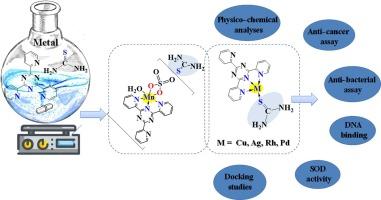
In this report, we have isolated and structurally characterized seven novel heteroleptic complexes (C1-C7) synthesized from Mn(II), Cu(II), Ag(I), Rh(III) and Pd(II) with 2,4,6-tris-(2-pyridyl)-1,3,5-triazine (TPT) and thiourea (Tu). Elemental analysis, molar conductance, IR, TGA, ESI-MS, 1D and 2D-NMR techniques (1H-, 13C-, 1H-1H COSY and 1H-13C HSQCAD), UV.Vis., and EPR spectroscopy have been used to characterize these compounds. The crystal structure of C5 was evaluated by single-crystal X-ray diffraction, revealing the triclinic character of the rhodium complex. All of the compounds showed a broad spectrum of antibacterial and cytotoxic action. The in vitro antibacterial analysis demonstrated that the percent activity index of C2 was superior in comparison to Ciprofloxacin. The cytotoxic activity of the compounds was also evaluated against four human cancer cell lines: HeP-2, HePG2, MCF-7, and HeLa. The results revealed that C2 has the most toxicity (IC50 = 6.13 ±0.7 µM and 7.48 ± 0.6 µM) against HeLa and HeP2 cell lines, respectively. DNA binding assay of synthesized compounds were performed. The findings indicted that DNA is indeed a potential biotarget for all compounds. The ability of these metal complexes to interact with and affect DNA function supports their potential as therapeutic agents in cancer treatment. Superoxide dismutase (SOD) activity of the compounds has also been assessed by NBT assay. In addition, the modes of binding of the compounds with human serum albumin (HSA) were explored by molecular docking analysis. The molecular docking experiments revealed varying degrees of binding affinity and intermolecular interaction between the tested compounds and HSA.
期刊介绍:
Launched in January 1998, Inorganic Chemistry Communications is an international journal dedicated to the rapid publication of short communications in the major areas of inorganic, organometallic and supramolecular chemistry. Topics include synthetic and reaction chemistry, kinetics and mechanisms of reactions, bioinorganic chemistry, photochemistry and the use of metal and organometallic compounds in stoichiometric and catalytic synthesis or organic compounds.



 京公网安备 11010802042870号
京ICP备2023020795号-1
京公网安备 11010802042870号
京ICP备2023020795号-1

 分享
分享
 求助内容:
求助内容: 应助结果提醒方式:
 扫码关注我们
