J. Fernández-Català , J. Chávez-Caiza , R. Greco , M. Navlani-García , A. Berenguer-Murcia , W. Cao , D. Cazorla-Amorós
{"title":"Facile hydrothermal synthesis and photocatalytic properties of g-C3N4/Cu3TeO6 heterostructures","authors":"J. Fernández-Català , J. Chávez-Caiza , R. Greco , M. Navlani-García , A. Berenguer-Murcia , W. Cao , D. Cazorla-Amorós","doi":"10.1016/j.inoche.2025.114424","DOIUrl":null,"url":null,"abstract":"<div><div>In this work, we have developed, for the first time, heterostructures based on Cu<sub>3</sub>TeO<sub>6</sub> (CTO) with a strong interaction with a well-studied g-C<sub>3</sub>N<sub>4</sub> (GCN) semiconductor. This has been carried out to mitigate the drawbacks of CTO for its application as photocatalyst in H<sub>2</sub> production. In this sense, the resulting heterostructure presented higher activity than the pure CTO and GCN (113, 85, and 42 µmol<sub>H2</sub>/mg, respectively). The methodology employed to synthesise the heterostructure was a hydrothermal synthesis on the surface of GCN to ensure a strong interaction between both materials by growing the CTO crystal in presence of GCN. The physicochemical characterisation of the materials by XRD TG, SEM, TEM, and FTIR revealed that the synthesis was successfully developed and that Cu<sub>3</sub>TeO<sub>6</sub> grew on the g-C<sub>3</sub>N<sub>4</sub> surface. Indeed, this novel synthesis of the heterostructure based on CTO has huge interest for its application in H<sub>2</sub> production due to the redox capability of the materials, observed by UPS and UV–Vis spectroscopies. The enhancement of the catalytic activity of the heterostructure with respect to the pristine materials was associate to the strong interaction between both components, the catalytic effect of Cu species, and the improved charge transfer. Indeed, a lower e<sup>−</sup> − h<sup>+</sup> pair recombination rate was observed by steady PL analysis with respect to the pristine GCN material. These results indicate that it is possible to synthesise heterostructures based on metal tellurates with improved catalytic activity of the mixture with respect to the pristine material in a relevant energy application such as H<sub>2</sub> production.</div></div>","PeriodicalId":13609,"journal":{"name":"Inorganic Chemistry Communications","volume":"178 ","pages":"Article 114424"},"PeriodicalIF":5.4000,"publicationDate":"2025-04-03","publicationTypes":"Journal Article","fieldsOfStudy":null,"isOpenAccess":false,"openAccessPdf":"","citationCount":"0","resultStr":null,"platform":"Semanticscholar","paperid":null,"PeriodicalName":"Inorganic Chemistry Communications","FirstCategoryId":"92","ListUrlMain":"https://www.sciencedirect.com/science/article/pii/S1387700325005404","RegionNum":3,"RegionCategory":"化学","ArticlePicture":[],"TitleCN":null,"AbstractTextCN":null,"PMCID":null,"EPubDate":"","PubModel":"","JCR":"Q1","JCRName":"CHEMISTRY, INORGANIC & NUCLEAR","Score":null,"Total":0}
引用次数: 0
Abstract
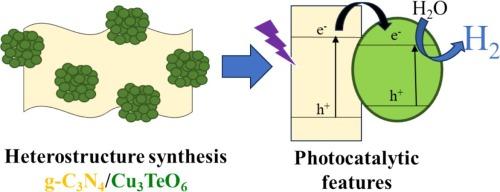
In this work, we have developed, for the first time, heterostructures based on Cu3TeO6 (CTO) with a strong interaction with a well-studied g-C3N4 (GCN) semiconductor. This has been carried out to mitigate the drawbacks of CTO for its application as photocatalyst in H2 production. In this sense, the resulting heterostructure presented higher activity than the pure CTO and GCN (113, 85, and 42 µmolH2/mg, respectively). The methodology employed to synthesise the heterostructure was a hydrothermal synthesis on the surface of GCN to ensure a strong interaction between both materials by growing the CTO crystal in presence of GCN. The physicochemical characterisation of the materials by XRD TG, SEM, TEM, and FTIR revealed that the synthesis was successfully developed and that Cu3TeO6 grew on the g-C3N4 surface. Indeed, this novel synthesis of the heterostructure based on CTO has huge interest for its application in H2 production due to the redox capability of the materials, observed by UPS and UV–Vis spectroscopies. The enhancement of the catalytic activity of the heterostructure with respect to the pristine materials was associate to the strong interaction between both components, the catalytic effect of Cu species, and the improved charge transfer. Indeed, a lower e− − h+ pair recombination rate was observed by steady PL analysis with respect to the pristine GCN material. These results indicate that it is possible to synthesise heterostructures based on metal tellurates with improved catalytic activity of the mixture with respect to the pristine material in a relevant energy application such as H2 production.
期刊介绍:
Launched in January 1998, Inorganic Chemistry Communications is an international journal dedicated to the rapid publication of short communications in the major areas of inorganic, organometallic and supramolecular chemistry. Topics include synthetic and reaction chemistry, kinetics and mechanisms of reactions, bioinorganic chemistry, photochemistry and the use of metal and organometallic compounds in stoichiometric and catalytic synthesis or organic compounds.



 京公网安备 11010802042870号
京ICP备2023020795号-1
京公网安备 11010802042870号
京ICP备2023020795号-1

 分享
分享
 求助内容:
求助内容: 应助结果提醒方式:
 扫码关注我们
