{"title":"Utilization of platinum nanoclusters (Ptn (n ≤ ca. 15)) as a co-catalyst for photocatalytic hydrogen evolution","authors":"Akira Ohnuma , Tsukasa Torimoto","doi":"10.1016/j.inoche.2025.114461","DOIUrl":null,"url":null,"abstract":"<div><div>To solve the global energy and environmental problems, there has been active research on heterogeneous particulate photocatalysts for hydrogen (H<sub>2</sub>) production by water splitting. Although such photocatalysts are typically composed of a semiconductor photocatalyst and a noble metal co-catalyst, there has not been sufficient studies on the effects of the sizes of co-catalysts as small as nanoclusters consisting of a few to tens of atoms. In this study, we have fabricated a new type of particulate photocatalysts deposited with platinum (Pt) nanoclusters consisting of approximately 15 atoms or fewer as a co-catalyst and evaluated the H<sub>2</sub> evolution activities from an aqueous solution. The Pt nanoclusters were generated by a dry fabrication method using magnetron sputtering (MSP), which simplifies the synthetic process, and they were directly embedded on photocatalyst powders, titanium(IV) oxide (TiO<sub>2</sub>) and graphitic carbon nitride (g-C<sub>3</sub>N<sub>4</sub>). The Pt nanoclusters could work as a photocatalytic co-catalyst equivalent to ordinary Pt nanoparticles by a well-known photodeposition method (wet process). Furthermore, the optimal amount of Pt co-catalysts to improve the rate of H<sub>2</sub> production was found to be 0.1 wt% in the diluted sample from photocatalyst powders deposited with Pt co-catalysts of 1 wt%, and the improvement in activity by diluting samples was more pronounced for the Pt-nanocluster-deposited photocatalyst than for the Pt-nanoparticle-deposited photocatalyst. Our method will be extended to the design of functional materials with Pt (including alloys) co-catalysts/catalysts for the widespread use by reducing the amount and cost of precious metals.</div></div>","PeriodicalId":13609,"journal":{"name":"Inorganic Chemistry Communications","volume":"178 ","pages":"Article 114461"},"PeriodicalIF":5.4000,"publicationDate":"2025-08-01","publicationTypes":"Journal Article","fieldsOfStudy":null,"isOpenAccess":false,"openAccessPdf":"","citationCount":"0","resultStr":null,"platform":"Semanticscholar","paperid":null,"PeriodicalName":"Inorganic Chemistry Communications","FirstCategoryId":"92","ListUrlMain":"https://www.sciencedirect.com/science/article/pii/S1387700325005775","RegionNum":3,"RegionCategory":"化学","ArticlePicture":[],"TitleCN":null,"AbstractTextCN":null,"PMCID":null,"EPubDate":"2025/4/1 0:00:00","PubModel":"Epub","JCR":"Q1","JCRName":"CHEMISTRY, INORGANIC & NUCLEAR","Score":null,"Total":0}
引用次数: 0
Abstract
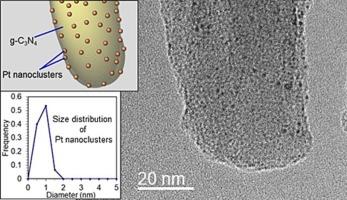
To solve the global energy and environmental problems, there has been active research on heterogeneous particulate photocatalysts for hydrogen (H2) production by water splitting. Although such photocatalysts are typically composed of a semiconductor photocatalyst and a noble metal co-catalyst, there has not been sufficient studies on the effects of the sizes of co-catalysts as small as nanoclusters consisting of a few to tens of atoms. In this study, we have fabricated a new type of particulate photocatalysts deposited with platinum (Pt) nanoclusters consisting of approximately 15 atoms or fewer as a co-catalyst and evaluated the H2 evolution activities from an aqueous solution. The Pt nanoclusters were generated by a dry fabrication method using magnetron sputtering (MSP), which simplifies the synthetic process, and they were directly embedded on photocatalyst powders, titanium(IV) oxide (TiO2) and graphitic carbon nitride (g-C3N4). The Pt nanoclusters could work as a photocatalytic co-catalyst equivalent to ordinary Pt nanoparticles by a well-known photodeposition method (wet process). Furthermore, the optimal amount of Pt co-catalysts to improve the rate of H2 production was found to be 0.1 wt% in the diluted sample from photocatalyst powders deposited with Pt co-catalysts of 1 wt%, and the improvement in activity by diluting samples was more pronounced for the Pt-nanocluster-deposited photocatalyst than for the Pt-nanoparticle-deposited photocatalyst. Our method will be extended to the design of functional materials with Pt (including alloys) co-catalysts/catalysts for the widespread use by reducing the amount and cost of precious metals.
期刊介绍:
Launched in January 1998, Inorganic Chemistry Communications is an international journal dedicated to the rapid publication of short communications in the major areas of inorganic, organometallic and supramolecular chemistry. Topics include synthetic and reaction chemistry, kinetics and mechanisms of reactions, bioinorganic chemistry, photochemistry and the use of metal and organometallic compounds in stoichiometric and catalytic synthesis or organic compounds.



 京公网安备 11010802042870号
京ICP备2023020795号-1
京公网安备 11010802042870号
京ICP备2023020795号-1

 分享
分享
 求助内容:
求助内容: 应助结果提醒方式:
 扫码关注我们
