P. Saranya , D. Vanitha , K. Sundaramahalingam , A. Shameem , N. Nallamuthu
{"title":"Comparative performance analysis of nanostructured metal oxides as cathode in solid state magnesium battery","authors":"P. Saranya , D. Vanitha , K. Sundaramahalingam , A. Shameem , N. Nallamuthu","doi":"10.1016/j.inoche.2025.114458","DOIUrl":null,"url":null,"abstract":"<div><div>Magnesium batteries are considered a promising alternative to lithium-ion batteries due to the abundance, low cost, and high theoretical energy density of magnesium. Metal oxide nanoparticles have shown significant potential in addressing some of these challenges like high charge/discharge rates, low conductivity, and poor cycle life by enhancing the electrochemical performance, stability, and efficiency of magnesium batteries. In this study, nanoparticles of magnesium oxide (MgO), manganese oxide (Mn<sub>2</sub>O<sub>3</sub>), and magnesium manganese oxide (MgMn<sub>2</sub>O<sub>4</sub>) are synthesized using the gel-combustion method. These nanoparticles are analyzed through X-ray diffraction (XRD) to determine their crystallite size. Their surface morphology is studied using Scanning Electron Microscopy (SEM), revealing agglomerated and uneven surfaces. The elemental composition is identified by using energy-dispersive X-ray spectrometry (EDX). Electrochemical properties are assessed using Cyclic Voltammetry (CV) and Galvanostatic Charge-Discharge (GCD) analysis. Compared to single metal oxides, the synthesized binary metal oxide demonstrated superior electrochemical performance. GCD results showed that MgMn<sub>2</sub>O<sub>4</sub> nanoparticles achieved a maximum specific capacitance of 203 F/g at a current density of 2.1 A/g. Furthermore, after 1000 charge–discharge cycles, the electrode’s power density remains stable, confirming its durability. Using the prepared metal oxides as cathode, three batteries are fabricated and their properties are compared. The electrochemical cell is fabricated using MgMn<sub>2</sub>O<sub>4</sub> as a cathode material performs better than the others and the discharge characteristics are also investigated.</div></div>","PeriodicalId":13609,"journal":{"name":"Inorganic Chemistry Communications","volume":"178 ","pages":"Article 114458"},"PeriodicalIF":5.4000,"publicationDate":"2025-08-01","publicationTypes":"Journal Article","fieldsOfStudy":null,"isOpenAccess":false,"openAccessPdf":"","citationCount":"0","resultStr":null,"platform":"Semanticscholar","paperid":null,"PeriodicalName":"Inorganic Chemistry Communications","FirstCategoryId":"92","ListUrlMain":"https://www.sciencedirect.com/science/article/pii/S138770032500574X","RegionNum":3,"RegionCategory":"化学","ArticlePicture":[],"TitleCN":null,"AbstractTextCN":null,"PMCID":null,"EPubDate":"2025/4/1 0:00:00","PubModel":"Epub","JCR":"Q1","JCRName":"CHEMISTRY, INORGANIC & NUCLEAR","Score":null,"Total":0}
引用次数: 0
Abstract
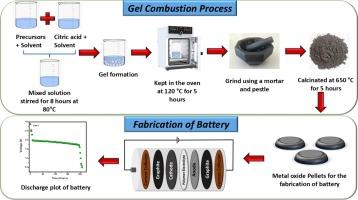
Magnesium batteries are considered a promising alternative to lithium-ion batteries due to the abundance, low cost, and high theoretical energy density of magnesium. Metal oxide nanoparticles have shown significant potential in addressing some of these challenges like high charge/discharge rates, low conductivity, and poor cycle life by enhancing the electrochemical performance, stability, and efficiency of magnesium batteries. In this study, nanoparticles of magnesium oxide (MgO), manganese oxide (Mn2O3), and magnesium manganese oxide (MgMn2O4) are synthesized using the gel-combustion method. These nanoparticles are analyzed through X-ray diffraction (XRD) to determine their crystallite size. Their surface morphology is studied using Scanning Electron Microscopy (SEM), revealing agglomerated and uneven surfaces. The elemental composition is identified by using energy-dispersive X-ray spectrometry (EDX). Electrochemical properties are assessed using Cyclic Voltammetry (CV) and Galvanostatic Charge-Discharge (GCD) analysis. Compared to single metal oxides, the synthesized binary metal oxide demonstrated superior electrochemical performance. GCD results showed that MgMn2O4 nanoparticles achieved a maximum specific capacitance of 203 F/g at a current density of 2.1 A/g. Furthermore, after 1000 charge–discharge cycles, the electrode’s power density remains stable, confirming its durability. Using the prepared metal oxides as cathode, three batteries are fabricated and their properties are compared. The electrochemical cell is fabricated using MgMn2O4 as a cathode material performs better than the others and the discharge characteristics are also investigated.
镁电池因其丰富、低成本和高理论能量密度而被认为是锂离子电池的一个有前途的替代品。金属氧化物纳米颗粒通过提高镁电池的电化学性能、稳定性和效率,在解决高充放电率、低电导率和低循环寿命等挑战方面显示出巨大的潜力。本研究采用凝胶燃烧法合成了氧化镁(MgO)、氧化锰(Mn2O3)和氧化锰镁(MgMn2O4)纳米颗粒。通过x射线衍射(XRD)对这些纳米颗粒进行分析,以确定它们的晶粒大小。利用扫描电子显微镜(SEM)对其表面形貌进行了研究,发现表面聚集和凹凸不平。利用能量色散x射线光谱法(EDX)鉴定了元素组成。利用循环伏安法(CV)和恒流充放电法(GCD)对其电化学性能进行了评价。与单一金属氧化物相比,合成的二元金属氧化物表现出优异的电化学性能。GCD结果表明,在2.1 a /g电流密度下,MgMn2O4纳米粒子的最大比电容为203 F/g。此外,在1000次充放电循环后,电极的功率密度保持稳定,证实了其耐久性。用所制备的金属氧化物作阴极制备了三种电池,并对其性能进行了比较。以MgMn2O4为正极材料制备的电化学电池性能较好,并对其放电特性进行了研究。
期刊介绍:
Launched in January 1998, Inorganic Chemistry Communications is an international journal dedicated to the rapid publication of short communications in the major areas of inorganic, organometallic and supramolecular chemistry. Topics include synthetic and reaction chemistry, kinetics and mechanisms of reactions, bioinorganic chemistry, photochemistry and the use of metal and organometallic compounds in stoichiometric and catalytic synthesis or organic compounds.



 京公网安备 11010802042870号
京ICP备2023020795号-1
京公网安备 11010802042870号
京ICP备2023020795号-1

 分享
分享
 求助内容:
求助内容: 应助结果提醒方式:
 扫码关注我们
