{"title":"Highly efficient MnO2-modified antifouling loose nanofiltration membrane for dye/salt separation","authors":"Yanchuan Zhang, Yali Zhao, Yu Liu","doi":"10.1016/j.memsci.2025.124069","DOIUrl":null,"url":null,"abstract":"<div><div>Loose nanofiltration (NF) membranes are promising in textile wastewater treatment due to their selective separation capabilities for dyes and salts. However, their widespread applications are hindered by complex manufacturing processes and membrane fouling. This work focuses on fabricating antifouling loose NF membranes using a facile method. Thereinto, amine-functionalized loose NF matrixes were first prepared using polyelectrolyte-complex induced phase inversion, where polyethyleneimine (PEI) in a coagulation bath as an inducer triggered an instantaneous phase inversion via electrostatic interactions with sulfonated polysulfone (SPSF) in dope solution. The acquired NF matrix has a dense skin layer with a mean pore size of 0.72 nm, endowing it with excellent dye retention. Consequently, the Fenton catalyst, MnO<sub>2</sub>, was in situ grown on the membrane via the interaction between amine and Mn<sup>2+</sup> followed by a one-step mineralization reaction. The MnO<sub>2</sub>-loaded loose NF membrane could achieve 99.7 % CR rejection while allowing only 1.67 % rejection of Na<sub>2</sub>SO<sub>4</sub> in a mixed solution of 60 mg/L Congo Red (CR) and 20 g/L Na<sub>2</sub>SO<sub>4</sub> at the permeability of 51.6 L m<sup>−2</sup> h<sup>−1</sup>·bar<sup>−1</sup>. After cleaning with H<sub>2</sub>O<sub>2</sub>, the flux recovery rate of the membrane remains above 97 %, attributed to the catalytic effect of MnO<sub>2</sub> on the membrane surface. Additionally, the membrane displayed similar performance in dealing with real wastewater, underscoring its potential for practical applications in textile wastewater treatment.</div></div>","PeriodicalId":368,"journal":{"name":"Journal of Membrane Science","volume":"726 ","pages":"Article 124069"},"PeriodicalIF":9.0000,"publicationDate":"2025-05-01","publicationTypes":"Journal Article","fieldsOfStudy":null,"isOpenAccess":false,"openAccessPdf":"","citationCount":"0","resultStr":null,"platform":"Semanticscholar","paperid":null,"PeriodicalName":"Journal of Membrane Science","FirstCategoryId":"5","ListUrlMain":"https://www.sciencedirect.com/science/article/pii/S0376738825003825","RegionNum":1,"RegionCategory":"工程技术","ArticlePicture":[],"TitleCN":null,"AbstractTextCN":null,"PMCID":null,"EPubDate":"2025/4/4 0:00:00","PubModel":"Epub","JCR":"Q1","JCRName":"ENGINEERING, CHEMICAL","Score":null,"Total":0}
引用次数: 0
Abstract
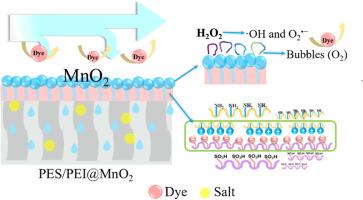
Loose nanofiltration (NF) membranes are promising in textile wastewater treatment due to their selective separation capabilities for dyes and salts. However, their widespread applications are hindered by complex manufacturing processes and membrane fouling. This work focuses on fabricating antifouling loose NF membranes using a facile method. Thereinto, amine-functionalized loose NF matrixes were first prepared using polyelectrolyte-complex induced phase inversion, where polyethyleneimine (PEI) in a coagulation bath as an inducer triggered an instantaneous phase inversion via electrostatic interactions with sulfonated polysulfone (SPSF) in dope solution. The acquired NF matrix has a dense skin layer with a mean pore size of 0.72 nm, endowing it with excellent dye retention. Consequently, the Fenton catalyst, MnO2, was in situ grown on the membrane via the interaction between amine and Mn2+ followed by a one-step mineralization reaction. The MnO2-loaded loose NF membrane could achieve 99.7 % CR rejection while allowing only 1.67 % rejection of Na2SO4 in a mixed solution of 60 mg/L Congo Red (CR) and 20 g/L Na2SO4 at the permeability of 51.6 L m−2 h−1·bar−1. After cleaning with H2O2, the flux recovery rate of the membrane remains above 97 %, attributed to the catalytic effect of MnO2 on the membrane surface. Additionally, the membrane displayed similar performance in dealing with real wastewater, underscoring its potential for practical applications in textile wastewater treatment.
期刊介绍:
The Journal of Membrane Science is a publication that focuses on membrane systems and is aimed at academic and industrial chemists, chemical engineers, materials scientists, and membranologists. It publishes original research and reviews on various aspects of membrane transport, membrane formation/structure, fouling, module/process design, and processes/applications. The journal primarily focuses on the structure, function, and performance of non-biological membranes but also includes papers that relate to biological membranes. The Journal of Membrane Science publishes Full Text Papers, State-of-the-Art Reviews, Letters to the Editor, and Perspectives.



 京公网安备 11010802042870号
京ICP备2023020795号-1
京公网安备 11010802042870号
京ICP备2023020795号-1

 分享
分享
 求助内容:
求助内容: 应助结果提醒方式:
 扫码关注我们
