Jinyu Wu, Hongying Zhao, Lin Li, Hailong Shen, Jiaheng Xu, Xianqing Liang, Zhiqiang Lan, Wenzheng Zhou, Jin Guo, Haifu Huang
{"title":"Enhanced electrochemical storage capability of NiCo2O4 nanosheet/nanowires hybrid arrays via synergistic collaborative MXene/Graphene","authors":"Jinyu Wu, Hongying Zhao, Lin Li, Hailong Shen, Jiaheng Xu, Xianqing Liang, Zhiqiang Lan, Wenzheng Zhou, Jin Guo, Haifu Huang","doi":"10.1016/j.jpowsour.2025.236936","DOIUrl":null,"url":null,"abstract":"<div><div>Transition metal oxides (TMOs) are potential high-performance electrode materials for supercapacitors, but their application is hindered by poor electrical conductivity and slow reaction kinetics. To overcome these challenges, self-supporting NiCo<sub>2</sub>O<sub>4</sub> (NCO) nanosheet-nanowire hybrid arrays were synthesized through a two-step hydrothermal process. The hierarchical architecture is constructed by successively growing NCO on reduced graphene oxide (rGO)-coated Ni foam and subsequently wrapping with 2D Ti<sub>3</sub>C<sub>2</sub>T<sub>x</sub> MXene layers. NCO serves as the energy storage material, while rGO and MXene collaboratively establish a three-dimensional conductive network, enhancing both electron transport and structural robustness. In the nanoarray, the composite denoted as MXene/NCO@rGO-NF exhibits strengthened interface effects (charge redistribution and lowered energy barriers at heterogeneous interfaces) and rapid electron transfer (uninterrupted electron pathways via MXene-rGO bridging). This design further promotes hydroxide ions (OH<sup>−</sup>) adsorption on NCO, accelerating redox reaction kinetics. As expected, the MXene/NCO@rGO-NF electrode delivers an outstanding specific capacity of 1236.5 C g<sup>−1</sup> at 1 A g<sup>−1</sup>. When assembled into a hybrid supercapacitor, it achieves a maximum energy density of 34.6 Wh kg<sup>−1</sup> at 375 W kg<sup>−1</sup>, with 82.5 % capacitance retention after 8000 cycles. This work demonstrates a stepwise assembly strategy to boost the electrochemical performance of TMOs with high-capacity electrodes with enhanced cycling stability.</div></div>","PeriodicalId":377,"journal":{"name":"Journal of Power Sources","volume":"642 ","pages":""},"PeriodicalIF":7.9000,"publicationDate":"2025-06-30","publicationTypes":"Journal Article","fieldsOfStudy":null,"isOpenAccess":false,"openAccessPdf":"","citationCount":"0","resultStr":null,"platform":"Semanticscholar","paperid":null,"PeriodicalName":"Journal of Power Sources","FirstCategoryId":"5","ListUrlMain":"https://www.sciencedirect.com/science/article/pii/S0378775325007724","RegionNum":2,"RegionCategory":"工程技术","ArticlePicture":[],"TitleCN":null,"AbstractTextCN":null,"PMCID":null,"EPubDate":"2025/4/7 0:00:00","PubModel":"Epub","JCR":"Q1","JCRName":"CHEMISTRY, PHYSICAL","Score":null,"Total":0}
引用次数: 0
Abstract
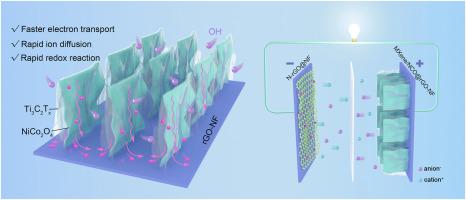
Transition metal oxides (TMOs) are potential high-performance electrode materials for supercapacitors, but their application is hindered by poor electrical conductivity and slow reaction kinetics. To overcome these challenges, self-supporting NiCo2O4 (NCO) nanosheet-nanowire hybrid arrays were synthesized through a two-step hydrothermal process. The hierarchical architecture is constructed by successively growing NCO on reduced graphene oxide (rGO)-coated Ni foam and subsequently wrapping with 2D Ti3C2Tx MXene layers. NCO serves as the energy storage material, while rGO and MXene collaboratively establish a three-dimensional conductive network, enhancing both electron transport and structural robustness. In the nanoarray, the composite denoted as MXene/NCO@rGO-NF exhibits strengthened interface effects (charge redistribution and lowered energy barriers at heterogeneous interfaces) and rapid electron transfer (uninterrupted electron pathways via MXene-rGO bridging). This design further promotes hydroxide ions (OH−) adsorption on NCO, accelerating redox reaction kinetics. As expected, the MXene/NCO@rGO-NF electrode delivers an outstanding specific capacity of 1236.5 C g−1 at 1 A g−1. When assembled into a hybrid supercapacitor, it achieves a maximum energy density of 34.6 Wh kg−1 at 375 W kg−1, with 82.5 % capacitance retention after 8000 cycles. This work demonstrates a stepwise assembly strategy to boost the electrochemical performance of TMOs with high-capacity electrodes with enhanced cycling stability.
过渡金属氧化物(TMOs)是一种极具潜力的高性能超级电容器电极材料,但其导电性差、反应动力学慢等问题阻碍了其应用。为了克服这些挑战,采用两步水热法合成了自支撑NiCo2O4 (NCO)纳米片-纳米线混合阵列。层次化结构是通过在还原氧化石墨烯(rGO)涂层的Ni泡沫上连续生长NCO,然后用二维Ti3C2Tx MXene层包裹而成。NCO作为储能材料,而rGO和MXene协同建立了三维导电网络,增强了电子传递和结构稳健性。在纳米阵列中,表示为MXene/NCO@rGO-NF的复合材料表现出增强的界面效应(异质界面上的电荷重新分配和降低的能量势垒)和快速的电子转移(通过MXene- rgo桥接的不间断电子路径)。该设计进一步促进了氢氧根离子(OH−)在NCO上的吸附,加速了氧化还原反应动力学。正如预期的那样,MXene/NCO@rGO-NF电极在1 A g−1时提供了1236.5 C g−1的出色比容量。当组装成混合超级电容器时,它在375 W kg - 1时达到34.6 Wh kg - 1的最大能量密度,在8000次循环后保持82.5%的电容。这项工作展示了一种逐步组装策略,以提高具有高容量电极的TMOs的电化学性能,并增强了循环稳定性。
期刊介绍:
The Journal of Power Sources is a publication catering to researchers and technologists interested in various aspects of the science, technology, and applications of electrochemical power sources. It covers original research and reviews on primary and secondary batteries, fuel cells, supercapacitors, and photo-electrochemical cells.
Topics considered include the research, development and applications of nanomaterials and novel componentry for these devices. Examples of applications of these electrochemical power sources include:
• Portable electronics
• Electric and Hybrid Electric Vehicles
• Uninterruptible Power Supply (UPS) systems
• Storage of renewable energy
• Satellites and deep space probes
• Boats and ships, drones and aircrafts
• Wearable energy storage systems



 京公网安备 11010802042870号
京ICP备2023020795号-1
京公网安备 11010802042870号
京ICP备2023020795号-1

 分享
分享
 求助内容:
求助内容: 应助结果提醒方式:
 扫码关注我们
