{"title":"Hybrid ultra-short term solar irradiation forecasting using resource-efficient multi-step long-short term memory","authors":"Lilla Barancsuk , Veronika Groma , Barnabás Kocziha","doi":"10.1016/j.renene.2025.122962","DOIUrl":null,"url":null,"abstract":"<div><div>Accurate forecasting of solar irradiance is a key tool for optimizing the efficiency and service quality of solar energy systems. In this paper, a novel approach is proposed for multi-step solar irradiation forecasting using deep learning models optimized for low computational resource environments. Traditional forecasting models often lack accuracy, and modern, deep-learning based models, while accurate, require substantial computational resources, making them impractical for real-time or resource-constrained environments. Our method uniquely combines dimensionality reduction via image processing with an LSTM-based architecture, achieving significant input data reduction by a factor of 4250 while preserving essential sky condition information, resulting in a lightweight neural network architecture that balances prediction accuracy with computational efficiency. The forecasts are generated simultaneously for multiple time steps: 1<!--> <!-->minute, 5<!--> <!-->minutes, 10<!--> <!-->minutes and 20<!--> <!-->minutes. Models are evaluated against a custom dataset, spanning across more than 3 years, containing 1 min samples encompassing both all-sky imagery and meteorological measurements. The approach is demonstrated to achieve better forecasting accuracy, namely a forecast skill of 10<!--> <!-->% compared to persistence, and a significantly reduced computational overhead compared to benchmark ConvLSTM models. Moreover, utilizing the preprocessed image features reduces input size by a factor of 6 compared to the raw images. Our findings suggest that the proposed models are well-suited for deployment in embedded systems, remote sensors, and other scenarios where computational resources are limited.</div></div>","PeriodicalId":419,"journal":{"name":"Renewable Energy","volume":"247 ","pages":"Article 122962"},"PeriodicalIF":9.1000,"publicationDate":"2025-07-01","publicationTypes":"Journal Article","fieldsOfStudy":null,"isOpenAccess":false,"openAccessPdf":"","citationCount":"0","resultStr":null,"platform":"Semanticscholar","paperid":null,"PeriodicalName":"Renewable Energy","FirstCategoryId":"5","ListUrlMain":"https://www.sciencedirect.com/science/article/pii/S096014812500624X","RegionNum":1,"RegionCategory":"工程技术","ArticlePicture":[],"TitleCN":null,"AbstractTextCN":null,"PMCID":null,"EPubDate":"2025/4/4 0:00:00","PubModel":"Epub","JCR":"Q1","JCRName":"ENERGY & FUELS","Score":null,"Total":0}
引用次数: 0
Abstract
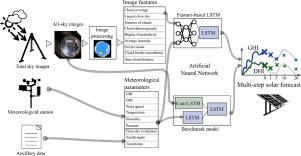
Accurate forecasting of solar irradiance is a key tool for optimizing the efficiency and service quality of solar energy systems. In this paper, a novel approach is proposed for multi-step solar irradiation forecasting using deep learning models optimized for low computational resource environments. Traditional forecasting models often lack accuracy, and modern, deep-learning based models, while accurate, require substantial computational resources, making them impractical for real-time or resource-constrained environments. Our method uniquely combines dimensionality reduction via image processing with an LSTM-based architecture, achieving significant input data reduction by a factor of 4250 while preserving essential sky condition information, resulting in a lightweight neural network architecture that balances prediction accuracy with computational efficiency. The forecasts are generated simultaneously for multiple time steps: 1 minute, 5 minutes, 10 minutes and 20 minutes. Models are evaluated against a custom dataset, spanning across more than 3 years, containing 1 min samples encompassing both all-sky imagery and meteorological measurements. The approach is demonstrated to achieve better forecasting accuracy, namely a forecast skill of 10 % compared to persistence, and a significantly reduced computational overhead compared to benchmark ConvLSTM models. Moreover, utilizing the preprocessed image features reduces input size by a factor of 6 compared to the raw images. Our findings suggest that the proposed models are well-suited for deployment in embedded systems, remote sensors, and other scenarios where computational resources are limited.
期刊介绍:
Renewable Energy journal is dedicated to advancing knowledge and disseminating insights on various topics and technologies within renewable energy systems and components. Our mission is to support researchers, engineers, economists, manufacturers, NGOs, associations, and societies in staying updated on new developments in their respective fields and applying alternative energy solutions to current practices.
As an international, multidisciplinary journal in renewable energy engineering and research, we strive to be a premier peer-reviewed platform and a trusted source of original research and reviews in the field of renewable energy. Join us in our endeavor to drive innovation and progress in sustainable energy solutions.



 京公网安备 11010802042870号
京ICP备2023020795号-1
京公网安备 11010802042870号
京ICP备2023020795号-1

 分享
分享
 求助内容:
求助内容: 应助结果提醒方式:
 扫码关注我们
