Hage Sonia , Techi Boni , Nilamoni Chelleng , Nazim Uddin Afzal , Prasenjit Manna , Suman Koirala , Parimal Kar , Chandan Tamuly
{"title":"Unraveling the bioactive profile of finger millet wine: In-vitro hypoglycemic, anti-urease activities, and In-silico molecular docking approach","authors":"Hage Sonia , Techi Boni , Nilamoni Chelleng , Nazim Uddin Afzal , Prasenjit Manna , Suman Koirala , Parimal Kar , Chandan Tamuly","doi":"10.1016/j.sajb.2025.03.058","DOIUrl":null,"url":null,"abstract":"<div><div>There is no comprehensive chemical analysis of hypoglycemic and anti-urease properties, as well as computational studies of finger millet wine (FMW). Therefore, the current study aims to investigate its hypoglycemic and anti-urease properties along with its glucose utilisation and GLUT4 transport behaviour in Rat L6 myoblast cell line and its molecular docking studies. Results revealed that FMW inhibited α-glucosidase and urease enzyme with an IC<sub>50</sub> value of 8.45 and 67.67 µg/mL, respectively. Seven phenolic compounds: <em>p</em>-coumaric, <em>trans-</em>ferulic, caffeic, protocatechuic, sinapic, vanillic, and <em>trans</em>-cinnamic acid were identified by HPLC. HS-SPME/LLE-GC–MS identified major compounds 2,3-Butanediol (24.80/0.08 %), Ethyl hydrogen succinate (24.46/11.04 %), Caffeine (14.84/5.81 %), and Methyl 4-<em>O</em>-methyl-d-arabinopyranoside (4.23/2.09 %). Glucose utilization and GLUT4 translocation showed significant (<em>p</em> < 0.05) improvement at the concentration of 40 µg/mL. Molecular docking (MD) simulation and Molecular Mechanics Poisson-Boltzmann Surface Area (MM-PBSA) studies revealed protocatechuic acid (-27.84 kcal/mol) had highest binding affinity. Additionally, we identified the hotspot residues Trp-376, Trp-481, Glu-521, Asp-404, Asp-649, and Asp-616. Thus, it can be summarised, finger millet-based wine shows potential hypoglycaemic activity backed up by glucose utilisation, docking studies have further supported the bioactive importance of this wine. This finding might open a scope for further optimization and further <em>in-vivo</em> research.</div></div>","PeriodicalId":21919,"journal":{"name":"South African Journal of Botany","volume":"180 ","pages":"Pages 820-836"},"PeriodicalIF":2.7000,"publicationDate":"2025-05-01","publicationTypes":"Journal Article","fieldsOfStudy":null,"isOpenAccess":false,"openAccessPdf":"","citationCount":"0","resultStr":null,"platform":"Semanticscholar","paperid":null,"PeriodicalName":"South African Journal of Botany","FirstCategoryId":"99","ListUrlMain":"https://www.sciencedirect.com/science/article/pii/S0254629925001826","RegionNum":3,"RegionCategory":"生物学","ArticlePicture":[],"TitleCN":null,"AbstractTextCN":null,"PMCID":null,"EPubDate":"2025/4/7 0:00:00","PubModel":"Epub","JCR":"Q2","JCRName":"PLANT SCIENCES","Score":null,"Total":0}
引用次数: 0
Abstract
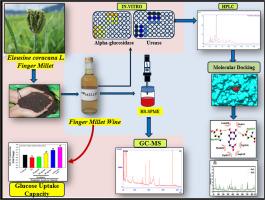
There is no comprehensive chemical analysis of hypoglycemic and anti-urease properties, as well as computational studies of finger millet wine (FMW). Therefore, the current study aims to investigate its hypoglycemic and anti-urease properties along with its glucose utilisation and GLUT4 transport behaviour in Rat L6 myoblast cell line and its molecular docking studies. Results revealed that FMW inhibited α-glucosidase and urease enzyme with an IC50 value of 8.45 and 67.67 µg/mL, respectively. Seven phenolic compounds: p-coumaric, trans-ferulic, caffeic, protocatechuic, sinapic, vanillic, and trans-cinnamic acid were identified by HPLC. HS-SPME/LLE-GC–MS identified major compounds 2,3-Butanediol (24.80/0.08 %), Ethyl hydrogen succinate (24.46/11.04 %), Caffeine (14.84/5.81 %), and Methyl 4-O-methyl-d-arabinopyranoside (4.23/2.09 %). Glucose utilization and GLUT4 translocation showed significant (p < 0.05) improvement at the concentration of 40 µg/mL. Molecular docking (MD) simulation and Molecular Mechanics Poisson-Boltzmann Surface Area (MM-PBSA) studies revealed protocatechuic acid (-27.84 kcal/mol) had highest binding affinity. Additionally, we identified the hotspot residues Trp-376, Trp-481, Glu-521, Asp-404, Asp-649, and Asp-616. Thus, it can be summarised, finger millet-based wine shows potential hypoglycaemic activity backed up by glucose utilisation, docking studies have further supported the bioactive importance of this wine. This finding might open a scope for further optimization and further in-vivo research.
期刊介绍:
The South African Journal of Botany publishes original papers that deal with the classification, biodiversity, morphology, physiology, molecular biology, ecology, biotechnology, ethnobotany and other botanically related aspects of species that are of importance to southern Africa. Manuscripts dealing with significant new findings on other species of the world and general botanical principles will also be considered and are encouraged.



 京公网安备 11010802042870号
京ICP备2023020795号-1
京公网安备 11010802042870号
京ICP备2023020795号-1

 分享
分享
 求助内容:
求助内容: 应助结果提醒方式:
 扫码关注我们
