Sali Khair Biek , Leadin S. Khudur , Matthew Askeland , Jacob Jones , Kriushnapriya Sundararajan , Shivaram Lakshminarayanan , Andrew S. Ball
{"title":"Fate of per- and polyfluoroalkyl substances through commercial composting facilities","authors":"Sali Khair Biek , Leadin S. Khudur , Matthew Askeland , Jacob Jones , Kriushnapriya Sundararajan , Shivaram Lakshminarayanan , Andrew S. Ball","doi":"10.1016/j.biortech.2025.132485","DOIUrl":null,"url":null,"abstract":"<div><div>Rising concerns about solid waste management globally necessitate the adoption of sustainable practices, particularly in dealing with organic waste, which constitutes a significant portion of municipal solid waste (MSW). Composting is an effective waste management strategy that can reduce both the environmental impact and greenhouse gas emissions of organic wastes, while producing valuable organic material (compost) for soil enhancement. However, the presence of persistent contaminants such as per- and polyfluoroalkyl substances (PFAS) in compost poses environmental and human health risks, challenging the sustainable management of organic wastes. This study investigates the fate of 33 PFAS compounds in two composting systems—windrow and in-vessel—focusing on the transformation and persistence of these compounds through the composting process, with the aim of collecting information which will support the identification of strategies to mitigate PFAS contamination in composting practices. The findings indicate significant reductions in total PFAS concentrations after composting, with reductions of 88.3% and 86.3% in the windrow and in-vessel systems, respectively. Notably, certain PFAS compounds, such as PFBS, appeared after composting, while PFPeA, became undetectable, suggesting potential leaching or transformation. Across both leachate and dust samples, PFAS concentrations were relatively low, with only a few compounds detected in each matrix. The final compost products met Australia’s proposed NEMP 3.0 guidelines. However, considering the variation in PFAS content within similar categories of waste (feedstock), compliance with regulatory limits may vary. These results highlight the need for continued research into PFAS behaviour during composting and the development of best practices to mitigate contamination risks.</div></div>","PeriodicalId":258,"journal":{"name":"Bioresource Technology","volume":"428 ","pages":"Article 132485"},"PeriodicalIF":9.0000,"publicationDate":"2025-07-01","publicationTypes":"Journal Article","fieldsOfStudy":null,"isOpenAccess":false,"openAccessPdf":"","citationCount":"0","resultStr":null,"platform":"Semanticscholar","paperid":null,"PeriodicalName":"Bioresource Technology","FirstCategoryId":"5","ListUrlMain":"https://www.sciencedirect.com/science/article/pii/S0960852425004511","RegionNum":1,"RegionCategory":"环境科学与生态学","ArticlePicture":[],"TitleCN":null,"AbstractTextCN":null,"PMCID":null,"EPubDate":"2025/4/3 0:00:00","PubModel":"Epub","JCR":"Q1","JCRName":"AGRICULTURAL ENGINEERING","Score":null,"Total":0}
引用次数: 0
Abstract
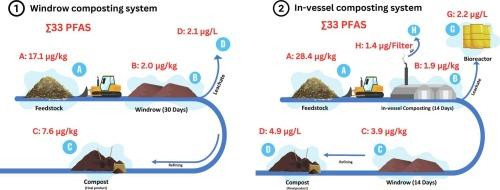
Rising concerns about solid waste management globally necessitate the adoption of sustainable practices, particularly in dealing with organic waste, which constitutes a significant portion of municipal solid waste (MSW). Composting is an effective waste management strategy that can reduce both the environmental impact and greenhouse gas emissions of organic wastes, while producing valuable organic material (compost) for soil enhancement. However, the presence of persistent contaminants such as per- and polyfluoroalkyl substances (PFAS) in compost poses environmental and human health risks, challenging the sustainable management of organic wastes. This study investigates the fate of 33 PFAS compounds in two composting systems—windrow and in-vessel—focusing on the transformation and persistence of these compounds through the composting process, with the aim of collecting information which will support the identification of strategies to mitigate PFAS contamination in composting practices. The findings indicate significant reductions in total PFAS concentrations after composting, with reductions of 88.3% and 86.3% in the windrow and in-vessel systems, respectively. Notably, certain PFAS compounds, such as PFBS, appeared after composting, while PFPeA, became undetectable, suggesting potential leaching or transformation. Across both leachate and dust samples, PFAS concentrations were relatively low, with only a few compounds detected in each matrix. The final compost products met Australia’s proposed NEMP 3.0 guidelines. However, considering the variation in PFAS content within similar categories of waste (feedstock), compliance with regulatory limits may vary. These results highlight the need for continued research into PFAS behaviour during composting and the development of best practices to mitigate contamination risks.
期刊介绍:
Bioresource Technology publishes original articles, review articles, case studies, and short communications covering the fundamentals, applications, and management of bioresource technology. The journal seeks to advance and disseminate knowledge across various areas related to biomass, biological waste treatment, bioenergy, biotransformations, bioresource systems analysis, and associated conversion or production technologies.
Topics include:
• Biofuels: liquid and gaseous biofuels production, modeling and economics
• Bioprocesses and bioproducts: biocatalysis and fermentations
• Biomass and feedstocks utilization: bioconversion of agro-industrial residues
• Environmental protection: biological waste treatment
• Thermochemical conversion of biomass: combustion, pyrolysis, gasification, catalysis.



 京公网安备 11010802042870号
京ICP备2023020795号-1
京公网安备 11010802042870号
京ICP备2023020795号-1

 分享
分享
 求助内容:
求助内容: 应助结果提醒方式:
 扫码关注我们
