Sultan Suboktagin , Muhammad Wajid Ullah , Sivasamy Sethupathy , Hareef Ahmed Keerio , Khulood Fahad Alabbosh , Khalid Ali Khan , Daochen Zhu
{"title":"Microbial cell factories for bioconversion of lignin to vanillin — Challenges and opportunities: A review","authors":"Sultan Suboktagin , Muhammad Wajid Ullah , Sivasamy Sethupathy , Hareef Ahmed Keerio , Khulood Fahad Alabbosh , Khalid Ali Khan , Daochen Zhu","doi":"10.1016/j.ijbiomac.2025.142805","DOIUrl":null,"url":null,"abstract":"<div><div>The bioconversion of lignin into vanillin via microbial cell factories offers a promising and sustainable route for producing high-value aromatic compounds from the abundant and underutilized byproducts of plant biomass. This review comprehensively explores the synthesis, structural characteristics, and diverse industrial applications of lignin, while addressing the inherent challenges posed by its complex structure in bioconversion processes. It examines the potential of microbial cell factories for lignin degradation, emphasizing the latest advancements in genetic engineering and metabolic optimization strategies that enhance microbial efficiency in lignin degradation and vanillin biosynthesis. It further assesses the economic feasibility of lignin-to-vanillin conversion by discussing key factors influencing cost-effectiveness and scalability, highlighting the transformative potential for producing high-value aromatic compounds in an environmentally sustainable manner. The review also highlights ongoing research efforts to develop robust microbial strains and optimize metabolic pathways for improved vanillin yield. By integrating multidisciplinary approaches, this review highlights the transformative potential of microbial cell factories to valorize lignin, offering a sustainable pathway for the production of vanillin and related aromatic compounds.</div></div>","PeriodicalId":333,"journal":{"name":"International Journal of Biological Macromolecules","volume":"309 ","pages":"Article 142805"},"PeriodicalIF":8.5000,"publicationDate":"2025-05-01","publicationTypes":"Journal Article","fieldsOfStudy":null,"isOpenAccess":false,"openAccessPdf":"","citationCount":"0","resultStr":null,"platform":"Semanticscholar","paperid":null,"PeriodicalName":"International Journal of Biological Macromolecules","FirstCategoryId":"92","ListUrlMain":"https://www.sciencedirect.com/science/article/pii/S0141813025033574","RegionNum":1,"RegionCategory":"化学","ArticlePicture":[],"TitleCN":null,"AbstractTextCN":null,"PMCID":null,"EPubDate":"2025/4/3 0:00:00","PubModel":"Epub","JCR":"Q1","JCRName":"BIOCHEMISTRY & MOLECULAR BIOLOGY","Score":null,"Total":0}
引用次数: 0
Abstract
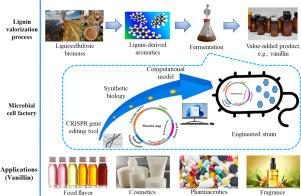
The bioconversion of lignin into vanillin via microbial cell factories offers a promising and sustainable route for producing high-value aromatic compounds from the abundant and underutilized byproducts of plant biomass. This review comprehensively explores the synthesis, structural characteristics, and diverse industrial applications of lignin, while addressing the inherent challenges posed by its complex structure in bioconversion processes. It examines the potential of microbial cell factories for lignin degradation, emphasizing the latest advancements in genetic engineering and metabolic optimization strategies that enhance microbial efficiency in lignin degradation and vanillin biosynthesis. It further assesses the economic feasibility of lignin-to-vanillin conversion by discussing key factors influencing cost-effectiveness and scalability, highlighting the transformative potential for producing high-value aromatic compounds in an environmentally sustainable manner. The review also highlights ongoing research efforts to develop robust microbial strains and optimize metabolic pathways for improved vanillin yield. By integrating multidisciplinary approaches, this review highlights the transformative potential of microbial cell factories to valorize lignin, offering a sustainable pathway for the production of vanillin and related aromatic compounds.
期刊介绍:
The International Journal of Biological Macromolecules is a well-established international journal dedicated to research on the chemical and biological aspects of natural macromolecules. Focusing on proteins, macromolecular carbohydrates, glycoproteins, proteoglycans, lignins, biological poly-acids, and nucleic acids, the journal presents the latest findings in molecular structure, properties, biological activities, interactions, modifications, and functional properties. Papers must offer new and novel insights, encompassing related model systems, structural conformational studies, theoretical developments, and analytical techniques. Each paper is required to primarily focus on at least one named biological macromolecule, reflected in the title, abstract, and text.



 京公网安备 11010802042870号
京ICP备2023020795号-1
京公网安备 11010802042870号
京ICP备2023020795号-1

 分享
分享
 求助内容:
求助内容: 应助结果提醒方式:
 扫码关注我们
