Significance of busulfan administration route including therapeutic drug monitoring in the conditioning regimen of pediatric patients prior to hematopoietic stem cell transplantation.
Stephanie Hämmerle, Jana Ernst, Regula Steiner, Tayfun Güngör, Till Milde, Bernd Gruhn
{"title":"Significance of busulfan administration route including therapeutic drug monitoring in the conditioning regimen of pediatric patients prior to hematopoietic stem cell transplantation.","authors":"Stephanie Hämmerle, Jana Ernst, Regula Steiner, Tayfun Güngör, Till Milde, Bernd Gruhn","doi":"10.1007/s00432-025-06179-w","DOIUrl":null,"url":null,"abstract":"<p><strong>Purpose: </strong>Busulfan is an important myeloablative agent in various conditioning regimens prior to hematopoietic stem cell transplantation (HSCT) in pediatric patients. This retrospective study compares three different routes of busulfan administration and their impact on transplantation-related mortality (TRM) and overall survival (OS).</p><p><strong>Methods: </strong>The study included 250 pediatric patients with malignant and non-malignant diseases who underwent HSCT at the Department of Pediatrics, Jena University Hospital, Jena, Germany. One hundred forty-eight patients received busulfan orally without therapeutic drug monitoring (TDM) (group 1), 62 patients received busulfan intravenously (i.v.) without TDM (group 2) and 40 patients received busulfan i.v. with additional TDM (group 3).</p><p><strong>Results: </strong>The TRM rate at 5 years after transplantation for all patients was 40.5% for group 1, 25.2% for group 2, and 8.4% for group 3 (p < 0.001). The TRM rate at 5 years after transplantation for patients with malignant diseases only was 40.3% for group 1 compared to 28.4% for group 2 and 15.3% for group 3 (p = 0.051). For patients with non-malignant diseases, group 1 showed a TRM rate of 43.8% compared to 15.4% in group 2 and 4.6% in group 3 (p = 0.009). In addition, the 5-year OS rate for all patients was 39.9% for group 1, 61.2% for group 2, and 83.9% for group 3 (p < 0.001). Regarding the OS of the groups for patients with only malignant or only non-malignant diseases, we obtained similar results with p-values of p = 0.017 and p = 0.007, respectively. The cumulative incidence of hepatic sinusoidal obstruction syndrome (SOS) for patients with malignant diseases and a cumulative AUC > 85.0 mg/L x h was 55.6%, while patients with malignant diseases and a cumulative AUC < 85.0 mg/L x h showed a cumulative incidence of 11.1% (p = 0.038).</p><p><strong>Conclusion: </strong>In this study, we demonstrate that patients with i.v. administration of busulfan with TDM had a significantly lower rate of TRM and a significantly improved OS compared to patients who received i.v. administration of busulfan without TDM, who, in turn, had a better outcome than patients with oral busulfan administration. Additionally, these data emphasize the clinical relevance of AUC measurements in patients with malignant diseases to prevent hepatic SOS.</p>","PeriodicalId":15118,"journal":{"name":"Journal of Cancer Research and Clinical Oncology","volume":"151 4","pages":"132"},"PeriodicalIF":2.8000,"publicationDate":"2025-04-04","publicationTypes":"Journal Article","fieldsOfStudy":null,"isOpenAccess":false,"openAccessPdf":"https://www.ncbi.nlm.nih.gov/pmc/articles/PMC11971230/pdf/","citationCount":"0","resultStr":null,"platform":"Semanticscholar","paperid":null,"PeriodicalName":"Journal of Cancer Research and Clinical Oncology","FirstCategoryId":"3","ListUrlMain":"https://doi.org/10.1007/s00432-025-06179-w","RegionNum":3,"RegionCategory":"医学","ArticlePicture":[],"TitleCN":null,"AbstractTextCN":null,"PMCID":null,"EPubDate":"","PubModel":"","JCR":"Q3","JCRName":"ONCOLOGY","Score":null,"Total":0}
引用次数: 0
Abstract
Purpose: Busulfan is an important myeloablative agent in various conditioning regimens prior to hematopoietic stem cell transplantation (HSCT) in pediatric patients. This retrospective study compares three different routes of busulfan administration and their impact on transplantation-related mortality (TRM) and overall survival (OS).
Methods: The study included 250 pediatric patients with malignant and non-malignant diseases who underwent HSCT at the Department of Pediatrics, Jena University Hospital, Jena, Germany. One hundred forty-eight patients received busulfan orally without therapeutic drug monitoring (TDM) (group 1), 62 patients received busulfan intravenously (i.v.) without TDM (group 2) and 40 patients received busulfan i.v. with additional TDM (group 3).
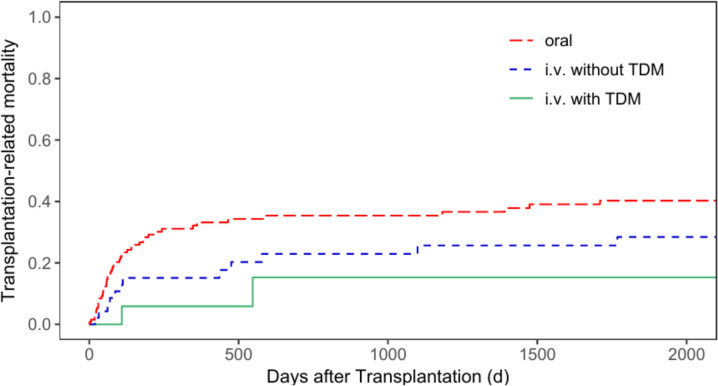
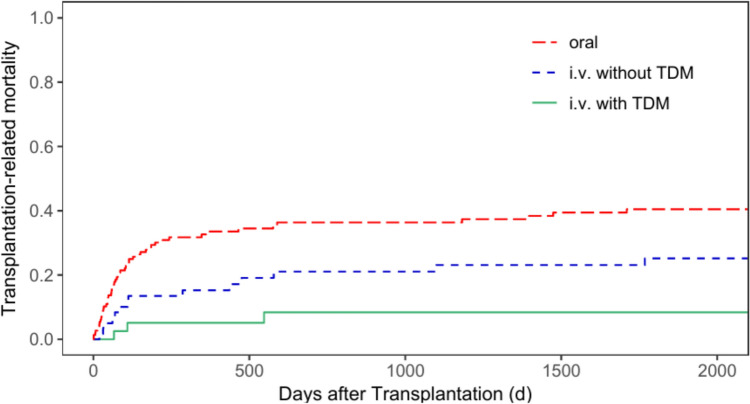
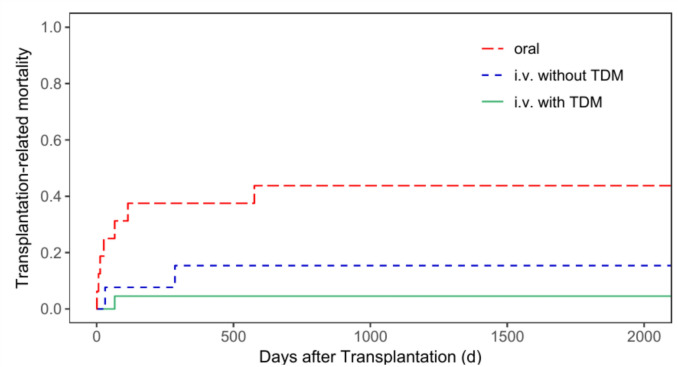
Results: The TRM rate at 5 years after transplantation for all patients was 40.5% for group 1, 25.2% for group 2, and 8.4% for group 3 (p < 0.001). The TRM rate at 5 years after transplantation for patients with malignant diseases only was 40.3% for group 1 compared to 28.4% for group 2 and 15.3% for group 3 (p = 0.051). For patients with non-malignant diseases, group 1 showed a TRM rate of 43.8% compared to 15.4% in group 2 and 4.6% in group 3 (p = 0.009). In addition, the 5-year OS rate for all patients was 39.9% for group 1, 61.2% for group 2, and 83.9% for group 3 (p < 0.001). Regarding the OS of the groups for patients with only malignant or only non-malignant diseases, we obtained similar results with p-values of p = 0.017 and p = 0.007, respectively. The cumulative incidence of hepatic sinusoidal obstruction syndrome (SOS) for patients with malignant diseases and a cumulative AUC > 85.0 mg/L x h was 55.6%, while patients with malignant diseases and a cumulative AUC < 85.0 mg/L x h showed a cumulative incidence of 11.1% (p = 0.038).
Conclusion: In this study, we demonstrate that patients with i.v. administration of busulfan with TDM had a significantly lower rate of TRM and a significantly improved OS compared to patients who received i.v. administration of busulfan without TDM, who, in turn, had a better outcome than patients with oral busulfan administration. Additionally, these data emphasize the clinical relevance of AUC measurements in patients with malignant diseases to prevent hepatic SOS.
期刊介绍:
The "Journal of Cancer Research and Clinical Oncology" publishes significant and up-to-date articles within the fields of experimental and clinical oncology. The journal, which is chiefly devoted to Original papers, also includes Reviews as well as Editorials and Guest editorials on current, controversial topics. The section Letters to the editors provides a forum for a rapid exchange of comments and information concerning previously published papers and topics of current interest. Meeting reports provide current information on the latest results presented at important congresses.
The following fields are covered: carcinogenesis - etiology, mechanisms; molecular biology; recent developments in tumor therapy; general diagnosis; laboratory diagnosis; diagnostic and experimental pathology; oncologic surgery; and epidemiology.



 京公网安备 11010802042870号
京ICP备2023020795号-1
京公网安备 11010802042870号
京ICP备2023020795号-1

 分享
分享
 求助内容:
求助内容: 应助结果提醒方式:
 扫码关注我们
