Larissa Ventura Ribeiro Bruscky, Bruno Pereira Valdigem, Edileide de Barros Correia, Paulo Chaccur, Andrea de Andrade Vilela, Antônio Tito Paladino Filho, Ibraim Pinto, Rui Fernando Ramos, Jorge Eduardo Assef
{"title":"Efficacy and safety of myectomy and radiofrequency septal ablation for treating hypertrophic obstructive cardiomyopathy.","authors":"Larissa Ventura Ribeiro Bruscky, Bruno Pereira Valdigem, Edileide de Barros Correia, Paulo Chaccur, Andrea de Andrade Vilela, Antônio Tito Paladino Filho, Ibraim Pinto, Rui Fernando Ramos, Jorge Eduardo Assef","doi":"10.1136/openhrt-2025-003166","DOIUrl":null,"url":null,"abstract":"<p><strong>Background: </strong>Novel treatments are needed for patients with severely symptomatic obstructive hypertrophic cardiomyopathy (oHCM). Radiofrequency (RF) septal ablation has emerged as a promising technique for improving the left ventricular outflow tract (LVOT) gradient and alleviating symptoms, potentially achieving outcomes comparable to the gold-standard surgical myectomy.</p><p><strong>Objectives: </strong>To compare the 1-year efficacy and safety of surgical myectomy with RF septal ablation in patients with oHCM.</p><p><strong>Methods: </strong>This observational, retrospective cohort study included patients aged≥18 years with oHCM and an LVOT gradient≥50 mm Hg, unresponsive to medical therapy, who underwent surgical myectomy or RF septal ablation between 2012 and 2022.</p><p><strong>Results: </strong>The mean age was 49.8±14 and 56.9±10.9 years for the myectomy and RF groups, respectively, with the same sex distribution. The proportions of patients in functional class III distributions were 54.5% and 76.1% in the myectomy and RF groups, respectively. The LVOT gradient was 108.6±49.8 and 101.1±40.3 mm Hg for the myectomy and RF groups, respectively. Procedural success, defined as a reduction in the LVOT gradient to <50 mm Hg or an improvement to functional class I or II, showed no significant difference between the groups (HR: -3.5; 95% CI: -20.2 to 13.12; p=0.673). Complications occurred in 57.6% and 4.6% of the patients in the myectomy and RF groups, respectively (p<0.001).</p><p><strong>Conclusions: </strong>RF septal ablation and surgical myectomy demonstrated similar efficacy in reducing LVOT gradients and improving symptoms. However, RF ablation exhibited a superior safety profile.</p>","PeriodicalId":19505,"journal":{"name":"Open Heart","volume":"12 1","pages":""},"PeriodicalIF":2.8000,"publicationDate":"2025-04-04","publicationTypes":"Journal Article","fieldsOfStudy":null,"isOpenAccess":false,"openAccessPdf":"https://www.ncbi.nlm.nih.gov/pmc/articles/PMC11973751/pdf/","citationCount":"0","resultStr":null,"platform":"Semanticscholar","paperid":null,"PeriodicalName":"Open Heart","FirstCategoryId":"1085","ListUrlMain":"https://doi.org/10.1136/openhrt-2025-003166","RegionNum":0,"RegionCategory":null,"ArticlePicture":[],"TitleCN":null,"AbstractTextCN":null,"PMCID":null,"EPubDate":"","PubModel":"","JCR":"Q2","JCRName":"CARDIAC & CARDIOVASCULAR SYSTEMS","Score":null,"Total":0}
引用次数: 0
Abstract
Background: Novel treatments are needed for patients with severely symptomatic obstructive hypertrophic cardiomyopathy (oHCM). Radiofrequency (RF) septal ablation has emerged as a promising technique for improving the left ventricular outflow tract (LVOT) gradient and alleviating symptoms, potentially achieving outcomes comparable to the gold-standard surgical myectomy.
Objectives: To compare the 1-year efficacy and safety of surgical myectomy with RF septal ablation in patients with oHCM.
Methods: This observational, retrospective cohort study included patients aged≥18 years with oHCM and an LVOT gradient≥50 mm Hg, unresponsive to medical therapy, who underwent surgical myectomy or RF septal ablation between 2012 and 2022.
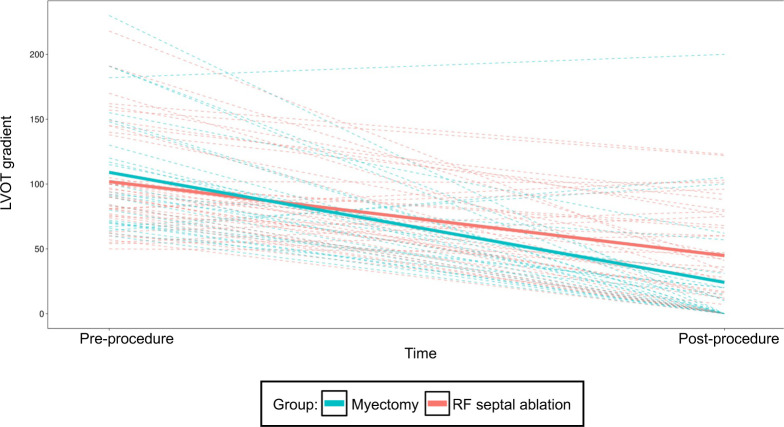
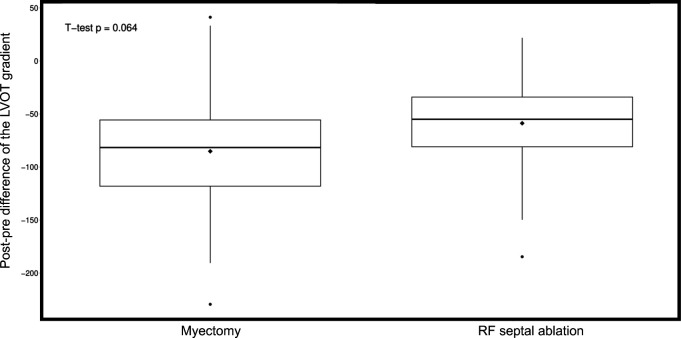
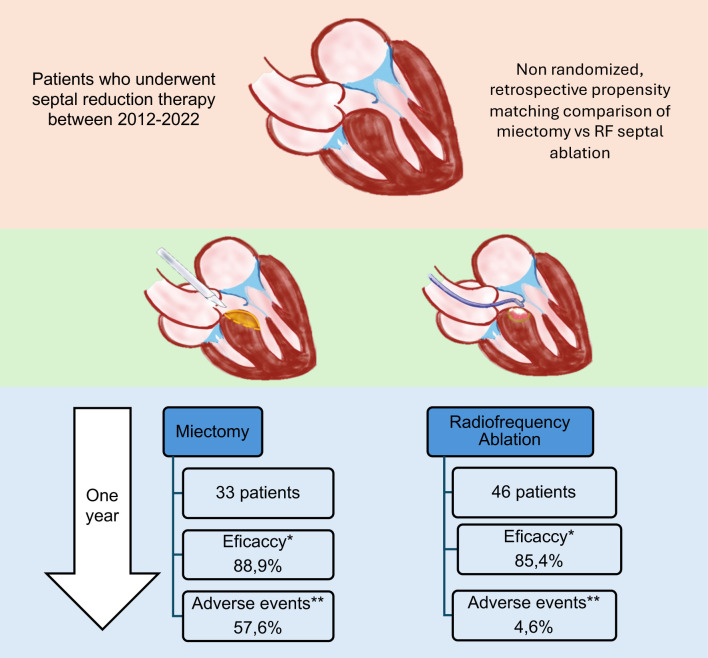
Results: The mean age was 49.8±14 and 56.9±10.9 years for the myectomy and RF groups, respectively, with the same sex distribution. The proportions of patients in functional class III distributions were 54.5% and 76.1% in the myectomy and RF groups, respectively. The LVOT gradient was 108.6±49.8 and 101.1±40.3 mm Hg for the myectomy and RF groups, respectively. Procedural success, defined as a reduction in the LVOT gradient to <50 mm Hg or an improvement to functional class I or II, showed no significant difference between the groups (HR: -3.5; 95% CI: -20.2 to 13.12; p=0.673). Complications occurred in 57.6% and 4.6% of the patients in the myectomy and RF groups, respectively (p<0.001).
Conclusions: RF septal ablation and surgical myectomy demonstrated similar efficacy in reducing LVOT gradients and improving symptoms. However, RF ablation exhibited a superior safety profile.
背景:严重症状性梗阻性肥厚性心肌病(oHCM)患者需要新的治疗方法。射频(RF)室间隔消融术已成为改善左心室流出道(LVOT)梯度和缓解症状的一种很有前途的技术,可能达到与金标准手术肌瘤切除术相当的结果。目的:比较外科子宫肌瘤切除术与射频间隔消融术治疗oHCM患者1年的疗效和安全性。方法:这项观察性、回顾性队列研究纳入了年龄≥18岁、LVOT梯度≥50 mm Hg、对药物治疗无反应的oHCM患者,这些患者在2012年至2022年期间接受了子宫肌瘤切除术或射频间隔消融手术。结果:肌瘤切除组和射频组的平均年龄分别为49.8±14岁和56.9±10.9岁,性别分布相同。在myectomy组和RF组中,功能性III类分布的患者比例分别为54.5%和76.1%。术后LVOT梯度分别为108.6±49.8 mm Hg和101.1±40.3 mm Hg。结论:射频间隔消融和手术肌瘤切除术在降低LVOT梯度和改善症状方面表现出相似的疗效。然而,射频消融显示出优越的安全性。
期刊介绍:
Open Heart is an online-only, open access cardiology journal that aims to be “open” in many ways: open access (free access for all readers), open peer review (unblinded peer review) and open data (data sharing is encouraged). The goal is to ensure maximum transparency and maximum impact on research progress and patient care. The journal is dedicated to publishing high quality, peer reviewed medical research in all disciplines and therapeutic areas of cardiovascular medicine. Research is published across all study phases and designs, from study protocols to phase I trials to meta-analyses, including small or specialist studies. Opinionated discussions on controversial topics are welcomed. Open Heart aims to operate a fast submission and review process with continuous publication online, to ensure timely, up-to-date research is available worldwide. The journal adheres to a rigorous and transparent peer review process, and all articles go through a statistical assessment to ensure robustness of the analyses. Open Heart is an official journal of the British Cardiovascular Society.




 京公网安备 11010802042870号
京ICP备2023020795号-1
京公网安备 11010802042870号
京ICP备2023020795号-1

 分享
分享
 求助内容:
求助内容: 应助结果提醒方式:
 扫码关注我们
