{"title":"Engineering Lattice Distortion in Ruthenium Oxide Enables Robust Acidic Water Oxidation via Direct O–O Coupling","authors":"Yin'an Zhu, Fei Wu, Xiaozan Zhang, Yichao Lin, Linjuan Zhang, Ting-Shan Chan, Qiuju Zhang, Liang Chen","doi":"10.1002/adma.202500449","DOIUrl":null,"url":null,"abstract":"<p>Ruthenium is considered one of the most promising alternatives to iridium as an anode electrocatalyst for proton exchange membrane water electrolysis (PEMWE). However, Ru-based electrocatalysts suffer from poor stability, primarily due to structural collapse under the harsh acidic conditions of oxygen evolution reaction (OER). Here, a design strategy is introduced that significantly enhances both the stability and activity of RuO<sub>2</sub> by switching the catalytic mechanism from the adsorbate evolution mechanism (AEM) to the oxide pathway mechanism (OPM). This is achieved through lattice distortion engineering using a co-doping strategy involving large-radius ions (Na⁺ and Hf <sup>4+</sup>). The incorporation of Na<sup>+</sup> and Hf <sup>4+</sup> into RuO<sub>2</sub> induces significant lattice distortion, shortening partial Ru─Ru bond distance and optimizing the electronic structure. This modification facilitates direct O–O radical coupling, as confirmed by in situ vibrational measurements and theoretical calculations. It can drive a current density of 1 A cm<sup>−2</sup> in a PEMWE device at 60 °C with 1.646 V and operates stably for 85 h at 0.5 A cm<sup>−2</sup>. The present study highlights that optimizing the synergistic interaction between two adjacent Ru sites to promote direct O–O coupling is an effective strategy for enhancing the acidic OER performance of RuO<sub>2</sub>.</p>","PeriodicalId":114,"journal":{"name":"Advanced Materials","volume":"37 24","pages":""},"PeriodicalIF":26.8000,"publicationDate":"2025-04-07","publicationTypes":"Journal Article","fieldsOfStudy":null,"isOpenAccess":false,"openAccessPdf":"","citationCount":"0","resultStr":null,"platform":"Semanticscholar","paperid":null,"PeriodicalName":"Advanced Materials","FirstCategoryId":"88","ListUrlMain":"https://advanced.onlinelibrary.wiley.com/doi/10.1002/adma.202500449","RegionNum":1,"RegionCategory":"材料科学","ArticlePicture":[],"TitleCN":null,"AbstractTextCN":null,"PMCID":null,"EPubDate":"","PubModel":"","JCR":"Q1","JCRName":"CHEMISTRY, MULTIDISCIPLINARY","Score":null,"Total":0}
引用次数: 0
Abstract
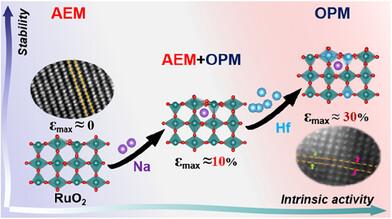
Ruthenium is considered one of the most promising alternatives to iridium as an anode electrocatalyst for proton exchange membrane water electrolysis (PEMWE). However, Ru-based electrocatalysts suffer from poor stability, primarily due to structural collapse under the harsh acidic conditions of oxygen evolution reaction (OER). Here, a design strategy is introduced that significantly enhances both the stability and activity of RuO2 by switching the catalytic mechanism from the adsorbate evolution mechanism (AEM) to the oxide pathway mechanism (OPM). This is achieved through lattice distortion engineering using a co-doping strategy involving large-radius ions (Na⁺ and Hf 4+). The incorporation of Na+ and Hf 4+ into RuO2 induces significant lattice distortion, shortening partial Ru─Ru bond distance and optimizing the electronic structure. This modification facilitates direct O–O radical coupling, as confirmed by in situ vibrational measurements and theoretical calculations. It can drive a current density of 1 A cm−2 in a PEMWE device at 60 °C with 1.646 V and operates stably for 85 h at 0.5 A cm−2. The present study highlights that optimizing the synergistic interaction between two adjacent Ru sites to promote direct O–O coupling is an effective strategy for enhancing the acidic OER performance of RuO2.
钌作为质子交换膜电解(PEMWE)的阳极电催化剂,被认为是最有前途的铱替代品之一。然而,钌基电催化剂的稳定性较差,主要是由于在析氧反应(OER)的恶劣酸性条件下结构崩溃。本文介绍了一种设计策略,通过将催化机制从吸附质演化机制(AEM)转变为氧化途径机制(OPM),显著提高了RuO2的稳定性和活性。这是通过使用大半径离子(Na⁺和Hf 4+)共掺杂策略的晶格畸变工程实现的。在RuO2中掺入Na+和Hf 4+引起了明显的晶格畸变,缩短了部分Ru─Ru键的距离,优化了电子结构。原位振动测量和理论计算证实,这种改性有利于O-O自由基的直接耦合。它可以在60°C、1.646 V的PEMWE器件中驱动1 a cm−2的电流密度,并在0.5 a cm−2下稳定工作85小时。本研究强调,优化相邻两个Ru位点之间的协同作用,促进O-O直接耦合是提高RuO2酸性OER性能的有效策略。
期刊介绍:
Advanced Materials, one of the world's most prestigious journals and the foundation of the Advanced portfolio, is the home of choice for best-in-class materials science for more than 30 years. Following this fast-growing and interdisciplinary field, we are considering and publishing the most important discoveries on any and all materials from materials scientists, chemists, physicists, engineers as well as health and life scientists and bringing you the latest results and trends in modern materials-related research every week.



 京公网安备 11010802042870号
京ICP备2023020795号-1
京公网安备 11010802042870号
京ICP备2023020795号-1

 分享
分享
 求助内容:
求助内容: 应助结果提醒方式:
 扫码关注我们
