{"title":"Low-Threshold and Ultrastable Amplified Spontaneous Emission from CsPbBr3@Glass via Glass Network Modulation","authors":"Ruidan Zhang, Zhehong Zhou, Xueyang Li, Tao Pang, Tong Song, Haijun Wu, Qingqing Liao, Zhibin Wang, Feng Huang, Kaifeng Wu, Daqin Chen","doi":"10.1021/acsnano.5c01653","DOIUrl":null,"url":null,"abstract":"Inorganic lead halide perovskite quantum dot (QD)-embedded glasses with exceptional optical properties and stability are promising optical gain media for laser applications, but their amplified spontaneous emission (ASE) typically occurs at high pumping thresholds. Here, we report a glass network modulation strategy for low-threshold ASE from CsPbBr<sub>3</sub>@glass. By adding ZrO<sub>2</sub> to enhance the glass network polymerization, high-quality and compact growth of QDs inside glass is promoted rather than uncontrolled self-crystallization. Transient absorption measurements reveal that this method reduces carrier trapping, inhibits biexciton Auger recombination, and accelerates hot exciton cooling, enabling efficient population inversion. Consequently, the CsPbBr<sub>3</sub>@glass exhibits a record-low ASE threshold of 54.5 μ J cm<sup>–2</sup> and a high net modal gain coefficient of 394.4 cm<sup>–1</sup> under femtosecond pulse excitation, together with quasi-continuous ASE realized using nanosecond laser pumping. Notably, our CsPbBr<sub>3</sub>@glass is orders of magnitude more stable than their colloidal counterparts for ASE under identical excitation conditions. This study underscores the potential for developing high-performance lasers using glass-protected perovskite QDs.","PeriodicalId":21,"journal":{"name":"ACS Nano","volume":"86 1","pages":""},"PeriodicalIF":16.0000,"publicationDate":"2025-04-07","publicationTypes":"Journal Article","fieldsOfStudy":null,"isOpenAccess":false,"openAccessPdf":"","citationCount":"0","resultStr":null,"platform":"Semanticscholar","paperid":null,"PeriodicalName":"ACS Nano","FirstCategoryId":"88","ListUrlMain":"https://doi.org/10.1021/acsnano.5c01653","RegionNum":1,"RegionCategory":"材料科学","ArticlePicture":[],"TitleCN":null,"AbstractTextCN":null,"PMCID":null,"EPubDate":"","PubModel":"","JCR":"Q1","JCRName":"CHEMISTRY, MULTIDISCIPLINARY","Score":null,"Total":0}
引用次数: 0
Abstract
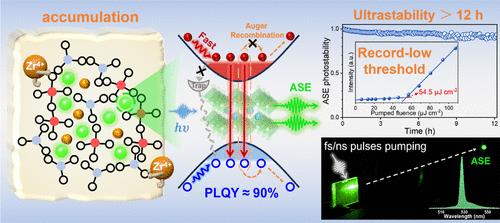
Inorganic lead halide perovskite quantum dot (QD)-embedded glasses with exceptional optical properties and stability are promising optical gain media for laser applications, but their amplified spontaneous emission (ASE) typically occurs at high pumping thresholds. Here, we report a glass network modulation strategy for low-threshold ASE from CsPbBr3@glass. By adding ZrO2 to enhance the glass network polymerization, high-quality and compact growth of QDs inside glass is promoted rather than uncontrolled self-crystallization. Transient absorption measurements reveal that this method reduces carrier trapping, inhibits biexciton Auger recombination, and accelerates hot exciton cooling, enabling efficient population inversion. Consequently, the CsPbBr3@glass exhibits a record-low ASE threshold of 54.5 μ J cm–2 and a high net modal gain coefficient of 394.4 cm–1 under femtosecond pulse excitation, together with quasi-continuous ASE realized using nanosecond laser pumping. Notably, our CsPbBr3@glass is orders of magnitude more stable than their colloidal counterparts for ASE under identical excitation conditions. This study underscores the potential for developing high-performance lasers using glass-protected perovskite QDs.
期刊介绍:
ACS Nano, published monthly, serves as an international forum for comprehensive articles on nanoscience and nanotechnology research at the intersections of chemistry, biology, materials science, physics, and engineering. The journal fosters communication among scientists in these communities, facilitating collaboration, new research opportunities, and advancements through discoveries. ACS Nano covers synthesis, assembly, characterization, theory, and simulation of nanostructures, nanobiotechnology, nanofabrication, methods and tools for nanoscience and nanotechnology, and self- and directed-assembly. Alongside original research articles, it offers thorough reviews, perspectives on cutting-edge research, and discussions envisioning the future of nanoscience and nanotechnology.



 京公网安备 11010802042870号
京ICP备2023020795号-1
京公网安备 11010802042870号
京ICP备2023020795号-1

 分享
分享
 求助内容:
求助内容: 应助结果提醒方式:
 扫码关注我们
