{"title":"Interpretable Machine Learning for Evaluating Nanogenerators’ Structural Design","authors":"Chi Han, Mingyu Jin, Fuying Dong, Pengchong Xu, Xinnian Jiang, Sheling T. Cai, Yuanwen Jiang, Yongfeng Zhang, Yin Fang, Simiao Niu","doi":"10.1021/acsnano.5c02525","DOIUrl":null,"url":null,"abstract":"The limited battery life in modern mobile, wearable, and implantable electronics critically constrains their operational longevity and continuous use. Consequently, as a self-powered technology, triboelectric nanogenerators (TENGs) have emerged as a promising solution to this. Traditional approaches for evaluating TENG structural design typically require manual, repetitive, time-consuming, and high-cost finite element modeling or experiments. To overcome this bottleneck, we developed a fully automated platform that leverages machine learning (ML) techniques. Our framework contains an artificial neuron network-based surrogate model that can provide accurate and reliable performance predictions for any structural parameters and a TreeSHAP interpretable ML model that can generate precise global and local insights for TENG structural parameters. Our platform shows broad adaptability to multiple TENG structures. In summary, our platform is an integrated platform that utilizes interpretable ML techniques to solve the complex multidimensional TENG structural evaluation problem, marking a significant advancement in TENG design and supporting sustainable energy solutions in mobile electronics.","PeriodicalId":21,"journal":{"name":"ACS Nano","volume":"37 1","pages":""},"PeriodicalIF":16.0000,"publicationDate":"2025-04-07","publicationTypes":"Journal Article","fieldsOfStudy":null,"isOpenAccess":false,"openAccessPdf":"","citationCount":"0","resultStr":null,"platform":"Semanticscholar","paperid":null,"PeriodicalName":"ACS Nano","FirstCategoryId":"88","ListUrlMain":"https://doi.org/10.1021/acsnano.5c02525","RegionNum":1,"RegionCategory":"材料科学","ArticlePicture":[],"TitleCN":null,"AbstractTextCN":null,"PMCID":null,"EPubDate":"","PubModel":"","JCR":"Q1","JCRName":"CHEMISTRY, MULTIDISCIPLINARY","Score":null,"Total":0}
引用次数: 0
Abstract
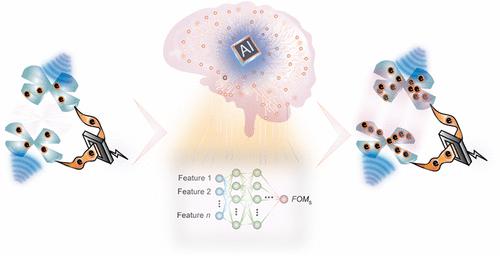
The limited battery life in modern mobile, wearable, and implantable electronics critically constrains their operational longevity and continuous use. Consequently, as a self-powered technology, triboelectric nanogenerators (TENGs) have emerged as a promising solution to this. Traditional approaches for evaluating TENG structural design typically require manual, repetitive, time-consuming, and high-cost finite element modeling or experiments. To overcome this bottleneck, we developed a fully automated platform that leverages machine learning (ML) techniques. Our framework contains an artificial neuron network-based surrogate model that can provide accurate and reliable performance predictions for any structural parameters and a TreeSHAP interpretable ML model that can generate precise global and local insights for TENG structural parameters. Our platform shows broad adaptability to multiple TENG structures. In summary, our platform is an integrated platform that utilizes interpretable ML techniques to solve the complex multidimensional TENG structural evaluation problem, marking a significant advancement in TENG design and supporting sustainable energy solutions in mobile electronics.
期刊介绍:
ACS Nano, published monthly, serves as an international forum for comprehensive articles on nanoscience and nanotechnology research at the intersections of chemistry, biology, materials science, physics, and engineering. The journal fosters communication among scientists in these communities, facilitating collaboration, new research opportunities, and advancements through discoveries. ACS Nano covers synthesis, assembly, characterization, theory, and simulation of nanostructures, nanobiotechnology, nanofabrication, methods and tools for nanoscience and nanotechnology, and self- and directed-assembly. Alongside original research articles, it offers thorough reviews, perspectives on cutting-edge research, and discussions envisioning the future of nanoscience and nanotechnology.



 京公网安备 11010802042870号
京ICP备2023020795号-1
京公网安备 11010802042870号
京ICP备2023020795号-1

 分享
分享
 求助内容:
求助内容: 应助结果提醒方式:
 扫码关注我们
