Ultrasensitive Love-SAW Biosensor Based on Self-Assembled DMSN@AuNPs with In Situ Amplification for Detecting Biomarker Procalcitonin in Exhaled Breath Condensate
Xiaojing Zhang, Li Sin Wong, Zhenyuan Tang, Hangming Xiong, Jiaying Sun, Liubing Kong, Min Tu, Yanjie Hu, Yong Zhou, Wenwu Zhu, K. Jimmy Hsia, Hao Wan, Ping Wang
{"title":"Ultrasensitive Love-SAW Biosensor Based on Self-Assembled DMSN@AuNPs with In Situ Amplification for Detecting Biomarker Procalcitonin in Exhaled Breath Condensate","authors":"Xiaojing Zhang, Li Sin Wong, Zhenyuan Tang, Hangming Xiong, Jiaying Sun, Liubing Kong, Min Tu, Yanjie Hu, Yong Zhou, Wenwu Zhu, K. Jimmy Hsia, Hao Wan, Ping Wang","doi":"10.1021/acssensors.5c00021","DOIUrl":null,"url":null,"abstract":"The COVID-19 pandemic has highlighted the importance of early screening and pathogen identification for the effective treatment of pneumonia. Exhaled breath condensate (EBC) provides a noninvasive and easily accessible method for early diagnosis of respiratory diseases, as it captures biomarkers from the airway lining fluid, offering a timely and reliable reflection of respiratory inflammation. Procalcitonin (PCT) is a biomarker widely used to assess infection type and severity, particularly for distinguishing between bacterial and nonbacterial pneumonia. However, detecting PCT especially in EBC is challenging due to its extremely low concentrations. In this work, we developed an ultrasensitive Love-type surface acoustic wave (Love-SAW) biosensor based on self-assembled gold nanoparticles on dendritic mesoporous silica nanoparticles (DMSN@AuNPs) with in situ amplification for PCT detection in EBC. Dendritic mesoporous silica nanoparticles (DMSNs), an emerging porous material with features of large surface area, high thermal stability, and ease of functionalization were employed to load a large amount of AuNPs that can spontaneously grow in situ to further enhance the sensing performance. An automatic detection system was also developed to integrate with the Love-SAW biosensor for multichannel detection of PCT in EBC for pneumonia screening. The DMSN@AuNPs based Love-SAW biosensor demonstrates remarkable performance with a detection range of 0.01–10 ng/mL and detection limit of 3.7 pg/mL, which is about 350 times higher than conventional AuNPs-based methods. These results validate the potential of DMSN@AuNPs based Love-SAW biosensors for ultrasensitive detection of low-concentration biomarkers, providing a promising platform for in vitro diagnostics.","PeriodicalId":24,"journal":{"name":"ACS Sensors","volume":"217 1","pages":""},"PeriodicalIF":9.1000,"publicationDate":"2025-04-07","publicationTypes":"Journal Article","fieldsOfStudy":null,"isOpenAccess":false,"openAccessPdf":"","citationCount":"0","resultStr":null,"platform":"Semanticscholar","paperid":null,"PeriodicalName":"ACS Sensors","FirstCategoryId":"92","ListUrlMain":"https://doi.org/10.1021/acssensors.5c00021","RegionNum":1,"RegionCategory":"化学","ArticlePicture":[],"TitleCN":null,"AbstractTextCN":null,"PMCID":null,"EPubDate":"","PubModel":"","JCR":"Q1","JCRName":"CHEMISTRY, ANALYTICAL","Score":null,"Total":0}
引用次数: 0
Abstract
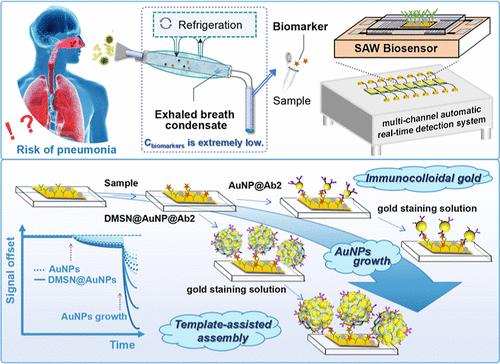
The COVID-19 pandemic has highlighted the importance of early screening and pathogen identification for the effective treatment of pneumonia. Exhaled breath condensate (EBC) provides a noninvasive and easily accessible method for early diagnosis of respiratory diseases, as it captures biomarkers from the airway lining fluid, offering a timely and reliable reflection of respiratory inflammation. Procalcitonin (PCT) is a biomarker widely used to assess infection type and severity, particularly for distinguishing between bacterial and nonbacterial pneumonia. However, detecting PCT especially in EBC is challenging due to its extremely low concentrations. In this work, we developed an ultrasensitive Love-type surface acoustic wave (Love-SAW) biosensor based on self-assembled gold nanoparticles on dendritic mesoporous silica nanoparticles (DMSN@AuNPs) with in situ amplification for PCT detection in EBC. Dendritic mesoporous silica nanoparticles (DMSNs), an emerging porous material with features of large surface area, high thermal stability, and ease of functionalization were employed to load a large amount of AuNPs that can spontaneously grow in situ to further enhance the sensing performance. An automatic detection system was also developed to integrate with the Love-SAW biosensor for multichannel detection of PCT in EBC for pneumonia screening. The DMSN@AuNPs based Love-SAW biosensor demonstrates remarkable performance with a detection range of 0.01–10 ng/mL and detection limit of 3.7 pg/mL, which is about 350 times higher than conventional AuNPs-based methods. These results validate the potential of DMSN@AuNPs based Love-SAW biosensors for ultrasensitive detection of low-concentration biomarkers, providing a promising platform for in vitro diagnostics.
期刊介绍:
ACS Sensors is a peer-reviewed research journal that focuses on the dissemination of new and original knowledge in the field of sensor science, particularly those that selectively sense chemical or biological species or processes. The journal covers a broad range of topics, including but not limited to biosensors, chemical sensors, gas sensors, intracellular sensors, single molecule sensors, cell chips, and microfluidic devices. It aims to publish articles that address conceptual advances in sensing technology applicable to various types of analytes or application papers that report on the use of existing sensing concepts in new ways or for new analytes.



 京公网安备 11010802042870号
京ICP备2023020795号-1
京公网安备 11010802042870号
京ICP备2023020795号-1

 分享
分享
 求助内容:
求助内容: 应助结果提醒方式:
 扫码关注我们
