Song Yang, Callum Robertson Smith, Christian Rosenberg Petersen, Ole Bang
{"title":"All-Fiber 2 µm Mamyshev Oscillator: Mapping of Different Operating Regimes","authors":"Song Yang, Callum Robertson Smith, Christian Rosenberg Petersen, Ole Bang","doi":"10.1002/lpor.202500074","DOIUrl":null,"url":null,"abstract":"<p>The Mamyshev oscillator is an elegant and versatile method for generating ultrashort and high-energy laser pulses. It is realized in an all-fiber structure, which provides robustness and good beam quality, ensuring reliable and efficient performance. An all-fiber 2 µm Mamyshev oscillator is presented based on two Tm-doped fiber amplifiers separated by a broadband fixed wavelength filter with 11.2 nm −3 dB bandwidth and a tunable narrow bandwidth filter with 1.1 nm −3 dB bandwidth. Three distinct emission regimes are identified and mapped out in terms of the pump power and the filter wavelength separation: 1) no mode-locking if either pump power is insufficient 2) stable mode-locking in a limited region of pump powers, and 3) noise-like pulse mode-locking if one of the pump powers exceeds a threshold. It is demonstrated how the mode-locking region in terms of the two pump powers narrows with increasing filter wavelength separation and the pulses are compressed to 309 fs in standard silica fiber. The map over operation regimes provides a clear relationship between operating regimes and cavity parameters, offering valuable insights into the design of Mamyshev oscillators using filters of significantly different bandwidths.</p>","PeriodicalId":204,"journal":{"name":"Laser & Photonics Reviews","volume":"19 14","pages":""},"PeriodicalIF":10.0000,"publicationDate":"2025-04-07","publicationTypes":"Journal Article","fieldsOfStudy":null,"isOpenAccess":false,"openAccessPdf":"https://onlinelibrary.wiley.com/doi/epdf/10.1002/lpor.202500074","citationCount":"0","resultStr":null,"platform":"Semanticscholar","paperid":null,"PeriodicalName":"Laser & Photonics Reviews","FirstCategoryId":"101","ListUrlMain":"https://onlinelibrary.wiley.com/doi/10.1002/lpor.202500074","RegionNum":1,"RegionCategory":"物理与天体物理","ArticlePicture":[],"TitleCN":null,"AbstractTextCN":null,"PMCID":null,"EPubDate":"","PubModel":"","JCR":"Q1","JCRName":"OPTICS","Score":null,"Total":0}
引用次数: 0
Abstract
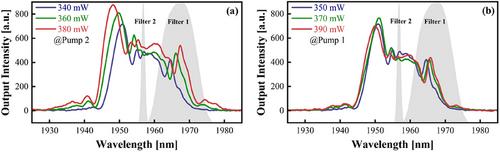
The Mamyshev oscillator is an elegant and versatile method for generating ultrashort and high-energy laser pulses. It is realized in an all-fiber structure, which provides robustness and good beam quality, ensuring reliable and efficient performance. An all-fiber 2 µm Mamyshev oscillator is presented based on two Tm-doped fiber amplifiers separated by a broadband fixed wavelength filter with 11.2 nm −3 dB bandwidth and a tunable narrow bandwidth filter with 1.1 nm −3 dB bandwidth. Three distinct emission regimes are identified and mapped out in terms of the pump power and the filter wavelength separation: 1) no mode-locking if either pump power is insufficient 2) stable mode-locking in a limited region of pump powers, and 3) noise-like pulse mode-locking if one of the pump powers exceeds a threshold. It is demonstrated how the mode-locking region in terms of the two pump powers narrows with increasing filter wavelength separation and the pulses are compressed to 309 fs in standard silica fiber. The map over operation regimes provides a clear relationship between operating regimes and cavity parameters, offering valuable insights into the design of Mamyshev oscillators using filters of significantly different bandwidths.
期刊介绍:
Laser & Photonics Reviews is a reputable journal that publishes high-quality Reviews, original Research Articles, and Perspectives in the field of photonics and optics. It covers both theoretical and experimental aspects, including recent groundbreaking research, specific advancements, and innovative applications.
As evidence of its impact and recognition, Laser & Photonics Reviews boasts a remarkable 2022 Impact Factor of 11.0, according to the Journal Citation Reports from Clarivate Analytics (2023). Moreover, it holds impressive rankings in the InCites Journal Citation Reports: in 2021, it was ranked 6th out of 101 in the field of Optics, 15th out of 161 in Applied Physics, and 12th out of 69 in Condensed Matter Physics.
The journal uses the ISSN numbers 1863-8880 for print and 1863-8899 for online publications.



 京公网安备 11010802042870号
京ICP备2023020795号-1
京公网安备 11010802042870号
京ICP备2023020795号-1

 分享
分享
 求助内容:
求助内容: 应助结果提醒方式:
 扫码关注我们
